My Husband Waited Until the Nurse Left—Then Pressed on My Surgical Wound and Said, “Tell Her Cancer Did It”

https://365pronews.com/
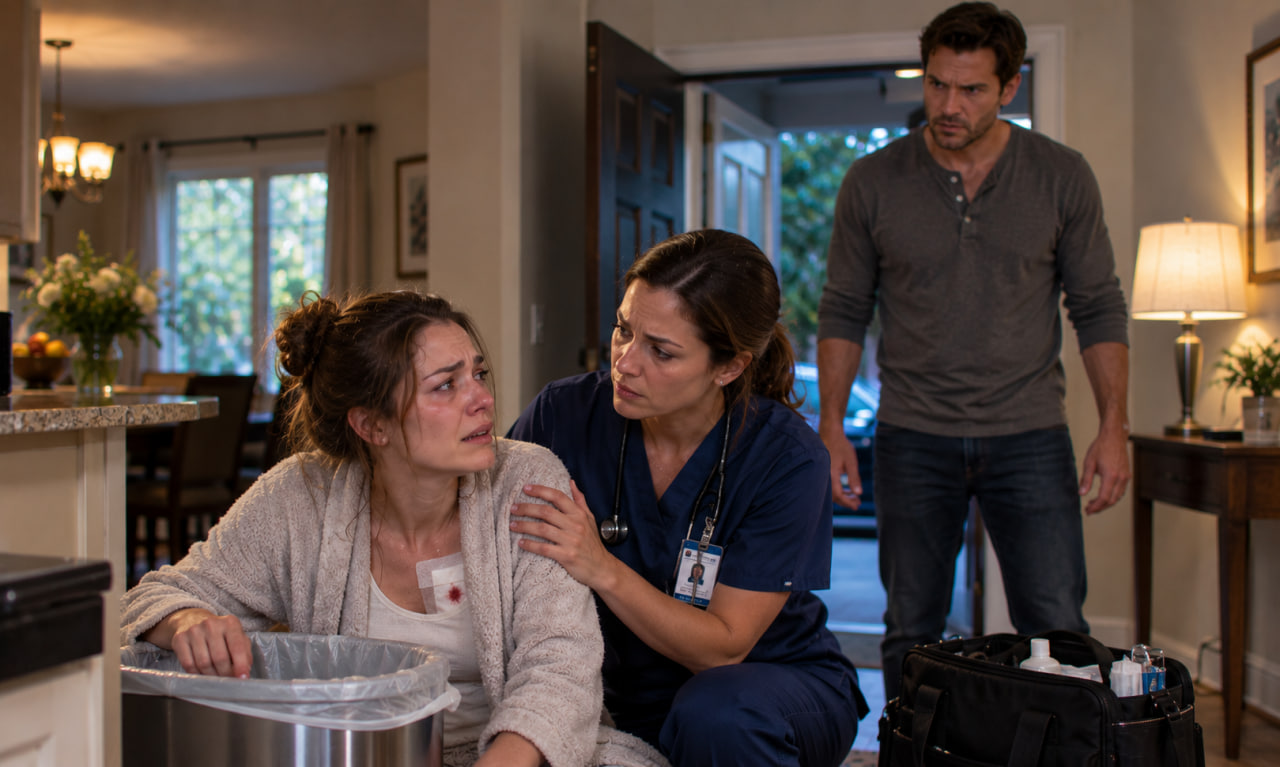
Minutes after my home nurse left, my husband shoved my head over the trash can because I couldn’t keep dinner down. Then he pressed his finger into the tender area from my recent surgery until I gasped and the clean dressing began to stain. “Tell the nurse cancer did it,” he said. I was still trying to catch my breath when I noticed something that made my heart pound—the nurse’s bag was still sitting near the door, and her car was still in our driveway. Then the front doorknob turned. My husband heard it too. His hand dropped instantly, and his face changed. When the nurse stepped back inside, her eyes went straight to the fresh blood on the dressing she had checked only minutes earlier.

PART 3

He gave her a polite smile that didn’t reach his eyes.

“She’s confused,” he said. “She’s been through major surgery. She’s taking medication. She’s frightened. She doesn’t understand what she’s saying.”

The nurse’s expression remained calm.

“I’m not asking you to explain her condition.”

“I’m her husband.”

“I heard you.”

“I’m responsible for her.”

The nurse looked at me.

“Do you want him responsible for you right now?”

My husband’s smile disappeared.

I swallowed.

“No.”

His face changed.

Not dramatically.

Not like in a movie.

Just a tiny tightening around his eyes.

But I knew him well enough to understand what it meant.

He was angry.

Very angry.

And for the first time since my diagnosis, I wasn’t alone with that anger.

The nurse reached for her phone.

“I’m going to call emergency medical services.”

My husband immediately stepped aside.

“Fine.”

He raised both hands as if surrendering.

“Call whoever you want. I have nothing to hide.”

The words sounded confident.

But his breathing had changed.

He walked toward the kitchen.

“I’ll get her medication list.”

The nurse didn’t stop him.

She simply watched.

Then she whispered to me, “Don’t move unless you have to.”

I nodded.

My hands were shaking.

I couldn’t tell whether it was fear, exhaustion, or the medication.

Maybe all three.

A minute later, my husband returned holding a folder.

He handed it to the nurse.

“This is everything.”

She took it without looking away from him.

Then her eyes dropped to the folder.

I watched my husband’s fingers.

There was something on his right index finger.

A tiny reddish mark.

The same finger he’d pressed against my surgical dressing.

He noticed me staring.

His hand disappeared into his pocket.

That was when I realized something.

I had spent weeks thinking he was simply cruel.

Maybe he was.

But cruelty wasn’t the whole story.

There was something else.

Something he was desperately trying to hide.

The ambulance arrived eight minutes later.

It felt like an hour.

Two paramedics entered the house, followed by a police officer.

My husband immediately became the perfect concerned spouse.

He explained my surgery.

He explained my nausea.

He explained my medication.

He explained how difficult the last few weeks had been.

He spoke calmly.

He sounded reasonable.

He sounded like the man everyone would trust.

I watched the police officer listen.

Then the officer turned to me.

“Can you tell me what happened?”

My husband opened his mouth.

The nurse interrupted.

“She can answer for herself.”

The officer nodded.

I took a breath.

“He pushed my head over the trash can.”

My husband’s expression tightened.

“And then?”

“He pressed on my surgical wound.”

“Why?”

“Because I was vomiting.”

The officer looked at my husband.

“Did you do that?”

“No.”

The answer came instantly.

“He’s lying,” I said.

My voice cracked.

But I kept going.

“He told me to tell the nurse the cancer caused the bleeding.”

The room became silent.

The officer wrote something down.

My husband shook his head.

“That isn’t what I said.”

“What did you say?” the officer asked.

“I told her to tell the nurse she had been bleeding because of the surgery.”

The nurse looked up sharply.

“That is not what you said.”

My husband stared at her.

She continued.

“I was standing in the doorway. I heard him clearly.”

Something inside me shifted.

Not because the police were there.

Not because the nurse believed me.

Because someone else had heard him.

For months, he had controlled the story.

Now there were witnesses.

The paramedics examined me and recommended that I go to the hospital.

My husband immediately said, “I’ll drive her.”

The police officer shook his head.

“No.”

My husband looked surprised.

“She’s my wife.”

“She’ll go by ambulance.”

“I should be with her.”

“You can follow.”

My husband looked at me.

For a moment, his eyes were cold.

Then he smiled.

“Of course.”

The paramedics lifted me carefully.

Pain shot through my abdomen.

I closed my eyes.

As they wheeled me toward the door, I heard my husband behind me.

“I’m sorry.”

I opened my eyes.

He was standing in the hallway.

He looked devastated.

If someone had taken a photograph of him in that moment, they would have seen a loving husband watching his sick wife being carried away.

But I knew what the camera wouldn’t capture.

His hand was clenched into a fist.

And his eyes weren’t full of sadness.

They were full of warning.

At the hospital, the first thing the surgeon asked was why my dressing was stained.

I told her.

She examined the wound.

Then she looked at the nurse who had accompanied me.

The nurse explained everything.

The surgeon’s expression hardened.

“This doesn’t look like spontaneous bleeding.”

I stared at her.

“What does it look like?”

She paused.

“Trauma.”

The word landed heavily.

Trauma.

Not cancer.

Not nausea.

Not complications.

Trauma.

Someone had caused it.

A social worker came to speak with me.

She asked whether I felt safe returning home.

I almost laughed.

Home.

The word had once meant warmth.

Now it meant locked doors and whispered threats.

“No,” I said.

“Do you have somewhere else you can stay?”

I thought about my sister.

We hadn’t spoken much since my diagnosis.

My husband had always said she was selfish.

He had told me she didn’t want to deal with someone who was sick.

But suddenly I wondered whether that had ever been true.

“I have a sister.”

“Can you contact her?”

I nodded.

The social worker handed me a phone.

My fingers trembled as I dialed.

She answered on the fourth ring.

“Hello?”

I couldn’t speak.

There was silence.

Then she said my name.

“Are you okay?”

That question broke me.

I started crying.

Not quietly.

Not gracefully.

I cried the way I hadn’t allowed myself to cry in months.

“I need somewhere to go.”

She didn’t ask why.

She didn’t ask what my husband had done.

She simply said:

“Come home.”

I closed my eyes.

“I’m sick.”

“I know.”

“I might need treatment for a long time.”

“I know.”

“I don’t want to be a burden.”

Her voice became firm.

“You are my sister. You are not a burden.”

I cried harder.

For the first time in months, I felt something I thought I had forgotten.

Relief.

My husband arrived at the hospital two hours later.

He brought flowers.

White lilies.

He placed them beside my bed.

“I was terrified,” he said.

I looked at him.

He looked exhausted.

Almost convincing.

“You didn’t come with the ambulance.”

“I was speaking with the police.”

“Why?”

He shrugged.

“Because they had questions.”

The nurse standing nearby said nothing.

My husband pulled a chair closer.

“I made mistakes.”

I stared at him.

He reached for my hand.

I pulled it away.

His smile faded.

“I love you.”

I said nothing.

“I know you think I hurt you.”

“You did.”

He lowered his head.

“I was overwhelmed.”

“You hurt me.”

“I panicked.”

“You hurt me.”

He looked at me.

Then his voice changed.

“You’re destroying our marriage.”

There it was.

The old tactic.

The guilt.

The reversal.

The suggestion that my pain was the real problem.

I looked at him for a long moment.

Then I said quietly:

“Our marriage was already destroyed.”

He froze.

The nurse looked away.

My husband stood.

“You don’t mean that.”

“I do.”

He leaned closer.

“You need me.”

I looked directly into his eyes.

“No.”

It was the first time I had ever said it.

And somehow, that one word frightened him more than anything else.

He left without another word.

That night, I couldn’t sleep.

My sister arrived just after midnight.

She rushed into the room wearing yesterday’s clothes.

When she saw me, she stopped.

Her eyes filled with tears.

“Oh my God.”

She hugged me carefully.

I held her.

For several minutes, neither of us spoke.

Then she whispered:

“What happened?”

I told her everything.

She listened.

When I finished, she wiped her eyes.

“I knew something was wrong.”

I looked at her.

“What?”

“Every time I called, he answered.”

My stomach dropped.

“What do you mean?”

“He always said you were sleeping.”

I stared at her.

“I thought you didn’t want to talk to me.”

She shook her head.

“He told me you were angry with me.”

I felt cold.

“He told me you said I was selfish.”

She stared at me.

“I never said that.”

Neither of us spoke.

Suddenly, the last year began rearranging itself in my mind.

The missed calls.

The messages I never received.

The arguments I never understood.

The appointments he insisted on attending alone.

The bills he said were too complicated for me to worry about.

The medications he controlled.

The passwords he changed.

The bank account he said we didn’t need to discuss.

The way he always seemed to know exactly what the doctors had said before I did.

My sister looked at me.

“What?”

I whispered:

“I think there’s more.”

“More what?”

“I think he’s been hiding something.”

She took my hand.

“Then we’ll find it.”

I looked toward the hospital window.

Outside, the city was dark.

But for the first time, darkness didn’t feel like the end.

It felt like the beginning of seeing what had been hidden.

The next morning, a detective came to my room.

Her name was Detective Harris.

She introduced herself and asked if I was willing to speak.

I agreed.

She placed a small recorder on the table.

“We have statements from the nurse and paramedics.”

She paused.

“And your husband has already hired an attorney.”

My heart sank.

“Already?”

“He knew this could become serious.”

Detective Harris opened a folder.

“There is something else.”

She pulled out several photographs.

They were pictures of my home.

The kitchen.

The bedroom.

The bathroom.

The hallway.

I stared at them.

“Why did you take these?”

“Your nurse contacted us after she left. She was concerned there might be evidence that would disappear.”

My hands went cold.

“What evidence?”

Detective Harris turned over one photograph.

It showed the trash can.

There were tiny red stains on the rim.

I stared at it.

Then she showed me another.

The bathroom floor.

A faint smear near the sink.

Another photograph showed the bedroom doorway.

There was a small scratch on the wall.

I remembered it.

My husband had grabbed my arm there two weeks earlier.

He had told me I was being dramatic.

Detective Harris watched my face.

“Do you remember this?”

“Yes.”

“Tell me.”

I did.

Then she asked:

“Has your husband ever physically hurt you before?”

I hesitated.

That question was harder.

Because the answer wasn’t simple.

He had never punched me.

He had never broken a bone.

He had never left bruises that lasted long enough for anyone to notice.

Instead, there had been thousands of small things.

A grip that was too tight.

A shove disguised as frustration.

A hand over my mouth when I cried.

Standing in a doorway so I couldn’t leave.

Taking my phone.

Hiding my keys.

Threatening to leave me alone during treatment.

Making me believe that no one else would want me because I was sick.

Detective Harris listened carefully.

Then she said:

“Those things matter.”

I looked at her.

“I thought they didn’t.”

“They do.”

She closed the folder.

“And I think we should talk about your finances.”

My heart stopped.

“Why?”

“Because your husband told the officers he was responsible for all of your medical expenses.”

“He is.”

“Are you sure?”

I frowned.

“He handles our accounts.”

“Did you give him legal authority?”

“I signed some documents after my diagnosis.”

“What kind?”

“I don’t know.”

Detective Harris looked at me.

“Then we need to find out.”

My sister spent the afternoon going through everything she could access.

There were medical records.

Insurance statements.

Bank statements.

Property documents.

Tax records.

Most of them were locked behind passwords my husband had changed.

But there was one document in my email that I had never noticed.

It was an old bank notification.

A transfer.

$25,000.

Then another.

$40,000.

Then another.

$15,000.

All transferred from our joint account into an account I didn’t recognize.

My sister looked at me.

“When were these?”

I read the dates.

Some were from before my surgery.

Some were from after my diagnosis.

My hands started shaking.

“Where did the money go?”

“I don’t know.”

We called the bank.

They couldn’t give us everything immediately.

But they confirmed something that made my blood run cold.

The account was in my husband’s name.

Not ours.

His.

And there was one recurring payment attached to it.

Every month.

To a company called Havenridge Care Consulting.

I had never heard of it.

My sister searched the name.

Her face changed.

“What?”

She turned the laptop toward me.

The company existed.

But its listed address was a mailbox service.

No office.

No website.

No employees listed.

Nothing.

Except one thing.

The company had been registered six months before my cancer diagnosis.

I stared at the screen.

My husband had told me he had been shocked when the doctor found the tumor.

He had told me the diagnosis had destroyed our finances.

He had told me we were barely surviving.

But he’d been moving money before I even knew I was sick.

Why?

My sister whispered:

“We need to find out what this company is.”

I nodded.

Then my phone buzzed.

Unknown number.

One message.

Stop digging.

A second message appeared immediately.

You don’t know what you’re dealing with.

My sister looked at me.

“Did your husband send that?”

“I don’t know.”

Then another message arrived.

This time there were only four words.

Ask him about your will.

I stared at the screen.

My blood turned cold.

Because I suddenly remembered something my husband had said three months earlier.

He had brought home a stack of legal papers.

“Just routine,” he’d told me.

“Sign here.”

I had been too sick to read them.

And I had trusted him.

I closed my eyes.

My sister took my hand.

“We’re going to find every document you signed.”

I opened my eyes.

“Yes.”

Outside the hospital room, footsteps approached.

Someone stopped outside the door.

The handle slowly moved downward.

My sister stood.

The door opened.

It wasn’t my husband.

It was a man I’d never seen before.

He wore a dark suit and held a leather folder.

He looked directly at me.

Then he said something that made every part of me go still.

“Mrs. Carter, I’m afraid your husband hasn’t been telling you the truth about your cancer.”

And he closed the door behind him.

PART 4
The man closed the door behind him.

For several seconds, nobody moved.

My sister stood beside my bed, her body tense.

I looked at the stranger.

“Who are you?”

He placed the leather folder on the table.

“My name is Daniel Reeves. I’m an attorney.”

“Whose attorney?”

He looked at me carefully.

“Yours.”

I almost laughed.

“I already have an attorney?”

“No. You didn’t.”

He pulled a chair toward the bed but didn’t sit until I nodded.

“I represent the medical foundation that treated your case during the early stages of your diagnosis.”

I frowned.

“I don’t understand.”

“I know.”

He opened the folder.

“That’s why I’m here.”

He removed several documents and placed them on the table.

“The pathology report you were given is not the complete report.”

My sister leaned forward.

“What does that mean?”

Daniel looked at me.

“Your husband told you that your cancer was aggressive and terminal.”

I nodded slowly.

“He said I had maybe a year.”

Daniel shook his head.

“That isn’t what the original pathology showed.”

The room seemed to shrink.

“What are you saying?”

“Your tumor was serious. You needed treatment. But the original report classified it as highly treatable.”

My mouth went dry.

“How treatable?”

“With appropriate treatment, your prognosis was significantly better than what your husband told you.”

I stared at him.

“But my oncologist—”

“Your oncologist never told you that you were terminal.”

I couldn’t breathe.

My sister grabbed my hand.

Daniel continued.

“Someone altered the information that reached you.”

“Who?”

He didn’t answer immediately.

Then he opened another file.

“Your husband.”

The word echoed in my head.

No.

I wanted to reject it.

I wanted to tell myself there had been a mistake.

But suddenly everything made sense.

Every time I asked the doctor a question, my husband answered first.

Every time a nurse gave me paperwork, he took it.

Every time I received a medical message, he told me what it meant.

He had slowly built a wall between me and my own life.

“Why?” I whispered.

Daniel looked at the papers.

“Because of your estate.”

My sister’s face hardened.

“What estate?”

Daniel slid another document across the table.

“Before your diagnosis, your mother passed away.”

I nodded.

She had left me a substantial inheritance.

A house.

Investments.

A trust.

My husband had always told me it was complicated.

He had said we should put everything together because we were married.

I had agreed.

Daniel continued.

“Your mother established a trust that was supposed to remain under your control.”

I stared at the document.

“But my husband told me it became joint property.”

“It didn’t.”

My sister whispered, “Oh my God.”

Daniel pointed to another page.

“Six months before your diagnosis, your husband created a company.”

“Havenridge Care Consulting.”

“Yes.”

My stomach twisted.

“He used money from your joint account to fund it.”

“How much?”

Daniel looked at me.

“Approximately $180,000.”

I closed my eyes.

The number felt unreal.

“But why would he do that?”

Daniel’s voice became quieter.

“Because he believed your cancer would eventually give him control of the trust.”

I opened my eyes.

“Eventually?”

He nodded.

“He obtained documents that appeared to give him authority over your financial affairs in the event of your death.”

My hands began trembling.

“Did I sign them?”

“You signed some documents.”

I stared at him.

“Did they give him control?”

“Not legally.”

I felt something inside me crack.

All those nights.

All those appointments.

All those moments when he told me I was dying.

He hadn’t been preparing to save me.

He had been preparing to inherit me.

Daniel explained everything.

My husband had been siphoning money from our accounts.

He had created the consulting company to make the transfers appear legitimate.

He had manipulated medical information.

He had intercepted correspondence.

He had even contacted my insurance company pretending to be me.

But there was one thing Daniel hadn’t known.

The nurse’s report from that evening had triggered an investigation.

And once investigators began looking at my husband, they found inconsistencies everywhere.

The company.

The bank transfers.

The medical records.

The legal documents.

Then they found something worse.

My husband had been telling people that my condition was deteriorating long before it actually was.

He had already spoken to a life insurance agent.

My sister covered her mouth.

I stared at Daniel.

“Life insurance?”

He nodded.

“There is a policy.”

“How much?”

“Two million dollars.”

The room went silent.

Two million.

My husband had been waiting for me to die.

The realization was so horrifying that my mind refused to process it.

I remembered him sitting beside my hospital bed.

Holding my hand.

Telling me not to be afraid.

Telling me he loved me.

All the while, he had been calculating what my death would be worth.

I began crying.

My sister wrapped her arms around me.

“I should have seen it,” I whispered.

“No.”

“I trusted him.”

“That isn’t your fault.”

“I signed things.”

“You were sick.”

I looked at Daniel.

“What happens now?”

He closed the folder.

“Now you stop protecting him.”

I nodded.

“I won’t.”

The police arrested my husband three days later.

He was waiting outside the hospital when they approached him.

He had brought another bouquet of flowers.

He saw the officers.

Then he saw me standing behind the hospital window.

For the first time, I saw fear on his face.

Real fear.

Not anger.

Not manipulation.

Fear.

He pointed toward me.

“She’s confused.”

The detective shook her head.

“No. She’s finally informed.”

He was charged with multiple offenses related to assault, financial fraud, forgery, and abuse.

The investigation continued for months.

And every week, another piece of his carefully constructed life collapsed.

There were emails.

Bank records.

False signatures.

Messages to financial advisers.

Copies of documents.

A hidden notebook.

And finally, something that made even the detectives pause.

A spreadsheet.

It contained dates.

Expenses.

Expected insurance payments.

Expected inheritance amounts.

And beside my name was a projected date.

The date he believed I would die.

I stared at the document for a long time.

Then I closed the folder.

I didn’t cry.

I didn’t scream.

I simply said:

“Take it away.”

I didn’t want his calculations living in my head anymore.

My recovery wasn’t easy.

Leaving him didn’t magically heal my body.

There were still treatments.

There were still bad mornings.

There were still nights when fear woke me before sunrise.

But something had changed.

I was no longer afraid of disappointing him.

I was no longer afraid of asking questions.

I asked my doctors everything.

I read every medical report.

I learned what every medication was for.

I opened my own bank accounts.

I changed every password.

I hired my own attorney.

I took control of the trust my mother had left me.

And slowly, I began to understand something.

My husband hadn’t made me weak.

He had simply convinced me that I was.

There was a difference.

Six months later, I returned to the house.

Not to live there.

To collect the last of my belongings.

My sister came with me.

The police had already cleared the property.

The house felt strangely empty.

The furniture was still there.

The photographs were still hanging on the walls.

Our wedding picture stood on the mantel.

I picked it up.

For a moment, I stared at the younger version of myself.

She was smiling.

She believed she had found her forever.

I didn’t hate that woman.

I felt sorry for her.

She had loved someone who didn’t know how to love her.

But she had also survived him.

I put the photograph down.

In the bedroom closet, I found an old suitcase.

I packed the things that mattered.

My mother’s necklace.

A few photographs.

My father’s watch.

A box of letters.

Then I noticed something underneath the bed.

A small wooden box.

I pulled it out.

Inside were documents.

I recognized my husband’s handwriting.

There was a list.

Names.

Dates.

Amounts.

I showed it to my sister.

She looked at me.

“What is this?”

I read the first line.

It wasn’t about me.

It was about another woman.

Then another.

My husband had done this before.

I realized the truth.

I hadn’t been his first target.

And I probably wouldn’t have been his last.

I handed the box to the detective.

“Someone else needs to know.”

A year after I left him, I received a letter.

It was from the hospital.

My latest scans were clear.

The doctor wanted to use the word remission.

I sat on my sister’s porch holding the letter.

The sun was setting.

For a long time, I simply stared at the horizon.

Then I smiled.

Not because everything had been easy.

It hadn’t.

Not because I had forgotten what happened.

I hadn’t.

I smiled because I was still here.

My husband had built his entire future around the idea that I wouldn’t be.

And yet here I was.

Alive.

Healthy enough to walk.

Strong enough to choose.

Free enough to begin again.

My sister sat beside me.

“What are you thinking?”

I folded the letter.

“That he was wrong.”

She smiled.

“About what?”

“Everything.”

The trial began several months later.

My husband pleaded not guilty.

His attorney tried to paint him as a desperate caregiver.

A man overwhelmed by his wife’s illness.

A man who had made mistakes.

But the evidence was overwhelming.

The nurse testified.

The paramedics testified.

The doctors testified.

The financial investigators testified.

The forensic accountants testified.

Then I took the stand.

My husband looked at me when I entered the courtroom.

For the first time, he looked smaller than I remembered.

He wasn’t the powerful man who had controlled every room.

He was simply a man sitting behind a table, waiting for judgment.

I told the truth.

I told them about the trash can.

The surgical wound.

The threats.

The lies.

The money.

The medical records.

The fear.

And when the prosecutor asked me the most difficult question—

“Why didn’t you leave sooner?”

—I took a long breath.

Then I answered:

“Because he spent years convincing me that I couldn’t survive without him.”

I looked toward the jury.

“But I did.”

Nobody spoke.

I continued.

“And I want anyone listening to understand something. Abuse doesn’t always look like a fist. Sometimes it looks like someone taking your phone. Sometimes it looks like someone answering every question for you. Sometimes it looks like someone telling you that you’re too sick, too weak, or too confused to understand your own life.”

I glanced at my husband.

“And sometimes the person who says they are protecting you is the person you need protection from.”

The courtroom was silent.

I stepped down.

I never looked back.

He was convicted.

The financial court ordered the return of the money he had taken.

The trust remained mine.

The house was sold.

The insurance policy was canceled.

The company called Havenridge Care Consulting was dissolved.

And the money recovered from his fraud was placed into a legal fund that helped cover my treatment and the costs of other victims connected to his scheme.

But the greatest victory wasn’t the money.

It wasn’t the conviction.

It wasn’t even seeing him taken away.

It was waking up one morning and realizing I hadn’t thought about him for an entire day.

Then another.

Then a week.

Two years later, I started volunteering at the hospital.

I wasn’t a nurse.

I wasn’t a doctor.

I simply sat with patients who were frightened.

People who had just received diagnoses.

People who didn’t know what questions to ask.

People who were scared of becoming burdens.

One afternoon, a woman sat beside me.

Her hands were shaking.

“My husband says I shouldn’t worry about the doctors,” she whispered.

My heart stopped for half a second.

Then I looked at her.

“Do you have your own access to your medical records?”

She shook her head.

“Do you have control of your medications?”

Another shake.

“Your finances?”

She looked down.

“No.”

I reached for her hand.

“Then let’s start there.”

Her eyes filled with tears.

“You think something is wrong?”

I smiled gently.

“I think you deserve to know what is happening in your own life.”

She nodded.

And I stayed beside her.

Because someone had once done that for me.

The nurse who came back for her forgotten bag.

The woman who could have left quietly but chose to stay.

The sister who answered the phone.

The detective who listened.

The attorney who showed me the truth.

They had all given me something I couldn’t give myself at first.

A chance.

Years later, I still remembered that night.

The trash can.

The stained dressing.

The sound of the front door opening.

The nurse’s forgotten bag sitting beside the doorway.

If she hadn’t forgotten it, she might never have returned.

If she hadn’t returned, I might have stayed silent.

If I had stayed silent, my husband might have continued his plan.

Sometimes people call these moments coincidences.

I don’t.

I call them doors.

And sometimes life gives you one tiny door when everything else feels closed.

You only have to be brave enough to walk through it.

I never saw my husband again after the sentencing.

I didn’t need to.

He had taken years from me.

I wasn’t going to give him another minute.

I rebuilt my life slowly.

I traveled.

I laughed again.

I learned how to cook for one.

I learned how to sleep without listening for footsteps.

I learned that silence could be peaceful instead of frightening.

And most importantly, I learned that surviving wasn’t the same as living.

Surviving was what I had done while I was with him.

Living was what I did afterward.

One evening, I stood on the beach watching the sun disappear beneath the horizon.

My sister stood beside me.

“You look happy,” she said.

I smiled.

“I am.”

She looked at me.

“Do you ever wonder what would have happened if that nurse hadn’t come back?”

I looked toward the ocean.

“All the time.”

“And?”

I took a breath.

“Then I remind myself that she did.”

The wind moved through my hair.

The waves rolled toward the shore.

I thought about the woman I had been.

Sick.

Frightened.

Dependent.

Convinced that the person hurting her was the person keeping her alive.

Then I thought about who I had become.

I was still scarred.

Still human.

Still carrying memories I would never completely erase.

But I was free.

And sometimes freedom doesn’t arrive with a dramatic victory.

Sometimes it arrives quietly.

In a hospital room.

In a trembling voice.

In one word.

No.

That one word had saved my life.

And I would spend the rest of mine making sure I never forgot how powerful it was.

THE END

Leave a Reply

Your email address will not be published. Required fields are marked *