PART 3
His eyebrows drew together.
“What difference does that make?”
“About two million dollars.”
The room fell quiet again.
I pulled my phone from my pocket and began photographing the controller screen, every modified parameter, the machine serial number, the alarm history, and the timestamp recorded inside the Siemens control.
Richard stepped forward.
“Those are company records.”
I kept taking pictures.
“And this is an independent forensic inspection performed by Parker Precision Services.”
“You’re diagnosing a machine, not investigating a crime.”
I finally looked at him.
“When someone changes protected calibration values without authorization, it stops being maintenance.”
Walter slowly removed his cap.
“I’ve worked here twenty-eight years,” he said. “I’ve never seen servo gains change themselves.”
Neither had I.
The impossible numbers
I plugged my diagnostic laptop into the controller.
Within seconds, the system exported its change history.
Every protected parameter carried a user ID.
Not a name.
A number.
Richard leaned over my shoulder.
“Can you tell who did it?”
“I can tell who logged in.”
The audit trail loaded.
User 14.
Timestamp: 10:41:16 AM.
Twenty-six minutes before my termination meeting.
My stomach tightened.
I already knew who User 14 was.
Tyler Brennan.
The same engineer Mason had mentioned.
Richard immediately shook his head.
“That doesn’t prove anything.”
“No,” I agreed. “It proves someone used Tyler’s credentials.”
Those were two very different statements.
Good engineers understood evidence.
Bad managers preferred assumptions.
I printed the audit report.
Before Richard could reach for it, I signed and dated the bottom.
“Contractor copy,” I said.
He looked irritated.
“You’re making this unnecessarily formal.”
“You fired the informal version of me.”
Walter coughed into his hand to hide a smile.
Tyler arrives
Almost on cue, the bay doors opened.
Tyler walked in carrying a tablet, completely unaware that everyone had turned toward him.
He couldn’t have been older than thirty-two.
Sharp haircut. Expensive watch. The kind of confidence that came from being promoted quickly.
He saw me first.
“Oh.”
Then Richard.
“What’s going on?”
Nobody answered.
I simply held up the printed audit log.
“Were you in this machine at 10:41?”
His expression changed almost too quickly.
“I… checked the offsets.”
“You changed protected servo parameters.”
“No, I didn’t.”
“The controller says User 14 did.”
“I logged in, but I wasn’t changing gains.”
Richard stepped between us.
“Let’s not accuse anyone.”
Tyler immediately nodded.
“Exactly.”
I asked one question.
“What’s the baseline value for third-axis gain?”
He hesitated.
“One twenty… four?”
Walter quietly muttered, “Wrong.”
The correct number was 122.
Tyler looked toward Richard for the briefest fraction of a second.
It lasted less than half a second.
But I noticed.
So did Walter.
The owner walks in
The overhead door opened again.
This time everyone stood straighter.
Eleanor Grant.
Founder of Horizon Precision.
She was seventy years old and had built the company from a twelve-person machine shop into one of the largest aerospace suppliers in the state.
She rarely came onto the production floor.
If she was here, the situation had already reached the boardroom.
Her eyes landed on me.
“Mr. Parker.”
“Ms. Grant.”
Richard immediately began explaining.
“We’ve isolated the failure and Ethan is restoring the machine—”
She raised one hand.
Richard stopped talking.
“Mr. Parker,” she said calmly, “are you working as an employee?”
“No.”
“As an independent contractor?”
“Yes.”
“Then I’d like your professional assessment.”
Richard’s face tightened.
For the next five minutes, I explained everything.
The modified gains.
The altered acceleration limits.
The audit trail.
The alarm cascade.
The production risk.
I didn’t mention Tyler by name until the evidence required it.
When I finished, Eleanor asked only one question.
“Can these parameters be changed accidentally?”
“No.”
“How many confirmations?”
“Three.”
She turned toward Tyler.
“Did you authorize those changes?”
He swallowed.
“No.”
“Did you make them?”
“No.”
She nodded once.
“IT will preserve your laptop.”
His shoulders dropped.
Not because he’d confessed.
Because he realized this was now an investigation.
A machine worth more than pride
Eleanor looked back at me.
“How long to recover production?”
I answered honestly.
“If nothing mechanical is damaged, forty-five minutes.”
Richard interrupted.
“You already charged us one hour.”
I smiled slightly.
“I did.”
Eleanor looked confused.
Richard wasn’t.
He suddenly understood.
I wasn’t billing by how fast I worked.
I was billing for solving the problem nobody else could.
She asked, “If recovery takes forty-five minutes?”
“The invoice remains one hour.”
She nodded.
“Fair.”
Richard looked like he’d bitten into something sour.
Bringing it back to life
I restored the protected parameter backup stored on my encrypted commissioning drive.
Every value returned to its validated baseline.
122.
98.
340.
One by one, the alarms disappeared.
Third axis.
Cleared.
Servo overload.
Cleared.
Spindle vibration.
Still active.
Walter frowned.
“That’s not good.”
“No,” I said quietly. “That’s the real problem.”
The fake parameter changes had hidden something underneath.
I removed the spindle access panel.
Inside, almost invisible against the steel housing, was a tiny aluminum shim lodged beside the vibration sensor.
Walter leaned closer.
“What is that?”
I picked it out with tweezers.
It was a machining spacer.
A part that should never have been inside the sensor housing.
Someone had intentionally wedged it there to create false vibration readings.
Walter whispered one word.
“Sabotage.”
Richard didn’t say anything.
Neither did Tyler.
But Tyler had suddenly become very interested in the floor.
The restart
I reassembled the housing.
Ran spindle warm-up.
2,000 RPM.
Perfect.
5,000.
Stable.
8,000.
No vibration.
The machine completed its calibration cycle without a single alarm.
Then the green light illuminated above Bay Three.
Production ready.
An entire manufacturing floor erupted into applause.
Operators who had been standing silently for nearly an hour finally breathed again.
Walter slapped my shoulder.
“I knew you’d save her.”
I smiled.
“I saved the machine.”
He grinned.
“Same thing.”
A much bigger offer
As the operators returned to work, Eleanor stopped me before I packed my laptop.
“I’ve reviewed your invoice.”
I waited.
“It was expensive.”
“Yes.”
“It was also cheaper than losing Meridian.”
She extended a business card.
“Tomorrow morning. Nine o’clock. My office.”
Richard immediately spoke.
“Ms. Grant, we already eliminated Ethan’s position because of restructuring—”
She looked at him.
“No, Richard.”
Her voice remained perfectly calm.
“We eliminated a salary.”
Then she looked back at me.
“I’d like to discuss a contract.”
I glanced at the temporary contractor badge still clipped to my shirt.
“For machine support?”
She smiled faintly.
“For something much larger.”
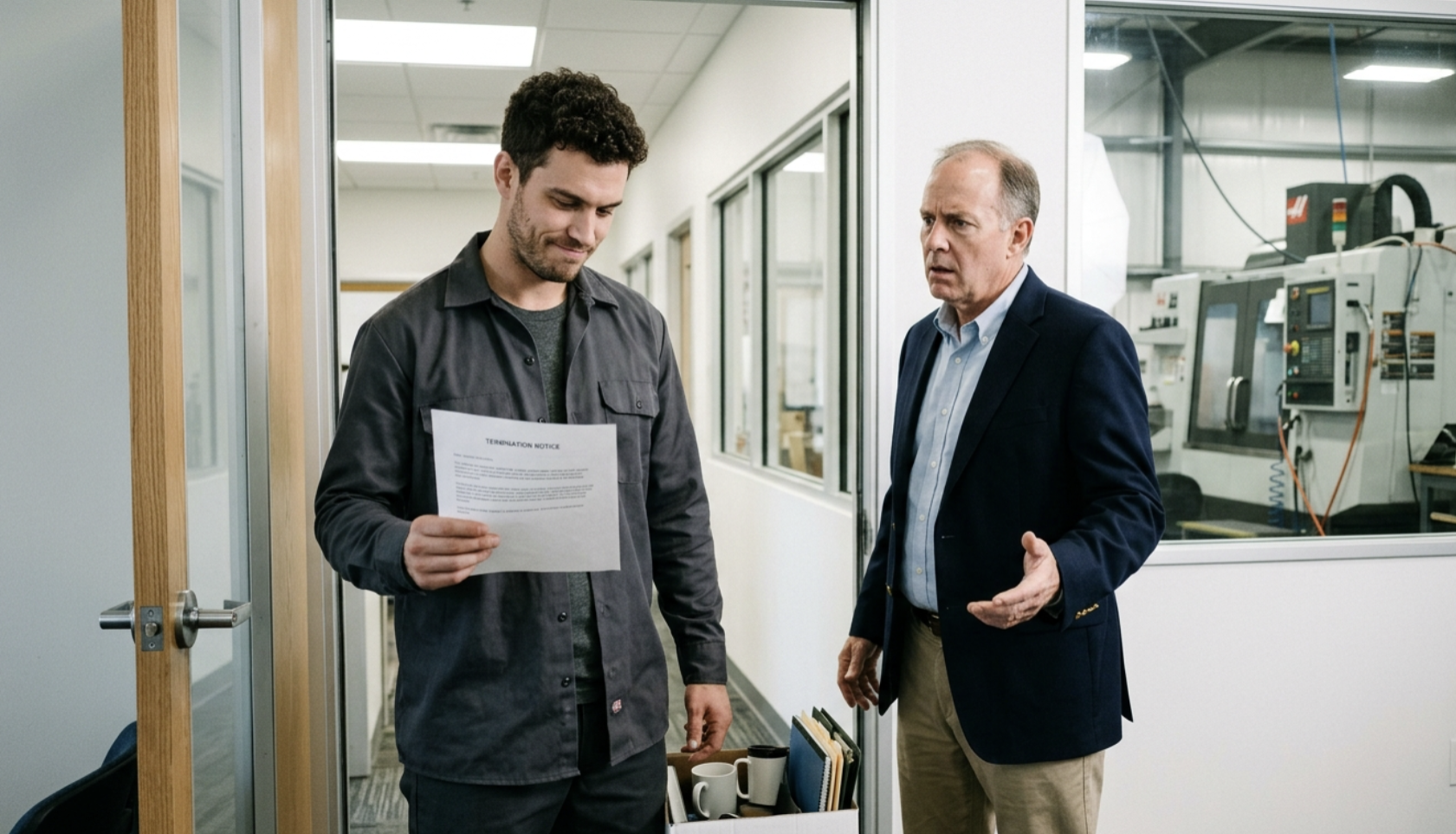
As I walked toward the exit carrying the same cardboard box I’d held when they fired me, Mason hurried after me.
He lowered his voice.
“Ethan… there’s something you should know.”
I stopped.
He looked over both shoulders to make sure no one was listening.
“Tyler wasn’t the only person in Bay Three at 10:41.”
My grip tightened on the cardboard box.
“Who else was there?”
Mason’s face went pale.
He whispered just three words.
“Richard logged in.”
