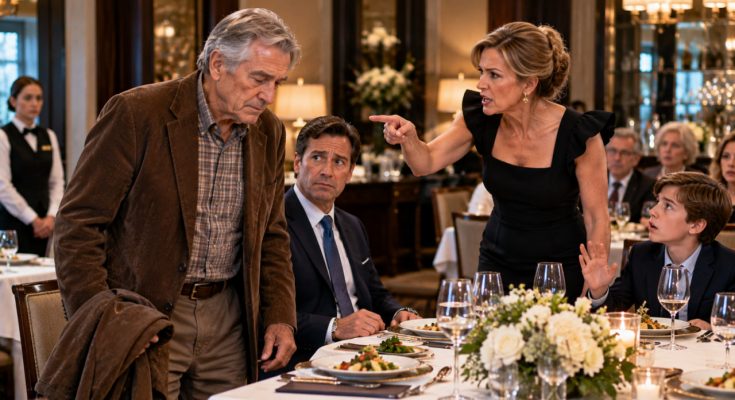
PART 3
It stopped directly in front of her.She glanced down.
Then she opened it.
The first page contained the name of the company that had purchased the Ambrose Hotel six months earlier. Beneath it was the acquisition agreement, followed by the official ownership registration and the signature of the managing member.
Lyall Puit.
Danica read the name once.
Then again.
She looked up at me.
Then back at the paper.
“This is some kind of joke.”
“No,” I said.
“You can’t possibly own this hotel.”
“I can understand why you might think that.”
“Because Mr. Puit is the owner of the Ambrose Hospitality Group, which acquired this property and its operating company last autumn.”
Danica’s mouth opened slightly.
She looked toward the HR director, a woman named Melissa Grant, as if expecting her to laugh and explain that the entire conversation was an elaborate misunderstanding.
Melissa didn’t move.
Danica turned back to me.
“But you drive an old pickup truck.”
I almost smiled.
“Yes.”
“You live on a farm.”
“I did.”
“You wear that jacket everywhere.”
I glanced down at my brown corduroy sleeves.
“This jacket belonged to me long before I owned the hotel. I don’t see a reason to throw it away.”
“That doesn’t make any sense.”
I leaned back in my chair.
“Which part, Danica? The part where a man can own property without dressing the way you expect, or the part where you never bothered to ask me a single question about my life?”
For the first time that morning, she had no immediate answer.
I let the silence remain.
I had spent most of my life around people who believed silence meant weakness. Farming had taught me otherwise. Sometimes you had to leave a field alone long enough to see what was actually growing there.
Danica finally pulled out a chair and sat down.
Not because she wanted to.
Because she had begun to understand that standing over me would no longer give her an advantage.
“Fine,” she said. “If you own the hotel, then we need to discuss last night’s incident.”
“We do.”
“I was acting in the best interests of the guests.”
I nodded toward the empty chair across from me.
“Then let’s begin with what happened to the guests.”
She frowned.
“What does that mean?”
“It means I want to understand why a woman who claims to care about the guest experience thought it was appropriate to have an elderly guest removed from a private birthday dinner without first asking the host whether he wanted that guest to leave.”
“I asked you to be patient with a young employee.”
“You undermined my authority.”
“Was the young employee making a mistake?”
Danica hesitated.
“That isn’t the point.”
“It seems like a reasonable place to start.”
Mr. Whitmore opened another folder.
“Danica, we have reviewed the incident report, the available dining-room footage, and statements from three employees who were present.”
She turned toward him sharply.
“You reviewed footage?”
“We did.”
“Why?”
“Because a guest was asked to leave the premises by a member of our management team, and the guest subsequently raised concerns through the ownership office.”
“I didn’t know he was the owner!”
The words came out louder than she intended.
I looked at her.
“That is precisely the problem.”
Her face reddened.
For a moment, I thought she might argue again. Danica had never been comfortable in situations where she couldn’t control the direction of a conversation.
At the hotel, she was accustomed to being the person who decided who entered a room, where people sat, which employees received praise, and which ones were made to feel small.
She had mistaken that authority for something much larger.
She had mistaken it for the right to decide who deserved respect.
I opened the second folder.
“Before we discuss what happens to your position, I want to make one thing clear. I didn’t buy this hotel to settle a personal argument with you.”
She stared at me.
“Then why are we here?”
“Because this building matters to me. Because the people who work here deserve to be treated fairly. And because last night made me wonder how many other people have been humiliated in rooms where you believed nobody important was watching.”
Danica’s fingers tightened around her portfolio.
“You’re making this sound like some kind of investigation.”
“It is.”
She looked toward Melissa.
The HR director spoke calmly.
“We’ve received several workplace complaints over the past six months. Some concern communication, others involve scheduling, public criticism, and alleged retaliation against employees who questioned management decisions.”
Danica sat very still.
Then she laughed once.
It was a sharp, uncomfortable sound.
“Those employees are disgruntled. They don’t like being held accountable.”
“Perhaps,” Melissa replied. “That’s why we’re reviewing the records instead of making assumptions.”
I looked at the folder.
“I want every complaint assessed fairly. I don’t want anyone punished simply because they disagreed with Danica, and I don’t want anyone protected simply because they’re friends with me. If she acted appropriately in a particular situation, the evidence should show that. If she didn’t, the evidence should show that too.”
Danica stared at me as though she’d expected something much simpler.
She had expected a personal confrontation.
She had expected anger.
Perhaps she had even expected me to threaten her with dismissal.
Instead, I had asked for evidence.
That made her nervous in a way my anger never could have.
Because anger could be dismissed as an old man’s pride.
Records were harder to dismiss.
And the records were only the beginning.
At 10:17 a.m., someone knocked on the conference-room door.
Mr. Whitmore stood.
“Come in.”
A young woman entered carrying a thin notebook.
She was the server from Shane’s birthday dinner.
Her name was Emily Carter.
I recognized her immediately, although she looked different from the nervous young woman who had stood beside our table the night before.
Today, she wore a clean white blouse and black trousers. Her hair was tied neatly behind her head. She held the notebook with both hands, and her eyes moved around the room before settling on me.
“Mr. Puit,” she said quietly.
“Good morning, Emily.”
“I was told you wanted to speak with me.”
“Only if you’re comfortable doing so.”
She glanced at Danica.
The young woman’s shoulders stiffened.
Danica noticed.
“Oh, for heaven’s sake,” she said. “Are we seriously going to make this about a waitress who couldn’t pour wine properly?”
Emily’s fingers tightened around her notebook.
I didn’t raise my voice.
“Danica, let her speak.”
“She needs to learn that mistakes have consequences.”
“And managers need to learn that employees are human beings.”
Danica opened her mouth, but Melissa intervened.
“Please allow Emily to finish.”
Emily took a breath.
“I wanted to apologize for last night.”
I shook my head.
“What happened last night wasn’t your fault.”
“I spilled a little wine when I was pouring. I was nervous, and Mrs. Puit—”
“I’m not Mrs. Puit,” Danica snapped.
Emily flinched.
“I’m sorry,” she whispered.
That tiny apology seemed to fill the room.
I had heard that tone before. It was the tone people used when they had learned that correcting someone else’s mistake was more dangerous than making one themselves.
I remembered being sixteen years old in the Ambrose basement kitchen.
A cook had once dropped an entire tray of roast potatoes. The head chef had screamed at him until the poor fellow looked ready to disappear into the floor.
June had been carrying dishes past the kitchen door that night.
She had stopped beside me and whispered, “Funny thing about people who shout at workers. They always seem to forget who actually makes their dinner.”
She had smiled when she said it, but there had been nothing careless about her words.
I never forgot them.
Now I looked at Emily.
“Tell us what happened from your perspective. Take your time.”
Emily opened her notebook.
She had written down the sequence of events because, as she explained, she was afraid she might forget something important if she tried to describe it from memory.
She told us that she had been assigned to the private dining room only three days earlier.
She had received a brief orientation, but the wine service had been rushed because another employee had called in sick.
When she poured the first glass, a few drops landed on the tablecloth.
Danica told her to pay attention.
Emily apologized and fetched a clean cloth.
When she returned, Danica complained that she had taken too long.
During the next course, Emily hesitated before pouring wine for one of the guests because she wasn’t sure whether the bottle was the same one the guest had ordered.
Danica told her that if she couldn’t remember a simple instruction, she shouldn’t be working in a luxury hotel.
Emily admitted that her hands had started shaking.
That was when I had spoken up.
Then Danica had ordered security to remove me.
Emily paused.
Her eyes were wet.
“I thought I was going to lose my job,” she said. “When you defended me, I wanted to thank you, but I was afraid that would make things worse.”
“Why would thanking me make things worse?”
She looked down at her notebook.
“Because Mrs. Puit told me afterward that I should remember who decides whether I get to work here.”
The room went quiet.
Danica leaned forward.
“I never said that.”
Emily swallowed.
“You told me that people who embarrass management shouldn’t expect their shifts to be protected.”
“That was a general statement.”
“You said it while looking directly at me.”
“Because you had made a mistake!”
Emily’s face reddened, but this time she didn’t look away.
“I know I made a mistake. I was willing to accept that. I wasn’t asking you to pretend I was perfect. I just wanted you to explain what I did wrong without making me feel like I was worthless.”
No one spoke.
I looked at Danica.
She looked away first.
Melissa asked Emily whether she had documented the earlier comments.
Emily opened her notebook to a page filled with dates.
She had written down several incidents, including the date an employee was publicly criticized for taking a scheduled medical appointment, the date another server’s shifts were reduced after raising a question about overtime, and the date Danica had threatened to replace a receptionist who asked for clearer instructions.
Those were allegations, not established findings. Melissa made that distinction clear.
But they were specific enough to investigate.
When Emily finished, I thanked her.
Then I asked her one question.
“If you could change one thing about working here, what would it be?”
She seemed surprised.
“Just one?”
“Start with one.”
She thought for a moment.
“I’d like managers to correct mistakes privately when possible. And I’d like new employees to receive proper training before they’re expected to serve important events.”
I nodded.
“Those sound like reasonable requests.”
Emily glanced at Danica, then back at me.
“There’s something else.”
“Go ahead.”
“I don’t want Mrs. Puit to lose her job because of me. I just don’t want to be afraid of her.”
That answer affected me more than she could have known.
The young woman Danica had dismissed as incompetent was sitting in front of the hotel’s owner, and she was worried about the consequences her own honesty might bring to someone who had treated her badly.
She was showing more generosity than the person who had humiliated her.
I closed the folder.
“Emily, no decision will be made against anyone simply because you spoke honestly. You have the right to report your experience without being threatened or punished for it.”
I turned toward Melissa.
“Please make sure that’s documented.”
Melissa nodded.
Emily thanked us and left.
As the door closed, Danica sat back in her chair.
For the first time that morning, she looked less angry than frightened.
“You’re letting employees dictate how managers do their jobs,” she said.
“No,” I replied. “I’m asking managers to remember why they have jobs in the first place.”
She gave a short, bitter laugh.
“You’ve been here for five minutes, Lyall. You don’t understand how this business works.”
I looked at the cracked photograph on the table.
“Perhaps not the way you do.”
Then I turned it around so the writing on the back faced her.
Four words, written in June’s careful handwriting.
Where it all started.
“Would you like to know why I bought this hotel?”
Danica didn’t answer.
“Because a long time ago, two young people worked in this building. One washed dishes. The other carried trays. They didn’t have much money, and nobody would have mistaken them for important people. But they worked hard, treated people decently, and built a life together.”
I touched the edge of the broken frame.
“My wife and I spent almost forty years together. We raised a son. We built a home. We worked a farm. We buried people we loved. We watched the world change. And when June died, this was one of the places I couldn’t bear to lose.”
I looked at Danica.
“I didn’t buy the Ambrose because I wanted people to bow when I walked into a room. I bought it because I wanted to preserve something that reminded me of the best parts of my life.”
For a moment, her expression softened.
Then she glanced at the ownership papers again.
“But you could have told us.”
“Yes,” I said. “I could have.”
She seized on the admission.
“Exactly. You deliberately hid it from us. You let me think you were just an old farmer, and then you arranged this whole thing to embarrass me.”
I shook my head.
“No, Danica. I let you believe what you chose to believe.”
She stared at me.
“You knew I was going to treat you differently if I thought you were wealthy.”
“I knew you were the director of events at a hotel I had recently purchased. I wanted you to be judged by your work, not by your relationship to the owner. I didn’t ask anyone to give you special treatment. I didn’t ask anyone to report on you because you’re my daughter-in-law.”
“Then why am I sitting here?”
“Because you ordered security to remove a guest without giving the situation a fair assessment, and because the hotel has a responsibility to investigate concerns about its management.”
I paused.
“And because that guest happened to be your father-in-law.”
Danica’s face hardened.
“That’s what this is really about. You’re angry because I embarrassed you.”
I considered her words.
Perhaps a younger version of me would have been.
At sixty-four, I had learned that humiliation could be a powerful teacher, but it was a terrible foundation for a decision.
“No,” I said. “I’m disappointed because I watched my son look at his watch instead of looking at his father.”
That silenced her.
I hadn’t intended to bring Shane into the meeting so quickly.
But his name had been sitting between us from the moment Danica entered the room.
And I had a feeling we were not going to finish this conversation without him.
At 10:46 a.m., Mr. Whitmore asked whether we should contact Shane.
Danica immediately objected.
“Why would Shane need to be involved in an internal hotel matter?”
