Ron swallowed.
I felt the room go cold.
“Where is it now?” I asked.
Ron looked down.
“It’s gone.”
Nate stared at him.
“What do you mean, gone?”
“The account was closed years ago. Some money went toward outstanding expenses. Some was used to settle family debts. I told myself I was protecting everyone from a worse situation.”
“Did you spend my money?”
Ron shook his head quickly.
“Not for myself. I never bought a car or took a holiday with it. I used it to cover obligations I thought had to be handled.”
“I know.”
His voice was almost inaudible.
“I know that now.”
Nate pushed the document away.
For a long moment, I thought he might shout.
Instead, he sat down and stared at the table.
“Did Grandma know this would happen?”
Ron hesitated.
“Not everything. But she knew the family was in danger of turning her wishes into another argument over money. That’s why she made certain provisions.”
“What provisions?”
Ron glanced toward the staircase.
“The original documents may still be in the chest.”
Nate looked at me.
We both understood that the letter was only the beginning.
The following morning, Opal returned.
She arrived shortly after sunrise, carrying a tin of homemade biscuits wrapped in a clean tea towel. She looked tired, but her expression was steady.
Ron was already waiting in the kitchen.
When he saw her, he stood.
For several seconds, the two of them regarded one another without speaking.
Then Opal said, “You should have told him.”
Ron lowered his head.
“Yes.”
“You should have honored your promise.”
“Yes.”
“And you should have remembered that Margaret’s love was never a debt you could collect from someone else.”
Ron closed his eyes.
“I know.”
Opal set the biscuits on the table.
“I loved my sister,” she said. “I loved her enough to keep her secrets when I thought they would protect the family. But silence can protect the wrong person just as easily as it can protect the innocent.”
She turned toward Nate.
“Your grandmother didn’t expect you to be perfect. She expected you to be honest. That’s all she ever wanted from any of us.”
Nate took her hand.
“Why didn’t you tell me?”
Opal’s eyes filled.
“Because I was afraid. I was afraid that if I spoke up, I’d lose what little family I had left. I kept waiting for the right time, and then another year passed, and another.”
She squeezed his fingers.
“I am sorry, Nathaniel.”
He nodded.
It wasn’t forgiveness, not completely.
But it was a beginning.
Over the next several weeks, we worked with an attorney to understand the old estate documents, determine what had happened to the fund, and establish whether any obligations remained.
There was no miraculous fortune waiting for us.
No hidden vault filled with gold.
No secret inheritance that suddenly made every difficult year worthwhile.
There were only old records, complicated decisions, and the uncomfortable truth that some damage could not be undone.
But there was also something else.
The house.
The place Margaret had loved.
The place Nate and I had purchased with our savings, our exhaustion, and every extra shift we could manage.
We repaired the porch in early summer.
We replaced the broken windows.
I planted flowers along the front steps, and Nate built a long wooden table for the kitchen.
When the first autumn rain came, it stayed outside where it belonged.
For the first time in years, the farmhouse felt like a home again.
And then, one Sunday afternoon, we invited the family over.
Kim arrived first, carrying a casserole. Jeff brought a box of tools, claiming he wanted to help with the last of the repairs. Stacy came with her children, who ran through the grass before anyone could remind them to be careful.
Judy arrived with Ron.
She stood in the doorway, looking around the restored kitchen.
“This is beautiful,” she said.
“Thank you,” I replied.
She touched the wooden frame beside the pantry.
Her fingers stopped at the little bluebird carving.
“Oh,” she whispered.
I watched her face.
“You recognize it?”
She nodded slowly.
“Margaret used to have a bluebird on everything. Her stationery, her kitchen towels, even the little cakes she made for the children.”
She turned toward Ron.
“You knew?”
He didn’t look away.
“Yes.”
Judy’s eyes filled with tears.
For the first time, she seemed to understand that the greeting card we’d received at Easter hadn’t been the simple, thoughtless gesture she had imagined it to be.
“I thought we were telling you how proud we were of you,” she said to me. “I never considered how it might feel to watch your brothers and sisters receive something so substantial while you received only words.”
I took a breath.
“I believe you were proud of us. But being proud of someone’s independence shouldn’t mean leaving them to carry every burden alone.”
She nodded, crying quietly.
“You’re right.”
Ron stood beside her.
He had brought no envelope that day. No check. No gift intended to settle a debt that could not be measured in dollars.
Instead, he walked to the center of the kitchen and addressed everyone.
“I owe Nathaniel and Emily an apology.”
The room fell silent.
“I made decisions without telling the truth. I convinced myself I was protecting this family, but I was protecting my pride. I allowed an important promise to be broken, and I let the consequences fall on people who had done nothing wrong.”
He looked at his son.
“I cannot give you back the years you spent wondering why you were treated differently. I cannot make the house fall into your hands the way Margaret intended. And I cannot pretend that the money I used was mine to use.”
He swallowed.
“But I can stop making excuses.”
Nate stood beside me.
“That’s a start,” he said.
Ron nodded.
It wasn’t a grand reconciliation.
There were still difficult conversations ahead. There were still records to review, hurt feelings to address, and trust to rebuild one decision at a time.
But that afternoon, for the first time, nobody pretended that everything was fine simply because everyone was sitting at the same table.
Before dinner, Opal asked us to gather around the kitchen.
She had brought an old photograph she’d found among Margaret’s belongings.
It showed a young woman standing on the farmhouse porch, holding a little boy in her arms.
The woman had dark hair, a tired smile, and the unmistakable look of someone who had worked hard for everything she owned.
The little boy was Nate’s father.
On the back, in faded handwriting, were seven words:
Home is where love is never rationed.
Opal placed the photograph in a simple wooden frame.
We hung it beside the pantry.
Then she sat at the kitchen table and watched the family gather around her.
For years, I’d thought that buying the farmhouse was our answer to the Easter card. A way of proving that we could succeed without anyone’s help.
But as I watched Nate serve dinner to his nieces and nephews, and listened to the laughter filling the rooms we’d spent months restoring, I understood that we’d been asking the wrong question.
The question was never whether we could manage on our own.
We had already proved that.
The real question was what kind of family we wanted to become once we no longer had to spend every day simply surviving.
That evening, after everyone had gone, Nate and I stood together on the porch.
The yard glowed beneath the last light of sunset. Beyond the fence, the fields stretched toward the road, and the farmhouse windows reflected the warm light from inside.
Nate slipped his arm around my shoulders.
“Do you ever regret buying it?” he asked.
I looked at the house.
At the repaired roof.
At the porch we’d rebuilt with our own hands.
At the kitchen window where Opal had stood and cried when she first came home to her memories.
“No,” I said. “Not for a single minute.”
He kissed my forehead.
“I used to think that being independent meant never needing anything from anybody.”
“And now?”
He looked toward the framed photograph visible through the window.
“Now I think it means being strong enough to build a life of your own, and wise enough to know that love isn’t supposed to be a competition.”
I leaned against him.
For a long time, we watched the sunset without speaking.
The greeting card was still in a drawer in our bedroom.
I had kept it, not because I wanted to remember the hurt, but because I wanted to remember how easily a kind-sounding sentence could hide a painful truth.
You’ve always been able to manage everything yourselves.
Once, those words had felt like a door closing.
Now, they reminded me of something else.
We had managed.
We had worked, saved, sacrificed, and built a home out of a property everyone else had abandoned.
But we had never needed to prove that we deserved love by struggling without it.
And Margaret, through a letter that had waited decades to be read, had finally made sure we understood that.
The family had given us no money at Easter.
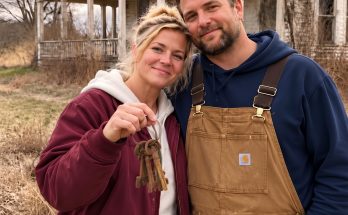
Two years later, we had bought a forgotten farmhouse for $41,500.
But what we found inside those weathered walls was worth far more than any check.
We found the truth about the family we came from.
And, more importantly, we found the freedom to decide what kind of family we would become.
Because in the end, the greatest inheritance wasn’t the house, the land, or the money that had disappeared.
It was a simple lesson Margaret had left behind for the grandson she loved:
Never confuse someone’s ability to survive without help with their willingness to live without love.


One Comment on “Final Part-My In-Laws Gave Everyone $20,000 Except Us—2 Years Later, Grandma Saw Our New House and Cried”