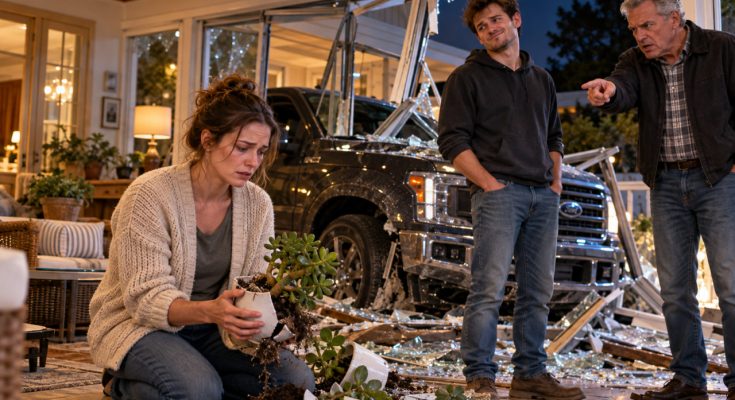
PART 3
“Dad, I have one question.”
He glanced at me impatiently.
“What?”
“When did you decide that my car belonged to Troy?”
He looked away.
“That isn’t the point.”
“It is exactly the point.”
“Karen, don’t start.”
I almost laughed.
Don’t start.
Those two words had followed me through childhood, adulthood, and every family crisis in between.
When Troy broke my mother’s favorite lamp at sixteen and blamed me, Dad told me not to start an argument.
And when I bought my own home, he asked whether I could afford to help Troy get his life together.
Now my sunroom was destroyed, and my father was still trying to control the conversation.
“I’m not starting anything,” I said quietly. “I’m asking you a question. When did you decide that my car belonged to Troy?”
Dad rubbed his forehead.
“Back in January, Troy told me he was struggling with his truck payments. He said he needed something more reliable. I told him I’d speak to you.”
“You never spoke to me.”
“I assumed you would understand.”
“Understand what?”
“That your brother needed help.”
I nodded slowly.
“So you promised him something worth twenty-eight thousand dollars without asking the person who owns it.”
“He’s your brother!”
“And I’m your daughter.”
The room fell silent.
For a moment, I thought those words might finally reach him.
Then Dad shook his head.
“You’ve always been difficult when it comes to money.”
I stared at him.
Not because I was surprised.
Because I finally understood.
He didn’t see the eight years I had spent working, saving, and sacrificing. He didn’t see the weekends I gave up or the extra shifts I accepted. He didn’t see the nights I sat at my kitchen table calculating expenses because I wanted to pay off my car and mortgage without depending on anyone.
He saw an available resource.
And because that resource belonged to his daughter, he believed he had the right to distribute it.
Troy suddenly stood.
“You know what? This is ridiculous.”
He pointed at the television.
“You made me look like a criminal.”
I looked directly at him.
“I didn’t drive your truck through my own house.”
His mouth opened, but nothing came out.
“You checked the street,” I continued. “You reversed into the sunroom. You climbed out and smiled at me. Then you said your foot slipped.”
He glanced at Dad, expecting him to intervene.
Dad did not.
Not because he had suddenly realized I was right, but because he was beginning to understand that the video had changed the situation.
He could no longer tell everyone that this was merely a family disagreement.
There was evidence.
There was a police report.
There were photographs.
And there was a legal demand with both their names on it.
Kira finally spoke.
“Troy, tell her what you told me that night.”
He spun around.
“Stay out of this.”
“No,” Kira replied. “I’m not staying out of it anymore.”
Her voice shook, but she kept going.
“You told me Karen would have no choice. You said that once your truck went through the sunroom, your dad would convince her to let you take the SUV because she wouldn’t want to make the situation worse.”
I felt something cold settle in my stomach.
I had suspected Troy’s actions were deliberate.
I had not realized he had planned what would happen afterward.
Kira looked at me.
“He said your father would tell you that paying for the damage was less important than keeping the family together. He thought you’d eventually give in.”
I turned toward my father.
“Did you know about this plan?”
“No.”
His answer came too quickly.
Troy looked at him.
“Dad!”
That single word carried more information than a lengthy explanation could have.
Dad’s face changed.
“Troy, be quiet.”
But Troy had already realized his mistake.
I watched my father carefully.
“Did you know he was going to damage my house?”
Dad stood up so abruptly that his armchair scraped against the floor.
“I never told him to hit your house!”
“That isn’t what I asked.”
He looked at the floor.
Then at the window.
Then at Troy.
Finally, he muttered, “I knew he was going over there to talk to you.”
“To talk?”
“I thought he’d try to convince you.”
“And you sat outside in your car?”
“I didn’t know what he was going to do.”
I took a breath.
“Then why didn’t you stop him when he started reversing?”
Dad said nothing.
The security footage had answered that question already.
He had watched the street.
He had watched Troy position the truck.
He had watched the vehicle accelerate backward.
And after the impact, he had waited until the destruction was complete before stepping out of his car.
Whatever excuse he offered now, it could not change what the camera had recorded.
I picked up my phone and disconnected it from the television.
“I’m finished here.”
Dad hurried toward me.
“Karen, wait. We can still resolve this without ruining anyone’s life.”
I turned around.
“I’m not trying to ruin anyone’s life, Dad. I’m trying to protect my own.”
“You’re going to send your brother to jail over a sunroom?”
“No. Troy made his choices. The police and the legal process will determine what happens next.”
“And what about me?”
I looked at him.
“What about you?”
“I’m your father.”
For years, that sentence had been enough to make me reconsider every boundary I tried to establish.
That afternoon, it wasn’t.
“Then you should have acted like one.”
I walked out.
Behind me, I heard Troy shouting at Dad.
I heard Kira crying.
I heard the familiar sounds of a family falling apart because, for the first time, someone had refused to carry the consequences for everyone else.
But the most painful part was that I didn’t feel triumphant.
I felt tired.
I had spent so many years believing that if I gave enough, forgave enough, and remained patient enough, my family would eventually understand how much I loved them.
Now I was beginning to understand something else.
Love could not make people respect you when they had decided your boundaries were obstacles to their desires.
And no amount of sacrifice could guarantee that the people you loved would treat you fairly.
I drove home alone.
When I arrived, I parked on the street because construction materials had already been delivered to my driveway.
The sunroom looked even worse in daylight.
The missing wall exposed the interior to the cold air. Broken framing lay across the floor. The contractor’s temporary measurements were marked in chalk beside the damaged tiles.
I stood in the doorway for a long time.
Then I went into the kitchen and checked on Mom’s jade plant.
Two leaves had fallen off.
The main stem was bent, but the roots were still intact.
I found a clean pot in the garage, filled it with fresh soil, and carefully transferred the plant.
As I pressed the earth around its roots, I remembered something Mom used to tell me.
“Karen, being strong doesn’t mean you never get hurt. It means you don’t have to let the hurt decide what you become.”
I hadn’t thought about that sentence in years.
That afternoon, I wrote it on a small piece of paper and tucked it beneath the new pot.
Then I called my attorney.
“There’s more to the situation than I originally thought,” I told him.
I explained what Kira had revealed and what had happened during the meeting.
He listened without interrupting.
When I finished, he said, “Keep every message. Don’t agree to any informal settlement under pressure. Let the insurance company and the authorities handle the parts that fall within their responsibility.”
“Understood.”
“And Karen?”
“Yes?”
“You’re allowed to want accountability without wanting revenge.”
I looked through the kitchen window at the ruined sunroom.
“That’s what I’m trying to do.”
“Then stay consistent.”
I promised I would.
I didn’t know it yet, but the next few weeks would test that promise more severely than the night Troy destroyed my house.
Because my father wasn’t finished trying to make me change my mind.
And Troy was about to discover that the consequences of his actions extended far beyond the damage to my home.
The first crack in their story
Three days after the family meeting, I received a call from the insurance adjuster.
She had reviewed the photographs, the police report, and the contractor’s preliminary estimate.
“Ms. Karen, I want to clarify something about the incident,” she said.
I sat down at my kitchen table.
“Go ahead.”
“Your brother’s vehicle appears to have entered the structure with considerable force. Given the circumstances, the claim may require additional review. Have you received any communication from his insurance company?”
“Not directly.”
“That’s fine. We will coordinate with the relevant parties. For now, please don’t discard any damaged materials until we’ve completed our inspection.”
I agreed.
Before hanging up, I asked whether the damage to the sunroom would be covered.
She explained that coverage depended on the policy terms, the cause of loss, and the insurer’s investigation. She couldn’t promise a specific outcome yet.
I understood.
My work had taught me that the difference between a problem and a catastrophe was often documentation.
So I kept documenting.
Every contractor visit.
Every temporary repair.
Every receipt.
Every phone call.
I saved copies of the camera footage in three separate locations.
I also stopped paying the bills I had been covering for Dad and Troy.
Not out of spite.
Because those payments had never been formal obligations, and I could no longer justify continuing them while my own home needed repairs.
The first change was Troy’s insurance payment.
I contacted the insurer and asked to remove my payment method from the account, following its procedures.
Then I canceled the automatic payment for Dad’s phone bill.
I did not call either of them to announce it.
I simply stopped quietly funding a situation in which my generosity was treated as a permanent entitlement.
The following morning, Dad called.
I let it go to voicemail.
His message began with an angry sigh.
“Karen, your brother’s insurance is overdue. Something happened with the payment. You need to sort it out.”
I listened twice.
Not once did he ask whether my house was safe.
Not once did he ask how much the repairs would cost.
He was worried about Troy’s insurance.
I deleted nothing.
Instead, I sent a short message.
I am no longer responsible for paying Troy’s insurance or your phone bill. Please make arrangements directly with your providers.
Dad called immediately.
I didn’t answer.
He texted.
You can’t just abandon your family because of one mistake.
I looked at the message for a long time.
One mistake.
That was how he described driving a truck through a house.
I typed a response, erased it, and tried again.
This was not one mistake. It was a deliberate act that damaged my home. I will communicate about the incident through the appropriate channels.
Then I put my phone away.
That evening, Kira called.
I almost didn’t answer, but something about her earlier messages made me think she had more to say.
“Karen?”
“I’m here.”
“I wanted to apologize.”
I leaned against the kitchen counter.
“For what?”
“For staying quiet for so long. I knew Troy talked about getting your SUV, and I knew your dad had promised it to him. I thought it was just family drama. I didn’t think he would actually do something like that.”
“You didn’t drive the truck.”
“No, but I laughed when he said you would eventually give in. I believed him when he said you were selfish for keeping everything to yourself.”
I closed my eyes.
That hurt more than I expected.
Not because Kira’s opinion had ever mattered much to me, but because she had repeated the same story I had heard from my father for years.
That I was selfish.
That I was difficult.
That my independence was evidence of a character flaw.
“I can’t tell you how to feel about what happened,” I said. “But I need people to stop treating my belongings like family property.”
“I understand.”
“Do you?”
“Yes.”
She paused.
“There’s another reason I’m calling.”
I waited.
“Troy has been getting calls from the finance company about his truck.”
I frowned.
“What does that have to do with me?”
“His payments are behind. He told me your dad was going to help him catch up, but your dad says he can’t afford it.”
I remembered the truck sitting in the middle of my ruined sunroom.
The bent hood.
The shattered glass.
The front tire resting on my broken tile.
“Is the truck still at the impound lot?”
“Yes. Troy says he can’t get it released.”
“Has he contacted the lender?”
“He says he’s trying to figure everything out.”
I sighed.
“Kira, that’s between Troy, the lender, and whoever is responsible for the truck. I can’t fix it.”
“I know. I just thought you should be aware.”
“Thank you for telling me.”
Before she hung up, she asked a question that caught me off guard.
“Do you think you’ll ever forgive him?”
I looked at the jade plant on the counter.
“I don’t know.”
“That’s fair.”
“But forgiveness won’t mean giving him my car.”
“I know.”
“And it won’t mean pretending this never happened.”
“I know that too.”
We ended the call.
For the first time since the accident, I felt that someone had listened to me without immediately asking me to sacrifice something.
It wasn’t much.
But it mattered.
The debt nobody wanted to discuss
The following week, my attorney contacted me with an update.
The demand letter had been delivered, and the other side had acknowledged receiving it. No settlement had been reached.
He advised me to continue preserving the evidence and to avoid negotiating directly with my father or brother while emotions remained high.
Then he asked whether I knew anything about the financing arrangement for Troy’s truck.
I explained that Dad had co-signed the loan.
“Do you know whether your father has any ownership interest in the vehicle?”
“I don’t know.”
“That’s something we’ll need to establish before determining how the damage claim should proceed. The registration, loan documents, and applicable insurance coverage will matter.”
I wrote everything down.
After the call, I sat at my desk and stared at the notes.
I had never been particularly interested in Troy’s finances.
I knew he earned money at the tire shop. I knew he spent freely when things were going well. I knew he had a habit of asking Dad for help whenever a bill became inconvenient.
But I had never understood how much of his life depended on other people rescuing him.
I didn’t need to understand it now.
I only needed to stop allowing his problems to become mine.
Two days later, I received an email from my attorney.
It contained a request from the other side for additional time to respond to the demand.
I approved the extension.
Then, on Friday afternoon, Dad appeared at my workplace.
I was in the dispatch office reviewing a delayed shipment when the receptionist called.
“Karen, there’s a man here asking for you. He says he’s your father.”
My stomach tightened.
“Did he make an appointment?”
“No.”
“Please tell him I’m unavailable.”
A few minutes later, my phone rang.
Dad.
I rejected the call.
Then a text appeared.
I drove all the way here. The least you can do is speak to me.
I didn’t respond.
Another message followed.
Your mother would be ashamed of you.
That one hurt.
I sat motionless at my desk, staring at the screen.
Mom had been gone for seven years, but Dad still knew exactly which words could reach the deepest part of me.
For years, I had used her memory as a reason to help him.
Now he was using her memory as a weapon.
I stood, walked into the break room, and called my attorney.
He listened while I explained what had happened.
“Save the messages,” he said. “If the contact continues and becomes threatening or disruptive, document it and discuss your options with the appropriate authorities.”