PART 5
I didn’t answer immediately.
“Maybe one day. But forgiveness doesn’t mean pretending nothing happened.”
She wiped her eyes.
“I understand.”
I hoped she did.
Because for the first time, I wasn’t going to rescue her from the consequences of her choices.
Two weeks later, investigators located the pocket watch.
It had been purchased by a private antique dealer in Scottsdale, who had bought it from the pawnshop after Marcus sold it.
The dealer had already been contacted about the investigation.
When I entered his shop, he placed a small velvet box on the counter.
“Is this the one?”
I opened it.
There it was.
The gold case was scratched near the winding crown. The glass had a tiny crack.
But the engraving was still visible.
A.R. — To Julian, with love.
My throat tightened.
“How much did you pay?”
“Three thousand eight hundred dollars.”
“I’ll reimburse you.”
He shook his head.
“Don’t worry about that. The investigators explained the situation. I just want it returned to the rightful owner.”
I held the watch in my palm.
It was heavier than I remembered.
Or maybe my hands were simply shaking.
For the first time since returning from Tokyo, I felt like I had recovered something that couldn’t be measured in dollars.
I slipped it into my pocket.
And I whispered:
“I’ve got it, Grandpa.”
PART 5 — THE FAMILY THAT THOUGHT MONEY COULD BUY SILENCE
The legal consequences arrived faster than my family expected.
Marcus was charged in connection with the fraudulent sale of my house and related financial transactions.
My father became the subject of a separate investigation involving the trust funds and allegedly unauthorized transfers.
Daniel Mercer was also investigated for his role in creating the companies and facilitating suspicious transactions.
My mother agreed to cooperate with investigators and provided records, emails, and copies of documents she had kept.
But the most important evidence came from Marcus himself.
He had apparently believed that if he could convince everyone the money was a legitimate business transaction, he could avoid responsibility.
When investigators confronted him with the emails, he changed his story.
He claimed my father had planned everything.
When they showed him the bank records, he blamed Daniel.
When they showed him the forged power of attorney, he claimed he thought I had approved it.
But the evidence kept accumulating.
The court eventually ordered the relevant assets frozen while the criminal proceedings and civil recovery efforts continued.
The Porsche was seized as potentially traceable proceeds.
The diamond ring was held as evidence.
The overseas account was identified through cooperation with financial institutions.
And the new homeowner, Vance, was confirmed to have purchased my house in good faith.
I never blamed him.
He had paid the full market price.
He had received what appeared to be legitimate legal documents.
He had no idea my family had sold something they didn’t own.
My attorney negotiated a resolution that protected Vance’s ownership rights while pursuing financial recovery from those responsible.
I wasn’t getting my old house back.
But I wasn’t going to let that become another reason for my family to escape responsibility.
Meanwhile, the independent audit of Grandpa’s trust continued.
The final report was devastating.
Of the approximately $4.2 million in assets originally placed under the trust’s management, substantial unauthorized withdrawals and questionable transfers had occurred over several years.
Some assets had been sold without proper authorization.
Some rental income had been diverted.
And several transactions had benefited businesses connected to my father and Daniel Mercer.
The court-appointed review found that the trust had suffered significant losses.
My father had always described himself as the man who had held the family together after Grandpa died.
Now he had to explain where the money had gone.
One afternoon, I received a letter from Marcus.
It was delivered through his attorney.
I almost threw it away.
But something made me open it.
Julian,
I know you probably hate me. I don’t blame you.
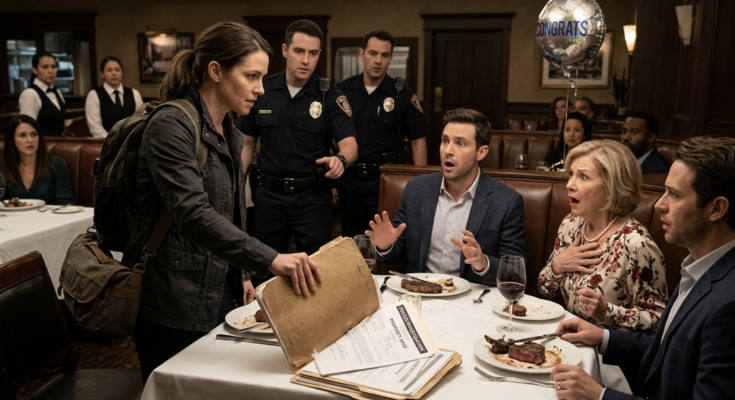
I keep thinking about that night at Sapphire Steakhouse. I remember how you walked in carrying that folder. I thought you were going to apologize for making a scene.
I never imagined you would actually stand up to us.
I want you to know that Dad was involved. He told me the house could be sold and that everything would be handled later. He said you wouldn’t care because you had enough money.
I believed him because it was easier than admitting I was stealing from my own brother.
I used the money. I bought things I didn’t need. I wanted people to think I was successful.
I wanted Dad to finally respect me.
I’m sorry about Grandpa’s watch.
I know you loved him.
Marcus.
I read it twice.
Then I placed it in a drawer.
I didn’t write back.
I wasn’t ready.
And I didn’t owe him immediate forgiveness simply because he had finally admitted what he had done.
The criminal proceedings took months.
There were hearings, financial reports, sworn statements, and negotiations between attorneys.
My father initially denied wrongdoing.
But eventually, confronted with the financial records and communications, he entered into a legal resolution that included admitting responsibility for specific financial misconduct.
Marcus also accepted responsibility for his role in the fraudulent property sale and related transactions.
The court imposed consequences based on the proven offenses, including criminal penalties, financial restitution, and restrictions designed to prevent further misuse of the affected assets.
Daniel Mercer faced separate proceedings over his involvement in the financial arrangements.
My mother was not treated as an innocent bystander simply because she was married to my father. Her role was examined carefully. Her cooperation, along with the evidence, helped establish what she had known and when she had known it.
There was no magical moment when everything was repaired.
There was no dramatic speech that made the judge forgive everyone.
There were simply documents, evidence, testimony, and consequences.
And for the first time in years, my family could no longer solve their problems by calling me.
PART 6— THE HOUSE I LOST AND THE LIFE I FINALLY FOUND
About eight months after I returned from Tokyo, the trust finally came under independent professional administration.
The forensic review established the extent of the financial damage.
The court-approved recovery process helped restore a substantial portion of the assets, although not everything could be recovered.
Some money had been spent.
Some investments had collapsed.
Some properties had been sold.
But the remaining trust assets were protected, and the administration was placed under independent oversight.
Thomas Bennett called me with the final valuation.
“Julian, after the recovery efforts and the adjustments, the trust remains substantial. You’re in a much stronger position than you were when this began.”
I thanked him.
But I didn’t feel like celebrating.
Four million dollars, five million dollars, or ten million dollars wouldn’t give me back the years I had spent believing my family respected me.
It wouldn’t restore the photographs ruined in that storage unit.
And it certainly wouldn’t erase the feeling of seeing a stranger standing inside my home.
I had to accept something difficult.
The family I thought I had wasn’t the family I actually had.
And that realization hurt more than losing the house.
I eventually bought another home.
It wasn’t as large as the old one.
It didn’t have the expensive landscaping or the enormous backyard.
It was a quiet house in a peaceful neighborhood, with a small office, a comfortable kitchen, and enough room for the things that mattered.
I chose the furniture myself.
I chose the paint.
I chose the photographs.
Nobody else had a key.
Nobody else had permission to make decisions about it.
On the first night, I sat alone in the living room.
The gold pocket watch rested on the table beside me.
I wound it carefully.
The familiar ticking filled the quiet room.
For a moment, I imagined Grandpa sitting across from me, smiling.
I could almost hear him saying:
“Never let people confuse your kindness with permission.”
I looked around my new home.
It wasn’t worth $850,000.
It wasn’t supposed to be.
It was mine.
And that was enough.
Six months later, I received another message from Chloe.
She had been cooperating with the investigation and had provided information about several purchases Marcus had made.
Her message was short.
Julian, I wanted to apologize for accepting the things he bought with your money. I should have asked more questions. I hope you’re doing well.
I replied:
Thank you for telling the truth. I hope you find peace and build a better life.
She thanked me.
We never became friends, but I held no resentment toward her.
She had made her own choices, and she had to live with them.
Marcus, however, remained someone I wasn’t ready to welcome back into my life.
He had written several times.
Sometimes he apologized.
Sometimes he asked whether I could help him financially.
The second type of message stopped me from answering the first.
I had learned that an apology without changed behavior was simply another request.
My mother called on my birthday.
I almost didn’t answer.
But eventually, I picked up.
“Happy birthday, Julian.”
“Thank you.”
There was a long silence.
Then she said:
“I know you don’t want to see us.”
I didn’t respond.
“Your father has been asking about you.”
I looked at the gold watch on my desk.
“How is he?”
“He’s dealing with everything.”
“That’s good.”
She began crying softly.
“I miss you.”
I closed my eyes.
For a long time, I had imagined this conversation.
I thought I would feel angry.
I thought I would want to list every terrible thing they had done.
Instead, I felt tired.
“Mom, I don’t hate you.”
She sniffed.
“Really?”
“But I can’t go back to the way things were.”
“I understand.”
“I need you to understand that loving someone doesn’t mean giving them unlimited access to your life.”
She was quiet.
Then she said:
“Your grandfather would have been proud of you.”
I looked down at the watch.
“Thank you.”
We spoke for another few minutes.
Before hanging up, she asked whether we could meet someday.
I told her maybe.
Not next week.
Not next month.
But someday, if we could have a relationship built on honesty rather than obligation.
She accepted that.
For the first time, she didn’t ask me to send money.
THE END — THE LAST LESSON FROM MY GRANDFATHER
A year after that night at Sapphire Steakhouse, I visited my grandfather’s grave.
I brought flowers.
I also brought the pocket watch.
The Arizona sky was clear, and a soft breeze moved through the trees.
I stood beside his headstone for a long time.
Then I sat on the nearby bench and opened the old leather photo album.
The original had been destroyed in the storage unit.
But I had spent months searching through old family archives and contacting relatives who had kept copies.
I managed to recover several photographs.
There was one of Grandpa teaching me chess.
Another showed us fishing.
And one showed him holding me outside the house I had lost.
I placed the recovered photographs beside his headstone.
“Well, Grandpa,” I whispered. “You were right about a lot of things.”
I wound the pocket watch.
It started ticking.
“I lost the house. I lost the money. I lost the family I thought I had.”
I paused.
“But I didn’t lose myself.”
I thought about Marcus.
I thought about my father.
I thought about my mother.
I couldn’t change what they had done.
I couldn’t force them to become different people.
And I couldn’t spend the rest of my life trying to prove that I deserved to be treated with respect.
That was the final lesson.
For years, I had confused being a good son with being an available son.
I had confused being a good brother with rescuing my brother from every bad decision.
And I had confused keeping the peace with accepting disrespect.
I would never make those mistakes again.
I put the watch back in its velvet box.
Then I stood up.
As I walked toward my car, my phone buzzed.
It was an email from Thomas.
The subject line read:
Final Trust Administration Update.
The remaining assets had been secured, the recovery process had been completed to the extent legally possible, and the independent administration would continue protecting the trust.
I smiled.
Not because I had become wealthy.
Not because my family had been punished.
But because the truth had finally been established.
I drove home with the windows down.
For the first time in a long time, I wasn’t driving toward a family obligation, another emergency, or another person waiting for me to solve their problems.
I was driving home to a place that was truly mine.
And when I opened the front door, there was no stranger in my living room.
No unfamiliar SUV in my driveway.
No forged document waiting on the table.
Just silence.
Peace.
And the ticking of my grandfather’s watch.
I finally understood something he had tried to teach me years earlier.
The greatest inheritance isn’t money, property, or a family name. It’s the courage to protect your dignity when the people who should love you are the ones trying to take it away.
And that night, for the first time in my life, I felt richer than I had ever been.


One Comment on “PART 5 – My Brother Sold My $850,000 House While I Was in Tokyo, My Parents Helped Him Steal My Inheritance, and They Celebrated at a Steakhouse”