The road has its own way of putting you where you’re supposed to be. I’ve believed that for years. Not in some mystical, fortune-cookie kind of way, but in the practical sense riders understand: you stay alert, you watch the edges, you notice what other people miss. You learn fast that one decision—one turn, one stop, one glance in the mirror—can change everything.
That night on Route 47 proved it.
It was just after midnight, the kind of cold October dark that makes the trees look like a wall. Route 47 runs through state forest for miles, a narrow two-lane strip of asphalt with no streetlights and no shoulder to speak of. I’d been riding for six hours, heading home after visiting a buddy who’d gotten out of rehab. The air cut through my gloves. My eyes burned from fatigue, but I knew these roads. I’d ridden them so many times I could picture every curve.
Then a deer exploded into my headlight beam.
I slammed the brakes, swerved right, did everything you’re trained to do, but there was no room and no time. The impact wasn’t catastrophic—more of a hard thud and a wobble—but it was enough to jar the front end. I wrestled the bike to the shoulder, killed the engine, and sat there for a second listening to my own breathing.
The deer lay in the road, motionless.
I got off, checked the bike. The front fender was dented. The headlight lens was cracked but still throwing enough light to keep me visible. I was annoyed, already thinking about how long it would take to get parts.
Then I saw movement at the edge of the woods.
Not the twitch of a wounded animal. Not leaves shifting in the wind.
Something smaller. Something human.
I froze, watching. The movement stopped. The forest went still again, like it was holding its breath.
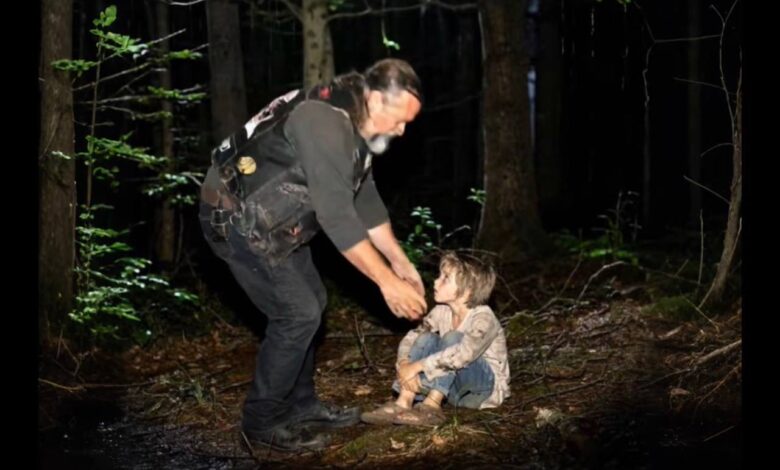
I turned on my phone flashlight and walked toward the sound, boots crunching through leaves. I didn’t call out at first. A lot of things live in the woods after midnight, and not all of them are friendly. But as I got closer, I heard it: quick, shallow breathing. Panicked breathing. The kind that comes from fear you can’t talk your way out of.
The light hit him and my stomach dropped.
A little boy, no older than six, sitting in the leaves with his knees pulled tight to his chest. Barefoot. Filthy. Thin pajamas soaked through with damp and dirt. His arms were scratched, and his lips had that bluish tint cold kids get when their bodies are losing the fight.
But it was his eyes that stopped me.
I’d seen that stare before—overseas, in places I don’t talk about much. The thousand-yard stare. The look of someone whose brain has decided the world is too dangerous to process, so it shuts down. It was the last expression I expected to see on a child in dinosaur pajamas.
I crouched slowly, keeping my voice low. Told him my name. Told him I wasn’t going to hurt him. Asked where his parents were, where he lived, if he was lost.
He didn’t blink. Didn’t answer. Didn’t even shift.
I took off my leather jacket and held it out like an offering. He didn’t reach for it. I set it down next to him instead and started to stand, figuring I’d walk back to the bike and call 911.
The second I turned away, I heard footsteps in the leaves.
I looked back and he was behind me, silent as a shadow, reaching for my hand.
He grabbed it with both of his. Tight. Desperate. His hands were ice-cold, and his grip shook like he was holding onto the last solid thing in the world. When I tried to move my arm, his fingernails dug into my skin.
He still didn’t speak. But he didn’t have to.
Don’t leave me.
I pulled my phone out with my free hand and dialed 911. The dispatcher asked the usual questions—location, emergency type, anyone injured.
“I found a kid,” I said. “About six. He’s alone in the woods off Route 47 near mile marker 33. He’s not talking. He’s freezing.”
“Is he injured?”
I crouched and ran my light over him. Scratches, bruises under the dirt, damp fabric clinging to his legs. No obvious broken bones.
“Scratches. He’s cold and dehydrated. He looks like he’s been out here awhile.”
“Stay with him. Deputies and EMS are en route.”
She warned it might take twenty to thirty minutes. Rural county, middle of the night.
So I sat down on the ground with him right there. He immediately dropped beside me, still gripping my hand like a lifeline. I wrapped my jacket around him one-handed. This time he let me. His shaking didn’t stop, but it slowed a little.
I talked anyway. Not because I expected answers, but because silence can feel like abandonment to someone in shock. I told him about my dog. I told him my bike had a name. I told him he was safe now, that help was coming.
When the red and blue lights finally cut through the darkness, he tensed so hard I felt it through his fingers. He pressed closer to my leg.
“It’s okay,” I murmured. “They’re here to help.”
Two sheriff’s deputies arrived first, then an ambulance. A young deputy crouched down and spoke gently. The boy turned his face into my shoulder. The paramedic tried to check vitals. The kid resisted anything that required letting go of me.
“He’s hypothermic,” the paramedic said, voice tightening. “We need to get him to the hospital.”
“He won’t let go,” I said.
The deputy looked at me—at my beard, my vest, my patches—doing that quick mental math people do when they don’t know what to make of you. Then she surprised me.
“Will you ride in the ambulance with him?” she asked. “Just until he’s settled.”
I looked down at those small hands locked around mine. The answer wasn’t complicated.
“Yeah,” I said. “I’m coming.”
Getting him into the ambulance was awkward. I climbed in first so he could keep his grip while they lifted him. The moment the doors shut, he started shaking again like the walls had closed in.
“I’m right here,” I told him. “I’m not going anywhere.”
The ride to the hospital took forty minutes. He didn’t sleep. Didn’t even blink much. Just stared forward, holding on. I’d seen grown men respond to trauma that way. It scared me more to see it in a child.
At the ER they put us in a private room. A nurse offered juice and crackers. He wouldn’t touch them until I took a bite first. Then, slowly, he ate like he wasn’t sure he was allowed to. He drained the juice box in seconds.
A doctor came in, calm, practiced. He examined the boy gently, lifting the pajama shirt to check his ribs.
That’s when I saw the bruises.
Not fresh ones. Older ones—yellow-green, fading in layers, like they’d been there for weeks. Bruises on his back, his sides, his ribs. The kind you don’t get from tripping on a toy.
The doctor’s eyes met mine. He saw what I saw.
He stepped outside with the deputy. Through the glass, I watched them talk and watched the deputy’s face change.
Later, a detective arrived with a folder. He told us they had a match from missing child reports: Ethan Parker, six years old, reported missing three days earlier from a town forty miles away.
Three days.
The detective said the parents were on their way.
The moment he said it, the boy went rigid. His breathing sped up. The hand gripping mine tightened until it hurt.
That wasn’t relief. That wasn’t a scared kid finally getting his family back.
That was fear.
When the parents arrived, Ethan saw them through the window and went completely still, like his body had decided the safest move was to become invisible. His mother came in first, crying, arms open. Ethan didn’t move toward her. He didn’t lean into her hug. He allowed it like someone enduring bad weather.
Then his father stepped in.
Big man. Hard jaw. The kind of posture that fills a room without saying a word. He didn’t rush to hug his son. He looked at the doctor, at the deputy, then at me like I was a problem that needed removing.
They began pushing to take Ethan home. The doctor recommended observation overnight. The father rejected it with a sharp edge that made the hairs on my arms lift.
The mother kept explaining. Ethan “eloped.” Ethan “wandered.” Ethan was “sometimes nonverbal.” It was all packaged neatly, like a script they’d rehearsed.
Ethan watched his father the whole time.
When the father finally said, “Ethan, let’s go,” something snapped in the boy’s face. His eyes found mine, wide and wet.
And for the first time all night, he spoke.
“No.”
The room went silent.
His mother tried to soften it. “Honey, what do you mean?”
Ethan’s grip locked around my hand with both of his, shaking now, tears spilling. He stared straight at me and forced the words out like they cost him something.
“Please,” he whispered. “Please don’t let them.”
That was it. That was the whole truth in one sentence.
The deputy stepped forward. The detective moved between Ethan and the father. The father’s voice rose, angry, insistent, talking about rights and confusion and trauma.
But the kid had found his voice, and once it was heard, everything changed.
They separated the parents for questioning. They kept Ethan at the hospital under supervision. Two days later, the story came apart completely: the bruises, the distance, the timeline. It wasn’t a child wandering off. It was a child discarded. Left in the woods like an inconvenience someone wanted erased.
Charges followed. Protection orders. A new placement for Ethan with people trained to care for a child who had already learned what terror feels like.
I visited him once a month for a while. Brought my dog, because he liked dogs. He started speaking more, piece by piece, like his voice was something he had to rebuild carefully. He wasn’t magically “fine.” Kids don’t bounce back from that like a cartoon. But he was safe, and that mattered more than any clean ending.
I keep a photo of him now—smiling for real, holding a school certificate. I carry it in my wallet, because it reminds me that stopping that night mattered.
People ask why I got involved. Why I stayed. Why I didn’t hand him off and disappear into the dark like most folks would.
Because riders have a code. You don’t pass someone who needs help. Not on the road. Not in the woods. Not in the worst moment of their life.
That night, the road showed me a child who couldn’t speak but still found a way to say what mattered.
And I listened.
