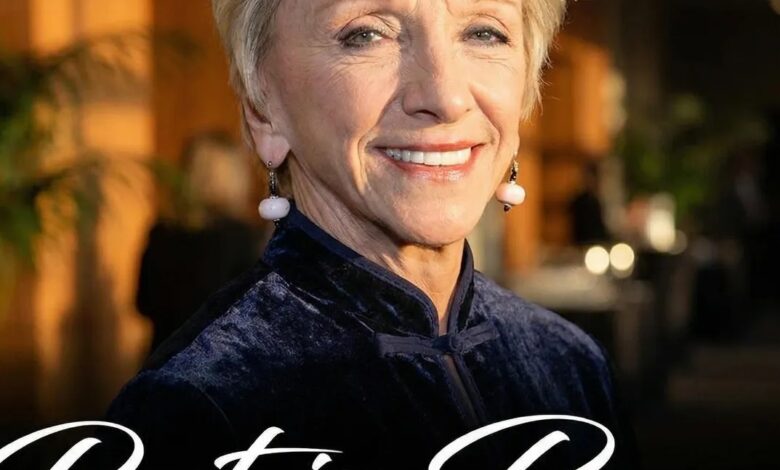
Elizabeth Franz’s passing has stirred a quiet ache throughout the theater world—a reminder that some artists do far more than perform. They shape the landscape. They influence the language of storytelling. They imprint themselves on the art form so deeply that the work becomes inseparable from their presence. At 84, she died at her home in Woodbury, Connecticut, after an illness, leaving behind a career that spanned more than six decades and a legacy that refuses to fade. Her husband, Christopher Pelham, confirmed her passing—a moment that quickly rippled through stages, rehearsal rooms, and living rooms across the country.
Tributes poured in immediately. Fellow actors spoke about her generosity, directors remembered her fierce commitment to truth, and audiences shared memories of watching her transform a stage the moment she stepped onto it. She wasn’t loud about her genius; she didn’t chase spectacle. She embodied something quieter, stronger—an unwavering honesty that elevated everything around her.
Affectionately dubbed “America’s Judi Dench,” she earned that comparison not through reputation alone but through a rare combination of emotional intelligence, precision, and fearless artistry. From the earliest days of her Off-Broadway career, she showed a depth that made audiences sit forward in their seats. Her breakthrough came with the role of Sister Mary Ignatius in Sister Mary Ignatius Explains It All for You, a performance that earned her an Obie Award and immediate recognition from critics who understood they were witnessing the rise of a singular force. Franz had a unique gift: she didn’t simply play a character—she revealed the soul inside it, no matter how contradictory or complicated.
Her defining moment arrived in the 1999 Broadway revival of Death of a Salesman, where she played Linda Loman opposite Brian Dennehy. The production was hailed as monumental, but her performance was its heartbeat—quiet, devastating, and unforgettable. Even Arthur Miller himself praised the raw sensitivity she brought to a role often overshadowed by the larger-than-life Willy Loman. She later reprised the role in the Showtime film adaptation, earning an Emmy nomination and cementing that portrayal as one of the most powerful modern interpretations of the character.
But her range stretched far beyond one iconic performance. She moved seamlessly between intense dramas and delicate character studies, appearing in Brighton Beach Memoirs, Morning’s at Seven, The Cherry Orchard, and The Miracle Worker. Her versatility was effortless—she could break a heart with a whisper or command a stage with a single raised eyebrow. For Franz, theater wasn’t performance. It was truth-telling.
Her influence extended to screens both big and small. She shared the frame with giants like Robert De Niro, Harrison Ford, and Jamie Lee Curtis. But she wasn’t the type of actress who needed a starring role to leave a mark. Whether she appeared in a major film or a single episode of a series, she delivered characters that felt lived-in and human. Audiences may remember her from Gilmore Girls, Grey’s Anatomy, Homeland, Judging Amy, or one of her many Law & Order appearances. On television, she had a knack for grounding even the briefest roles, making them feel like they had real histories and real weight.
Franz never hid from the struggles of her early life. She often spoke about how acting became a lifeline—an anchor that gave her purpose and resilience when things were hardest. That honesty endeared her to younger performers who admired not just her talent but her courage. She was a reminder that artistry comes not from perfection but from living fully, embracing flaws, and allowing all of it to feed the work.
Though she leaves behind her husband and brother, her true extended family is enormous: countless students, colleagues, fans, and strangers whose lives were shaped by her performances. She had the rare ability to make people feel something deep and unspoken—to show them a mirror they didn’t know they were searching for.
Elizabeth Franz gave American theater more than roles. She gave it honesty. She gave it courage. She gave it a standard that artists will be measured against for decades to come.
Her legacy isn’t just the characters she portrayed or the awards she earned. It lives in the emotional vocabulary of modern theater, in the craft she refined and protected, in the truth she insisted on delivering every time she stood under the lights.
For more than half a century, she shaped the art form she loved. And now, even in her absence, her voice continues to resonate—steady, graceful, unforgettable.
