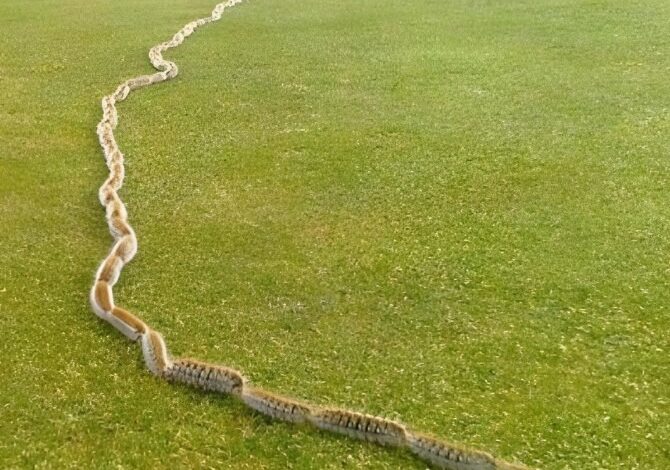
What began as a completely routine afternoon task quickly escalated into a moment of pure, instinctive shock for Hannah Morris, a 34-year-old homeowner focused on property maintenance and home organization. Hannah had merely stepped into her backyard to conduct a brief yard inspection, checking on her labrador dog and tidying up the debris left behind by a particularly windy night. She anticipated nothing more strenuous than collecting a few fallen tree branches or noting uneven patches in the lawn care plan. As she scanned the periphery of the yard, something dark, long, and oddly static near the perimeter of the lawn caught her eye.
At first glance, her mind immediately categorized the object as harmless outdoor clutter—perhaps an old piece of discarded nylon rope left over from a previous DIY home improvement project, or simply a forgotten, kinked section of garden hose partially concealed beneath the grass. With no immediate reason to engage her sense of suspicion, Hannah walked closer, entirely unaware that this ordinary, mundane moment was about to deliver a powerful, visceral lesson in wildlife biology and environmental awareness.
As Hannah reduced the distance, the object delivered a crucial, sudden piece of counter-evidence: it shifted. The item she had confidently dismissed as an inanimate object revealed itself, through a subtle but unmistakable movement, as a living, breathing creature. The shock of the realization was so immediate and profound that it caused her to halt instantly, freezing in place just a few feet away. In the span of seconds, she realized she was standing near a large, powerfully built serpentine species resting quietly amidst the high grass. Its natural camouflage was nearly flawless; the mottled, earthy coloring blended so perfectly with the surrounding soil and grass tones that it had rendered the animal virtually invisible.
The initial wave of surprise was enough to send her heart rate soaring. Hannah later recounted that her primary reaction was not paralyzing fear, but rather pure, adrenaline-fueled shock—an instinctive, primal response to the unexpected intrusion of raw wilderness into the perceived safety and control of her domestic residential space.
This type of encounter, far from being a rare anomaly, is increasingly common, according to leading wildlife experts focused on urban ecology and herpetology. As suburban development continues its expansion, natural habitats are fragmented, leading to more frequent interactions between people and local fauna. Snakes frequently seek out warm, secluded spots to regulate their body temperature and rest, finding ideal conditions in the shaded, undisturbed areas of residential yards, under landscaping features, or concealed within tall grass.
The key factor in these misidentification events is the animal’s behavior. Because snakes are masters of crypsis and can remain perfectly immobile for extensive periods, they are routinely mistaken for roots, discarded objects, or other forms of garden debris. Wildlife officials emphasize that in the vast majority of cases, these animals are fundamentally non-aggressive and exhibit a strong innate preference for avoiding all forms of human interaction. Once a snake senses nearby movement or vibration, its natural defense mechanism is typically evasion and retreat rather than confrontation, relying entirely on its ability to rapidly disappear or its camouflage rather than any active defense. This instinctive avoidance behavior minimizes the potential for wildlife conflict in urban environments.
In Hannah’s specific case, the animal was identified as a non-venomous snake species common to her geographical region. Far from being a threat, these snakes are actually regarded as beneficial agents of natural pest control, playing a crucial role in regulating local populations of rodents and other small mammals, thereby contributing positively to the overall ecosystem health of the area. After that brief, intense moment of mutual surprise—a silent acknowledgement of shared space—the snake slowly and deliberately moved away, retreating into the dense undergrowth and leaving Hannah physically unharmed but profoundly shaken.
The experience served as a powerful and lasting reminder. It instilled in Hannah a new, healthy appreciation for the diverse local biodiversity that silently coexists with human populations in residential real estate. Now, she conscientiously takes an extra beat to look twice—a practice of mindfulness and observation—before attempting to handle or pick up any object in her yard. What she had previously viewed as just an ordinary afternoon task has been transformed into a daily, enduring reminder that the complex patterns of natural life often blend seamlessly and invisibly into the fabric of our controlled daily existence, demonstrating that sometimes, the most unassuming and easily dismissed sights can conceal the most surprising, vivid, and essential aspects of the natural world.
