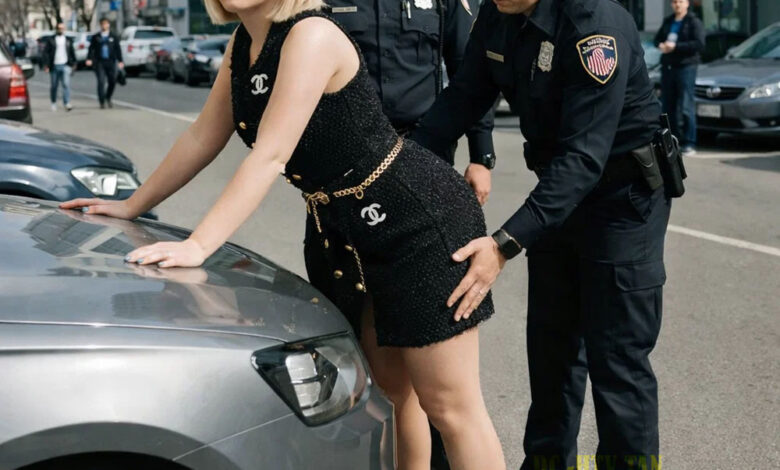
The sun was dipping toward the horizon, casting long, golden shadows across the undulating ribbon of asphalt that connected the rural outskirts to the heart of the county. Anna Parker rode with a rhythmic grace, the low, mechanical thrum of her motorcycle serving as the only soundtrack to her journey. She wasn’t dressed for a high-profile gala or a legislative session; she wore the anonymous uniform of the road—weathered leather, faded denim, and boots that had walked through more dirt than the polished marble floors of the capitol. To any observer, she was just another traveler, a solitary woman enjoying the fleeting peace of a Saturday afternoon.
Strapped to the back of her bike was a modest gift for a friend’s wedding. She had purposely chosen her motorcycle for the trip, seeking the anonymity and clarity that only a helmet and a highway can provide. In her role as Deputy Governor, her life was a constant barrage of voices, demands, and political maneuvering. On the road, she was simply Anna. But that peace was shattered when the aggressive flash of red and blue strobed in her rearview mirror.
The checkpoint ahead was staged with an unnecessary level of intimidation. Traffic cones were strewn about like tactical barriers, and two patrol cars were angled to create a bottleneck. As Anna rolled to a stop and killed the engine, she felt an immediate prickle of unease. This didn’t feel like a routine safety inspection; it felt like a display of territorial dominance.
Officer Johnson approached her with a slow, predatory swagger. He didn’t lead with a greeting or a reason for the stop. He simply stood over her, chewing gum with a rhythmic, disrespectful smack, his eyes hidden behind mirrored aviators. When Anna removed her gloves, he barked for her license and destination. His tone was saturated with a specific kind of condescension—the kind reserved for those who believe that a badge grants them the right to belittle others.
When Anna calmly explained she was headed to a wedding, Johnson let out a derisive bark of laughter. He began to circle her bike, his metal baton rhythmically tapping against his palm with a sound like a ticking clock. He made baseless accusations about her speed and her lack of a helmet, despite the fact that she had been riding safely and her helmet was tucked securely into her saddlebag. It became clear that Johnson wasn’t looking for a violation; he was looking for a victim. He was fishing for a reaction, hungry for the moment she would snap so he could justify an escalation.
“Sir, if there is no legitimate violation, I would like to be on my way,” Anna said, her voice a model of icy composure.
The shift in Johnson’s demeanor was instantaneous. The faux-joviality vanished, replaced by a snarling, fragile ego. To a man like Johnson, a woman who spoke with authority was a threat to be neutralized. He turned to his colleagues, mocking her for “knowing the law,” and when Anna stood her ground, asserting her rights, he did the unthinkable. He struck her. The slap was a sharp, stinging crack that rang out across the quiet road.
In that moment, Anna tasted copper and felt the searing heat of rage. Every instinct screamed for her to retaliate, to use the training she had acquired over years of public service to dismantle him. But she knew the game he was playing. Instead of screaming, she looked him directly in the eyes. “Touch me again,” she whispered, “and you will regret it.”
Johnson didn’t see a warning; he saw an invitation. He orchestrated a scene of “resisting arrest,” dragging her toward the patrol car while his fellow officers looked on with a mixture of amusement and complicity. He even took a baton to her motorcycle, shattering the headlight and denting the fuel tank—a petty, symbolic destruction of her autonomy. As she was shoved into the back of the cruiser, Anna didn’t plead. She didn’t reveal her identity. She simply pressed the discreet emergency transmitter on her watch, a silent beacon that bypassed the local precinct and went straight to the Governor’s security detail.
The atmosphere at the precinct was one of casual corruption. As Anna was processed, she watched as Johnson and his team fabricated a reality that didn’t exist. They laughed while typing up charges of reckless driving, theft, and assault on an officer. They treated her like “merchandise,” a trophy of their afternoon power trip. They tossed her into a holding cell that smelled of damp concrete and ancient despair, slamming the heavy iron door with a finality that would have broken a lesser person.
Johnson leaned against the bars, his face twisted into a smirk. He told her that no one was coming for her, that she was just another face in a long line of women who thought they were special. Anna remained silent, her eyes fixed on the clock on the far wall. She knew the mechanics of power far better than he did. She knew that while Johnson was busy enjoying his small, cruel victory, the gears of a much larger machine were beginning to turn.
The first sign of the impending storm arrived twenty minutes later in the form of a man in a nondescript suit. He didn’t shout; he didn’t even raise his voice. He simply flashed a credential for State Internal Affairs. The air in the room suddenly felt very thin. The precinct captain, sensing a shift in the political weather, immediately began to backpedal, but the investigator was surgical. He demanded body cam footage and surveillance tapes. When Johnson claimed a “malfunction,” the investigator merely nodded, a gesture that suggested the lack of footage was more damning than the footage itself.
The final blow came when the captain’s personal line rang. His face went from pale to ghostly white within seconds. He hung up the phone and ordered Johnson to step away from his desk. The bravado that had sustained Johnson all afternoon began to leak out of him like air from a punctured tire. When he asked why, the captain’s voice trembled: “Because the Governor is three minutes away.”
The precinct fell into a panicked silence. Outside, the distant hum of a high-speed convoy grew into a roar. When the Governor entered the station, he didn’t look at the officers; he walked straight to the holding cell. The look of recognition on his face when he saw his Deputy Governor behind bars—bruised and disheveled—was the silent death knell for every career in that room.
Anna walked out of the cell with her head held high, the power dynamic having flipped so violently it left the officers reeling. Johnson, the man who had been so vocal and aggressive on the roadside, was now small, silent, and shaking. He had mistaken her lack of a title for a lack of power, failing to realize that true authority doesn’t always wear a uniform—sometimes it rides a motorcycle on a quiet Saturday afternoon. As the Internal Affairs team began the process of dismantling the precinct’s corrupt culture, Anna looked at the man who had struck her. She didn’t need to say a word. The wreckage of his life, scattered across the floor of the station he had disgraced, said it all.
