PART 3
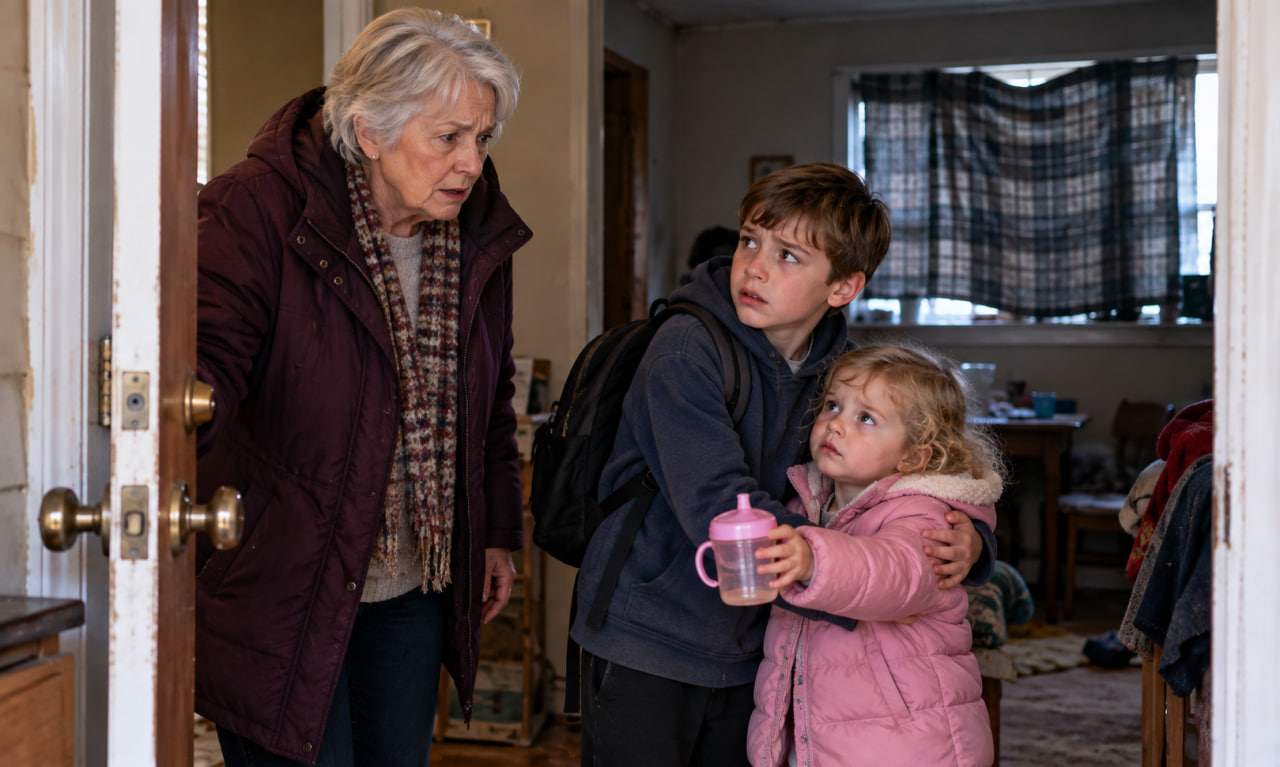
I reached for Maddie’s little cup. It weighed almost nothing. I stood, walked into their kitchen, and turned the faucet anyway, even though I already knew what would happen.
A dry cough.
Then silence.
The sink was filled with dirty cereal bowls. A saucepan sat on the stove with dried macaroni stuck to the bottom. The refrigerator hummed when I opened it, but inside there was only half a loaf of bread, a stick of butter, ketchup, and one carton of milk that had expired three days earlier.
Bentley watched me without blinking.
“I’ve got food next door,” I said.
“No, honey.”
“We’re okay until Mom gets home.”
Those words hurt more than anything else in that apartment.
Because children only say we’re okay when they’ve been practicing it.
I carried Maddie onto my hip, and she rested her head against my shoulder without hesitation. Bentley followed me across the porch, locking the apartment behind him exactly the way responsible adults do.
Not ten-year-olds.
The moment we stepped into my kitchen, Maddie pointed toward my cookie jar.
“She remembers,” I laughed softly.
“She remembers everything,” Bentley said.
I poured two glasses of water before doing anything else. Maddie drank hers so quickly she coughed halfway through. Bentley drank slower, taking tiny careful swallows like he was afraid it might disappear.
Then I made grilled cheese.
I cut Maddie’s into little squares.
Bentley waited until she’d eaten three pieces before touching his own.
“You’re hungry,” I said.
He shrugged.
“Eat while it’s hot.”
He finished both sandwiches in less than four minutes.
I quietly made two more.
Children tell the truth sideways.
I learned that after raising Doug.
So instead of asking, Where’s your mother? I asked, “Who’s your favorite teacher?”
Bentley smiled for the first time.
“Mrs. Alvarez.”
“She nice?”
“She lets us borrow books without asking.”
“Is that where the bear book came from?”
His smile faded.
“I forgot to take it back.”
“When did your mom leave for the hospital?”
He stared at the table.
“Last Monday.”
Nine days.
“What happened?”
“She couldn’t breathe.”
I stopped buttering toast.
“She fell down in the bathroom. I called 911.”
“You called them yourself?”
He nodded.
“I remembered the numbers from school.”
“What hospital?”
“I don’t know.”
“They didn’t tell you?”
“They asked if there was another grown-up.” His voice became very small. “Mom said to tell them she’d call my aunt.”
“Do you have an aunt?”
“No.”
I had to look away.
After lunch, I tucked Maddie into my recliner with one of Ray’s old quilts. She fell asleep holding a stuffed rabbit whose ears had been sewn back on with blue thread.
Bentley wandered over to my bookshelf.
“I read to Maddie when she cries.”
He picked up Charlotte’s Web.
“My husband loved this one.”
“I’ve never read it.”
“Well,” I said, pulling another chair beside mine, “I think Ray would’ve been downright offended by that.”
For thirty minutes, we read together.
He stumbled over “radiant.”
I helped him sound it out.
When he finally said it correctly, he grinned so proudly that I nearly forgot why he was sitting in my living room in the first place.
At three o’clock, my phone rang.
Doug.
I almost let it ring.
Almost.
“What?”
“Ma, did you go into the unit?”
“Yes.”
“You had no legal right.”
I laughed—a short, tired laugh.
“The irony of you mentioning legal rights is remarkable.”
“You’re exposing us.”
“Exposing us to what? The truth?”
He sighed loudly.
“Did she tell you some sob story?”
“She isn’t there, Doug.”
“So?”
“So her ten-year-old son has been raising a toddler alone for nine days!”
Silence.
Then, “That’s not my responsibility.”
I closed my eyes.
“When your father was alive,” I said quietly, “he used to tell you that owning property meant you owned responsibility too.”
“Dad also said never let tenants manipulate you.”
“You weren’t there when he said the rest.”
“What rest?”
“That every lease has human beings attached to it.”
Doug didn’t answer.
Instead he said, “Don’t interfere. I’ve already filed the eviction paperwork.”
The line went dead.
I stared at the phone until Bentley asked, “Was that your son?”
“Yes.”
“Is he mad?”
I forced a smile.
“He’ll survive.”
That evening I called every hospital in Muncie.
The first three couldn’t help.
The fourth asked, “Immediate family?”
“Neighbor.”
“I’m sorry.”
The fifth transferred me twice before someone finally said, “I can’t release patient information.”
I thanked them anyway.
Bentley had been pretending not to listen.
“See?” he whispered. “I told you.”
I refused to believe that was the end of it.
Around six, Maddie woke up crying.
Not loudly.
Just the exhausted little cry of a child who wanted one person in the world.
“Want Mama,” she sobbed.
Bentley picked her up before I could.
He bounced her gently.
“Shhh. Remember what Mom says?”
She hiccupped.
“What does she say?”
“Mama always comes back.”
He said it with complete faith.
I wondered if he believed it anymore.
That night I made up the guest room.
Bentley immediately shook his head.
“We can’t sleep here.”
“Why not?”
“If Mom comes home, she won’t know where we are.”
So we compromised.
I carried blankets, pillows, and one of Ray’s old space heaters into their apartment. The heater hummed beside the couch while I scrubbed two pots and threw away spoiled food.
Bentley protested every few minutes.
“You don’t have to do that.”
“I know.”
“You’re already helping.”
“I know.”
“You’re gonna make Mom feel bad.”
I stopped washing dishes.
“Honey…”
He looked terrified.
“Your mother would feel grateful.”
He blinked hard and looked away.
At eight-thirty, someone pounded on my front door.
Doug.
He stood on the porch in his work jacket holding a folder.
“I figured you’d do this.”
“Do what?”
He held up the eviction papers.
“You’re getting emotionally involved.”
I stepped outside and closed the door behind me.
“Keep your voice down.”
“You’re letting them stay rent-free.”
“There are children sleeping ten feet away.”
“They’re trespassing if she’s abandoned the property.”
My jaw tightened.
“Say that again.”
“She abandoned—”
I slapped Ray’s old porch railing so hard it echoed.
“She left in an ambulance!”
Doug froze.
I had never raised my voice to my son.
“Do you hear yourself?” I asked. “You were born in the maternity ward because your father carried me there in the middle of a snowstorm. Imagine if someone had called that abandonment.”
His expression softened for just a heartbeat.
Then it hardened again.
“You’re being manipulated.”
“No.”
I stepped closer.
“You know what manipulation looks like?”
He frowned.
“It looks like a ten-year-old boy walking to a school bus every morning so the neighbors won’t realize he’s home alone.”
Doug’s face lost its color.
He hadn’t known.
For the first time, I saw doubt.
He looked past me toward the shared duplex.
“You’re serious?”
I nodded.
“Maddie’s three.”
He rubbed both hands over his face.
“I… I didn’t know there were kids inside.”
“You never checked.”
He didn’t argue.
Because he couldn’t.
Before leaving, he quietly handed me the folder.
“Court date’s next Thursday.”
Then he walked away without another word.
I thought the hardest part was over.
I was wrong.
At 9:17 p.m., while Bentley and Maddie were finally asleep on the couch, my landline rang.
Nobody calls the landline anymore.
I answered on the second ring.
“Hello?”
A woman’s exhausted voice came through, barely louder than a whisper.
“Is this… Miss Arlene?”
My heart stopped.
