PART 3
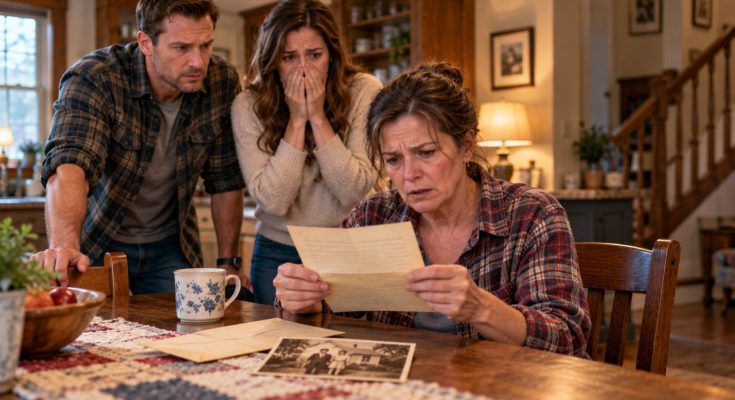
“There was an envelope with it.”He slid the envelope toward me.
My name was written on the front.
Tammy.
I recognized Mom’s handwriting immediately.
The envelope was yellow with age, and the seal had never been broken.
“Why would Mom leave something addressed to me in a house she sold us twenty years ago?” I asked.
Jeff shook his head.
“I don’t know. But there’s something else you need to know.”
He rubbed both hands over his face.
“Mom and Dad didn’t just ask for the farmhouse because I got divorced.”
My stomach tightened.
“What are you saying?”
“Last summer, Dad came to my house. He said the farm wasn’t supposed to be mine, but he also said it wasn’t supposed to be yours forever.”
I looked down at the photograph again.
“Did he explain?”
“No. He said you’d understand someday.”
I almost laughed.
Twenty years of replacing broken windows, patching walls, fixing plumbing, and paying bills hadn’t taught me what my own parents meant by a dollar sale.
Now my brother was telling me there was something else.
I opened the envelope.
Inside was a letter written in Mom’s careful handwriting.
Dear Tammy,
If you’re reading this, then the time has come for us to explain something we should have told you years ago.
Your father and I have made many mistakes in our lives. Some were small. Some were not.
Selling you the farmhouse for one dollar was never meant to be a way of giving you less than your brother.
I stopped reading.
I read that sentence again.
Giving me less?
I’d never thought of the farmhouse as a competition between Jeff and me.
I had been twenty-six, newly married, and determined to build a life with Dale. My parents had offered us a place to live, and we’d accepted the responsibility of turning a freezing, crumbling old house into a home.
I continued.
When Jeff was born, your father promised his father that we would always make sure our son had a place to return to if life ever became difficult.
We never imagined he would grow into a man who would need that promise kept in quite this way.
My hands began to tremble.
The letter went on for another page.
Mom explained that my grandfather had owned the original farm. When he died, he left it to Dad, but with one condition: Dad was supposed to preserve the farmhouse as a place where the family could gather and where future generations would always be welcome.
Not legal.
And that distinction mattered.
Your father and I believed that selling you the house for one dollar would keep it in the family. We thought you and Dale would look after it, and we thought that, if Jeff ever needed a place, there would always be room for him.
We should have told you this before you bought it.
I put the letter down.
For twenty years, my parents had let me believe the house was simply ours.
They had watched us spend our savings on it.
They had watched Dale work weekends replacing rotten floorboards while I painted bedrooms late into the night.
They had attended our summer cookouts on the back porch and complimented the new roof.
Never once had they mentioned a promise.
Never once had they said they considered the farmhouse a place that belonged to the whole family.
Jeff sat quietly.
“So they think you owe them the house,” he said.
“I don’t know what they think.”
“But they want it back.”
I looked at him.
“Yes. They do.”
He lowered his head.
“I’m sorry, Tam.”
“For what?”
“For being the reason they’re putting you in this position.”
I reached across the table and touched his hand.
“You didn’t ask them to do this.”
He looked toward the stairs.
“The kids love it here already.”
“I know.”
“Brody asked me if he could plant tomatoes in the garden this spring. Kenzie wants to paint her room yellow.
Cole thinks Pickles is going to live forever because Hannah told him goldfish are tough.”
I smiled despite myself.
“Pickles may outlive all of us.”
Jeff laughed softly.
Then his face became serious again.
“I don’t want your house, Tammy. I don’t want you and Dale to lose what you built. But I can’t afford another place right now, and the kids need stability.”
I folded Mom’s letter and returned it to the envelope.
“Then we’re going to make sure they have stability.”
He stared at me.
“What does that mean?”
“It means you’re staying upstairs for now. It means you get a chance to find work that pays enough to support you and the kids.
It means the children get to go to school without worrying about where they’ll sleep next month.”
“And Mom and Dad?”
I glanced at the old photograph.
“That’s what Saturday was supposed to be about.”
It was already Sunday morning.
And I had a feeling that our family was about to have the most uncomfortable dinner of its life.
Part 3: The Sunday Dinner Nobody Expected
Mom arrived at eleven-thirty carrying a covered casserole dish.
Dad followed her up the porch steps.
Neither of them knocked.
Mom opened the door and stopped when she saw Kenzie sitting on the living room floor, coloring a picture of the farmhouse.
Cole was beside her, carefully arranging toy cars along the baseboard.
Brody sat at the kitchen table working on his math homework.
Jeff was outside splitting wood with Dale.
Mom looked around the room.
“You’ve moved them in permanently?”
“No,” I said. “I’ve given them somewhere to stay while Jeff gets back on his feet.”
“That isn’t what we discussed.”
“We didn’t discuss anything. You asked me to sell you the house back for a dollar.”
Dad removed his cap.
“Tammy, we were hoping you’d understand.”
“I do understand, Dad. Jeff needs help. His kids need a home. That’s why they’re here.”
Mom set the casserole on the counter.
“But this was supposed to stay a family house.”
I stared at her.
“Mom, Dale and I have spent twenty years making this a family house.”
“I know you’ve done work on it.”
“Sixty thousand dollars’ worth.”
“We never asked you to spend that much.”
“No, you didn’t. But you sold us the property. We made it livable because we wanted a home.”
Dad shifted uncomfortably.
“We never thought you’d take it away from the family.”
I felt something inside me go very still.
“Take it away? Dad, we live here. Hannah grew up here.
Her first steps were taken in that hallway. Dale’s mother spent her last Christmas in that living room.
This is not an empty building you left behind.”
Mom’s expression changed.
For a moment, I thought she might finally understand.
Then she said something that erased the hope.
“Jeff has children. You have one daughter who’s almost grown. You can start over somewhere else.”
The kitchen went silent.
Even the refrigerator seemed louder.
I looked at my mother, the woman who had taught me to bake biscuits, helped me sew my first dress, and sat beside me when I cried after my first serious breakup.
“You’re asking me to give up my home because you believe my brother’s children need it more than my daughter does?”
“That’s not what I’m saying.”
“Then what are you saying?”
Mom opened her mouth, but no answer came.
Dad finally spoke.
“We’re saying that sometimes family has to make sacrifices.”
I nodded slowly.
“You’re right. Sometimes family does have to make sacrifices.”
I turned toward the window.
“Dale and I sacrificed vacations to pay for the roof. We sacrificed new furniture to replace the furnace.
We sacrificed evenings and weekends to make sure the pipes didn’t freeze and the porch didn’t collapse.”
I looked back at them.
“But we chose those sacrifices because we loved this house.
Nobody gets to decide that our sacrifices count for less simply because Jeff is having a difficult year.”
Dad looked down at his cap.
Mom’s eyes filled with tears.
I didn’t feel victorious.
I felt exhausted.
Then Jeff came through the back door.
He had heard enough to understand what was happening.
“Mom,” he said, “stop.”
She turned toward him.
“Jeff, we’re trying to help you.”
“No. You’re trying to help me by taking something away from Tammy.”
“We’re your parents.”
“And she’s your daughter.”
The words landed harder than any argument I could have made.
Jeff put the wood down beside the door.
“I didn’t ask Tammy for this house. I asked if I could stay here while I found work. She said yes. That’s enough.”
Mom shook her head.
“But your grandfather’s promise—”
“Grandpa never told me I was entitled to my sister’s home,” Jeff interrupted. “He told me that if I ever fell on hard times, I should be willing to work my way back up.”
