PART 4
I read the first page of Frank’s letter three times before I could bring myself to turn to the second.
My husband’s handwriting was unmistakable. The letters leaned slightly to the right, and his capital F always had an unusually long top line.
I had seen that handwriting on birthday cards, grocery lists, Christmas envelopes, and the little notes he used to leave beside my coffee cup.
But I had never seen him write anything like this.
My dearest Jean,
If you are reading this, it means I have finally run out of time to tell you something I should have told you many years ago.
I know you have wondered why I never spoke about the war. I know there were nights when you woke up and found me sitting in the dark.
It wasn’t because I didn’t trust you.
It was because I made a promise to a man, and I never found a way to explain what happened afterward.
I stopped reading.
My eyes were already filling with tears.
Frank had always been a quiet man, but he wasn’t unkind. He remembered every anniversary, fixed the neighbors’ fences without being asked, and never let me carry heavy grocery bags.
He was the kind of husband who showed love through actions rather than speeches.
I turned the page.
His name was Daniel Brooks.
He was twenty years old. He was the youngest man in our group, and he had a mother who sent him letters every week.
The night Ray was injured, Daniel was with us.
He helped me carry Ray. He was frightened, but he never complained. When we finally reached a place where Ray could be evacuated, Daniel went back to retrieve a radio and additional supplies.
He never came back.
My hand flew to my mouth.
I continued.
I spent years wondering whether I should have gone after him. The truth is, I wanted to. But I had another wounded man depending on me, and I made the decision I believed would save at least one life.
Ray survived. Daniel did not return.
Before Daniel left, he made me promise something.
He asked me to tell his mother that he had not been afraid.
He said he wanted her to know that he had done his best.
I promised him.
And I failed.
I lowered the letter.
For more than fifty years, my husband had carried the weight of a promise he believed he had broken.
I continued reading.
I wrote to his mother. I sent letters to the address he gave me. They came back. I tried again. Nothing.
I don’t know whether she moved, whether she died, or whether the letters simply never reached her.
I have looked for Daniel’s family for years.
Jean, if there is one thing I want you to understand, it is this: I never regretted carrying Ray. I would do it again. But I have never stopped wondering about the boy who went back for us.
I hope someday someone tells his mother that her son was brave.
I hope someone tells her he was loved.
And I hope she knows he was never forgotten.
Your loving husband,
Frank.
I sat completely still.
The house was quiet except for the refrigerator humming downstairs.
I looked at the date.
October 12, 1998.
Frank had written this twenty-two years before he died.
He had been carrying this secret for thirty years when he finally put it on paper.
I wiped my face.
Then I noticed something tucked behind the final page.
It was a small photograph.
A young soldier stood beside Frank and Ray.
The same three men Dennis had shown me.
On the back, Frank had written:
Ray. Daniel. Me.
I stared at Daniel’s face.
He looked like a boy.
Not a hardened soldier.
Not a hero from a history book.
Just a young man who should have had decades ahead of him.
And I suddenly understood that the Purple Heart was not the only thing Frank had left behind.
He had left an unfinished promise.
The next morning, I called Dennis.
He answered on the second ring.
“Mrs. Marlow! Is everything all right?”
“Dennis, I found something.”
I explained the letter and told him about Daniel Brooks.
He was silent for several seconds.
Then he said something that made me sit forward.
“My father mentioned Daniel.”
I nearly dropped the phone.
“He did?”
“Yes. He always said there were three men involved in the rescue. He remembered Frank and another soldier, but he couldn’t remember the third man’s full name. He said the young man had gone back for equipment.”
I closed my eyes.
“His name was Daniel Brooks.”
Dennis exhaled.
“Then we need to find his family.”
“Frank tried for years.”
“I know. But maybe we can do what he couldn’t.”
That afternoon, Dennis sent me the names of two veterans’ organizations and an archive that maintained historical military records.
He also contacted his siblings.
One of them, a woman named Margaret, had spent several years researching family military history.
She agreed to help.
For the next several days, I found myself doing something I hadn’t done in years.
I had a purpose beyond getting through the day.
I organized Frank’s documents, scanned photographs, and copied every letter I could find.
Dennis made calls.
Margaret searched public records.
Tyler even offered to help.
At first, I hesitated.
But I let him.
He spent an entire Saturday afternoon scanning Frank’s old photographs and organizing the files on his computer.
For the first time in a long while, we were doing something together that didn’t involve an argument about the house.
Then, four days later, Margaret called.
“I think I’ve found him.”
My heart started racing.
“Who?”
“Daniel Brooks.”
She explained that she had located a military casualty record matching the date and location Frank had mentioned.
Daniel Brooks had been officially listed as missing before his death was confirmed.
His hometown was in Ohio.
He had been twenty years old.
And his mother had spent decades trying to find out what happened to her son.
Margaret had also found an old newspaper article.
The headline read:
LOCAL FAMILY STILL SEARCHING FOR SON LOST OVERSEAS.
The article was dated 1972.
Daniel’s mother, Eleanor Brooks, was photographed sitting beside a window, holding a framed photograph of her son.
The article explained that she had never received a detailed account of his final days.
The military had informed her of his death, but the circumstances remained unclear.
I read the article twice.
Then I began to cry.
“Is she still alive?” I asked.
Margaret paused.
“Unfortunately, no. She passed away in 2009.”
I looked down at the photograph.
“But she had children?”
“Yes. A daughter named Patricia. She is seventy-four and lives outside Cleveland.”
I took a deep breath.
“Then we need to speak to her.”
Three days later, Dennis arranged a video call.
I was nervous.
I had never met Patricia Brooks, and I didn’t know how she would react to hearing about something that had happened fifty-eight years earlier.
When the screen finally connected, an elderly woman appeared.
She had silver hair, glasses, and a soft expression.
“Hello,” she said.
I smiled.
“Are you Patricia?”
“Yes.”
“My name is Jean Marlow. My husband was Frank Marlow.”
Her expression changed.
She leaned closer to the screen.
“Frank Marlow?”
“Yes, dear.”
She covered her mouth.
“My mother used to mention that name.”
I felt my breath catch.
“She did?”
Patricia nodded.
“Not often. But whenever she talked about the war, she mentioned a soldier named Frank. She said he had promised to tell her what happened to Daniel.”
I closed my eyes.
Frank had never forgotten.
Patricia continued.
“My mother waited for years. She wrote letters to military offices, but nobody could give her a clear answer. She always believed there was someone out there who knew what happened.”
I reached for Frank’s letter.
“I found something my husband wrote before he died. He wanted Daniel’s mother to know that her son was brave.”
Patricia’s eyes filled.
“Can you tell me?”
So I did.
I told her about the rescue.
About Ray.
About Daniel helping Frank carry a wounded man.
About the radio.
About the promise.
And finally, I read Frank’s words aloud.
He was frightened, but he never complained.
He did his best.
He was loved.
Patricia began crying.
I couldn’t hold back my own tears.
For several minutes, neither of us spoke.
Then Patricia said:
“My grandmother kept Daniel’s bedroom exactly the way it was for years. My mother did the same thing after Grandma died. She never understood why he hadn’t come home.”
I looked at the photograph beside me.
“Frank never stopped thinking about him.”
Patricia nodded.
“Then I think my mother finally got her answer.”
Before we ended the call, Patricia asked whether I would send her a copy of Frank’s letter.
I promised I would.
She also asked whether she could visit me.
I said yes.
A week later, Patricia arrived with her daughter.
She carried a small wooden box.
When we sat together in the living room, she opened it.
Inside were several photographs, a folded American flag, a few letters, and a small military photograph of a young man in uniform.
Daniel.
She placed the photograph beside Frank’s.
“That’s my uncle,” she said.
I studied his face.
He had the same youthful expression as in Frank’s photograph.
Patricia touched the edge of the picture.
“My mother used to say that Daniel was the kind of boy who would give away his last dollar if someone needed it.”
I smiled through my tears.
“Frank would have liked him.”
Patricia nodded.
“Can I ask you something?”
“Of course.”
“Do you think your husband knew how much my grandmother suffered?”
I considered the question.
“I think he knew she was waiting. I think that was why he never stopped trying to find her.”
Patricia looked at me.
“Then I don’t blame him.”
She reached across the table and held my hand.
“My mother would have wanted to thank him.”
I shook my head.
“He would have said he didn’t deserve it.”
Patricia smiled.
“Then I’ll thank you instead.”
She stood and embraced me.
For the first time in decades, I felt that the weight Frank had carried had finally been shared.
But the story of the medal had not yet reached its final chapter.
Two weeks later, Dennis called with another idea.
He wanted to organize a small remembrance ceremony for Frank, Ray, and Daniel.
Not a grand public event.
Just their families, a few veterans, and people who wanted to honor three men whose lives had become connected during one terrible night.
I agreed.
We chose a Saturday afternoon in May.
The ceremony would take place at a local veterans’ community center.
Dennis and his siblings traveled to attend.
Patricia brought her daughter and two grandchildren.
A representative from the veterans’ organization agreed to speak.
Tyler offered to drive me.
I accepted.
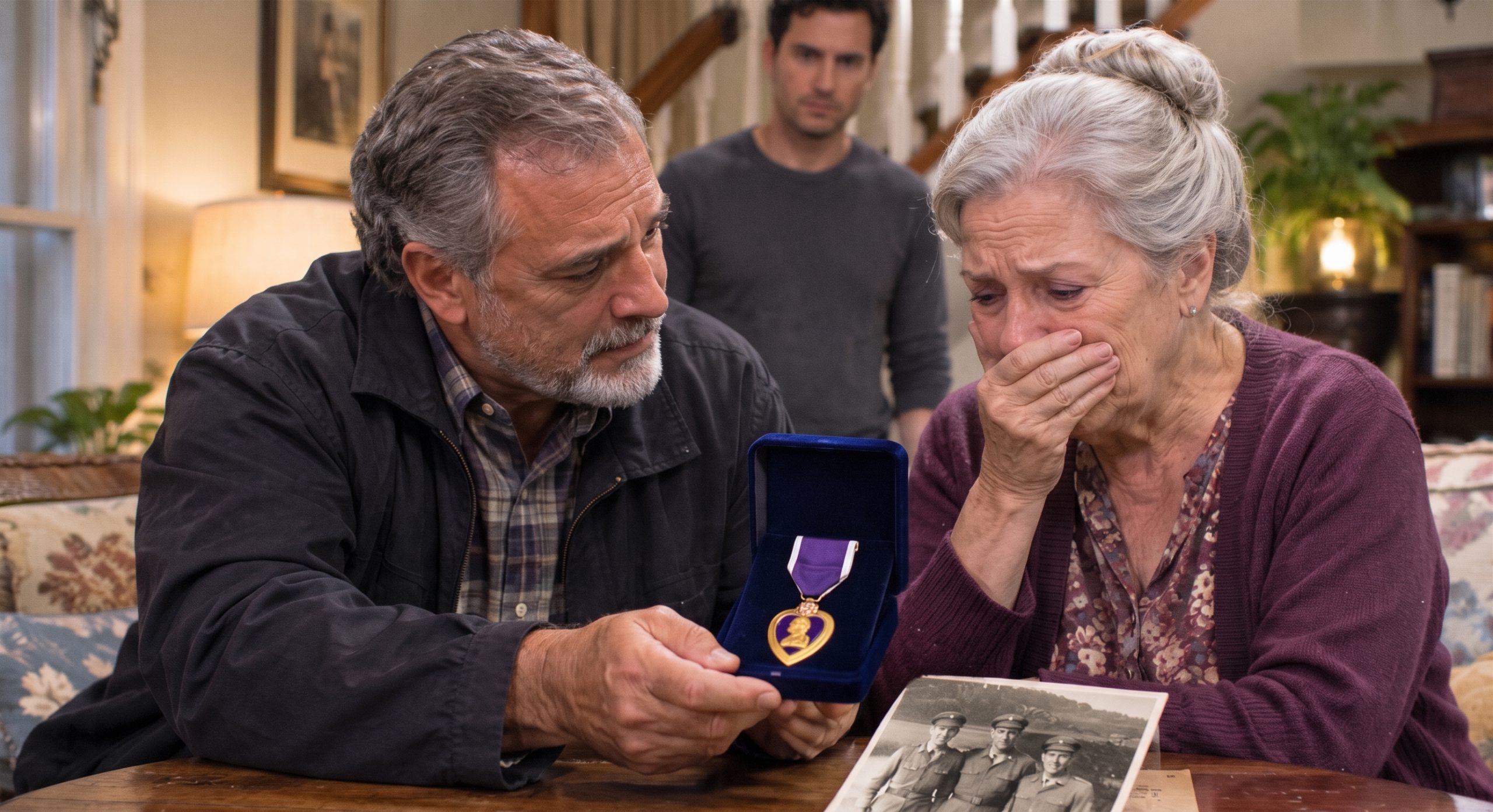
The night before the ceremony, I took Frank’s Purple Heart out of the blue velvet case.
I held it carefully in my hands.
The ribbon was beautiful.
The medal was clean.
I ran my thumb gently along the edge.
“Frank,” I whispered, “you can stop worrying now.”
Then I placed it inside the case.
The ceremony was smaller than I expected.
There were perhaps forty people in attendance.
Some were veterans.
Others were family members.
A few had simply heard about the story and wanted to pay their respects.
At the front of the room stood three framed photographs.
Frank Marlow.
Raymond Hale.
Daniel Brooks.
Below them were their names and the dates of their service.
Dennis spoke first.
He talked about his father and the man who had carried him to safety.
He explained how Ray had spent forty years thanking God for Frank Marlow.
Then he looked toward me.
“My father never considered himself a hero. He believed the real hero was the man who refused to leave him behind.”
He paused.
“But my father also understood that courage doesn’t always look like something extraordinary. Sometimes it looks like a tired young soldier refusing to give up on another human being.”
He stepped aside.
Patricia spoke next.
She held a photograph of Daniel.
“My uncle was twenty years old when he died. My grandmother waited for him for the rest of her life. She never received the full story.”
Her voice trembled.
“Today, I can finally tell her that Daniel was not forgotten. He was brave. He helped save another man’s life. And someone remembered his name.”
There wasn’t a dry eye in the room.
Then it was my turn.
I stood slowly, holding Frank’s medal.
I hadn’t prepared a speech.
I didn’t think I needed one.
I looked at the photographs.
Then I looked at the people sitting in front of me.
“My husband was not a man who liked attention,” I began.
A few people smiled.
“He was a quiet man. He fixed things around the house. He made me coffee every morning. He always checked the doors before going to bed.”
My voice broke.
“For fifty-one years, I knew him as my husband. I knew he had a limp. I knew he sometimes woke up at night. I knew there were things he couldn’t talk about.”
I held up the medal.
“But I didn’t know the whole story.”
I looked toward Dennis.
“Because of this young man’s father, I learned what Frank did that night.”
Then I looked at Patricia.
“And because of Patricia, I learned that another family had spent decades waiting for an answer.”
I paused.
“I wish Frank could have seen this room. I wish he could have known that the promise he carried for so long was finally fulfilled.”
My eyes filled.
“But perhaps the most important thing I’ve learned is that a medal is only a small piece of metal until someone understands the life behind it.”
I looked down at the Purple Heart.
“Frank, Ray, and Daniel were young men who found themselves in a terrible situation. They made difficult choices. They protected one another. And they left families behind who never stopped loving them.”
I took a breath.
“I want everyone here to remember their names.”
The room rose to its feet.
People applauded.
I wasn’t sure how long it lasted.
But for the first time since Frank died, I felt that he was not simply a memory sitting in an old photograph.
His life had reached people he had never met.
And his kindness had traveled farther than he could ever have imagined.
After the ceremony, Dennis approached me.
He was holding a small package.
“Mrs. Marlow, there’s something I’d like to give you.”
I opened it.
Inside was a framed photograph.
It was the original photograph of Frank, Ray, and Daniel, carefully restored and enlarged.
Underneath it was a small brass plaque.
It read:
THREE MEN. ONE NIGHT. THREE FAMILIES FOREVER CONNECTED.
I touched the frame.
“Thank you.”
Dennis smiled.
“My father would have loved this.”
Then he said something I would never forget.
“Mrs. Marlow, when I was a child, my father taught me that gratitude is not something you keep inside yourself. It’s something you pass on.”
He looked at the photograph.
“I think that’s what happened here.”
I nodded.
And I knew he was right.
THE LAST CONVERSATION WITH MY GRANDSON
On the drive home, Tyler was unusually quiet.
When we arrived, he helped me out of the car and carried the framed photograph inside.
He placed it on the living room table.
Then he sat beside me.
“Grandma?”
“Yes, sweetheart?”
“I’ve been thinking about something.”
I looked at him.
“What is it?”
He took a deep breath.
“I think I’ve been a coward.”
I didn’t interrupt.
He continued.
“When Kayla sold Grandpa’s medal, I knew it was wrong. I knew you were hurt. But I didn’t want an argument. I kept telling myself it wasn’t worth fighting about.”
He looked down.
“And then Dennis showed up, and I realized how much I had allowed someone to take away from you.”
I studied his face.
“Tyler, your grandfather wasn’t a perfect man. Neither am I. Neither are you.”
He nodded.
“But there are certain things you don’t sell. There are certain things you don’t throw away. And there are certain people you don’t make feel unwanted in their own family.”
His eyes filled.
“I’m sorry.”
I reached for his hand.
“I accept your apology.”
He looked relieved.
Then I added:
“But I need something to change.”
“Anything.”
“I want my own space. Somewhere I can keep my things, make my decisions, and live without worrying that someone will decide my belongings are worth more sold than kept.”
Tyler nodded immediately.
“I understand.”
I told him I had already spoken with a local senior housing community.
It wasn’t a nursing home.
It was a small independent-living apartment complex with private rooms, gardens, and activities for older residents.
I wanted to move there.
Tyler looked surprised.
“You’re leaving?”
“I’m not leaving you, sweetheart. I’m choosing a place where I can live comfortably.”
He looked toward the photograph.
“Grandpa would want you to be happy.”
I smiled.
“I think he would.”
He squeezed my hand.
“I’ll help you move.”
Kayla was less enthusiastic.
When Tyler told her about my decision, she immediately became upset.
“You’re moving out because of a medal?”
I was sitting at the kitchen table when she said it.
I looked up.
“No, Kayla. I’m moving because of two years of feeling like a guest in a house where I was supposed to be family.”
She crossed her arms.
“We’ve done everything for you.”
I remained calm.
“I appreciate the roof over my head. But providing a room doesn’t mean someone has the right to decide what happens to my belongings.”
She rolled her eyes.
“I already told you I didn’t know the medal was important.”
“And I told you that you should have asked.”
She looked at Tyler.
“Are you seriously letting her move?”
Tyler stood beside me.
“Grandma is eighty-one. She deserves to make her own decisions.”
Kayla looked stunned.
For once, Tyler didn’t retreat.
He didn’t change the subject.
He didn’t ask me to apologize to keep the peace.
He simply stood there.
I felt proud of him.
Not because he had chosen my side.
But because he had finally understood that doing the right thing sometimes means having an uncomfortable conversation.
A NEW HOME AND A NEW BEGINNING
Six weeks later, I moved into my new apartment.
It had two rooms, a small kitchen, and a balcony overlooking a garden.
There was a little patch of sunlight beside the window where I could place my favorite chair.
I brought Frank’s photographs, our wedding album, his old watch, and, of course, the Purple Heart.
I placed the medal inside a locked display case.
Beside it, I put the restored photograph of Frank, Ray, and Daniel.
Below that, I placed Dennis’s father’s letter.
Every morning, I sat with my coffee and looked at those three young men.
Sometimes I imagined Frank sitting beside me.
I imagined him looking at the display and shaking his head.
“Well, Jean,” he might have said, “you certainly made a fuss over a little medal.”
And I would have answered:
“Some things are worth making a fuss over, Frank.”
I also started attending the community center’s weekly activities.
I met a woman named Dorothy who had lost her husband several years earlier.
We became friends.
We played cards, walked in the garden, and occasionally went out for lunch.
For the first time in years, I had a social life that didn’t revolve around staying out of someone else’s way.
Tyler visited every Sunday.
Sometimes he brought groceries.
Sometimes he brought lunch.
Sometimes he simply sat with me and listened to stories about his grandfather.
One Sunday, he brought his daughter, my great-granddaughter, Lily.
She was twelve.
She stood in front of the display case for several minutes.
“Great-Grandma, is that the medal Grandpa Frank got?”
“Yes, sweetheart.”
“Why did he get it?”
I smiled.
“Because he helped save someone.”
She studied the photograph.
“Which one is he?”
I pointed.
“That’s Frank. The man in the middle is Ray. And the young man beside him is Daniel.”
“Did they all survive?”
I took a breath.
“Ray did. Frank came home. Daniel didn’t.”
Lily looked sad.
“That’s not fair.”
“No, sweetheart. It isn’t.”
She stood quietly for a moment.
Then she asked:
“Can I tell my class about them?”
I smiled.
“Of course.”
That evening, she wrote a short school report about three soldiers and a promise that took more than fifty years to fulfill.
She titled it:
THE MEN WHO DIDN’T LEAVE EACH OTHER BEHIND.
When she showed it to me, I cried.
Not because I was sad.
Because I knew Frank’s story would continue.
THE FINAL LETTER
Several months after the ceremony, Dennis sent me a letter.
It included a photograph of his father in uniform, another photograph of his family, and a handwritten note.
Dear Jean,
My father used to say that one day he hoped to meet the family of the man who saved him.
He never got that chance.
But I did.
When I found your husband’s medal online, I thought I was simply buying back a piece of history. I had no idea I would find a woman who had loved the man behind that medal for fifty-one years.
You gave me something my father wanted more than anything: the opportunity to tell Frank’s family how much he mattered.
I hope you know that your husband did not disappear into history.
He lives in my family.
My children know his name. My grandchildren know his name. And when we sit down for dinner, we still tell the story of the man who carried my father home.
Thank you for welcoming me into your home.
Your friend,
Dennis.
I folded the letter and placed it beside Frank’s medal.
Then I called Dennis.
We spoke for nearly an hour.
He told me his children were planning to visit during the summer.
I told him he was welcome anytime.
Before hanging up, he said:
“Jean, my father always ended his prayers by thanking God for Frank Marlow.”
I smiled.
“Then I hope Frank heard every one of them.”
Dennis laughed softly.
“I think he did.”
THE DAY I FINALLY UNDERSTOOD
It has been almost a year since Dennis knocked on my door.
The Purple Heart is still in its case.
The photograph is still beside it.
And I still think about that Saturday morning when a stranger stood on my porch holding a small blue velvet box.
If Kayla hadn’t sold the medal, Dennis might never have found us.
If he hadn’t recognized Frank’s name, I might never have learned the story of Ray Hale.
And if I hadn’t found Frank’s letter, Daniel Brooks might have remained a name on an old military record instead of a young man remembered by another family.
I sometimes wonder whether Frank would have approved of everything that happened.
I think he would have been embarrassed by the ceremony.
He probably would have complained that we spent too much money on the flowers.
But I also think he would have been relieved.
Because he finally knew that Ray had lived a long life.
That Daniel had not been forgotten.
And that the promise he had carried for so many years had finally reached the people who needed to hear it.
As for Kayla, she eventually apologized.
Not the quick kind of apology people offer when they want an argument to end.
A real one.
She came to my apartment one afternoon and sat across from me.
“Grandma Jean, I know I can’t undo what I did. I was selfish. I saw something valuable and thought about what I could get for it. I never thought about what it meant to you.”
I listened.
Then I said:
“Kayla, the medal wasn’t valuable because of what someone might pay for it. It was valuable because of the life my husband lived.”
She nodded.
“I understand that now.”
I accepted her apology.
But I didn’t move back.
Forgiveness doesn’t always mean returning to the same place.
Sometimes it means letting go of anger while still protecting your peace.
And I had finally found mine.
Last Sunday, Lily came to visit.
She stood in front of the display case, holding her school report.
“Great-Grandma, my teacher gave me an A.”
I smiled.
“That’s wonderful!”
She opened her notebook.
“Can I read you the last paragraph?”
“Please do.”
She began.
My great-great-grandfather Frank Marlow taught me something even though I never met him. Being brave doesn’t mean you aren’t afraid. It means you don’t leave someone behind just because helping them is difficult.
She paused.
Then she continued.
Ray Hale lived because Frank and Daniel helped him. Daniel is remembered because Frank never forgot him. And Frank is remembered because another family kept searching for him.
I think that is what family means. You remember people, you tell their stories, and you don’t throw away the things that matter.
Lily closed the notebook.
I couldn’t speak for a moment.
Then I hugged her.
“Your grandfather would be very proud of you.”
She smiled.
“Can I ask you something?”
“Anything.”
“Do you think Grandpa Frank knew he was a hero?”
I looked at the medal.
Then at the photograph of the three young soldiers.
I thought about the man who had spent fifty-one years beside me without ever asking for recognition.
I thought about the nights he woke up sweating.
The limp he carried.
The letters he never managed to deliver.
And the promise he finally left behind in an envelope with my name on it.
I gently touched the glass covering his Purple Heart.
“No, sweetheart,” I said. “I don’t think he ever did.”
I smiled through my tears.
“But I think he knew what it meant to be a good man.”
That evening, after Lily left, I sat beside the window with Frank’s photograph in my lap.
The sun was beginning to set.
I looked at his familiar face and whispered the words I had wanted to say for so long.
“You came home, Frank. You did your best. And they remember you.”
For the first time, I didn’t feel the need to ask him why he had remained silent.
I understood.
Some people carry their pain because they don’t know how to put it down.
And sometimes, the greatest gift we can give them is to make sure their sacrifices are not forgotten.
Frank’s medal had once been sold for $340.
But its true value could never have been measured in money.
It was worth the life of a father who got to raise his children.
It was worth the peace of a family that finally learned what happened to their son.
It was worth the gratitude of a man who spent forty years saying one name in his prayers.
And to me, it was worth every year I had spent loving my husband.
I closed the photograph album and placed it beside the medal.
Then I turned off the light.
Frank was gone.
But his story wasn’t.
And neither was the promise he had made.
Because some heroes don’t ask to be remembered. They simply hope that the people they saved get the chance to live a life worth remembering.

One Comment on “Final Part-My Grandson’s Wife Sold My Late Husband’s Purple Heart for $340—Then a Stranger Drove 700 Miles to My Door”