PART 3
There were charges from grocery stores, clothing retailers, restaurants, gas stations, online shopping websites, and even a hotel in Tennessee.
I recognized some of them immediately.
The grocery purchases belonged to Margaret.
The electronics purchases belonged to David.
The clothing stores and beauty salons belonged to Sarah.
But then I found something that made me stop.
A charge for $1,286.47 at a furniture store.
I remembered that purchase.
Margaret had called me in July, telling me she needed a new dining table because the old one had been damaged during the kitchen renovation.
She had said she would pay me back.
I had assumed she meant the money would come from Mark’s next paycheck.
Apparently, that had never happened.
I continued scrolling.
Another charge.
$749.99 at an electronics store.
David.
Then $392.18 at a restaurant I had never visited.
Another $214.63 at a clothing store.
Another $1,075 at a home improvement store.
I began writing the amounts on a yellow legal pad.
After an hour, I had filled nearly two pages.
My hands started trembling.
Not because I couldn’t afford the purchases.
Because I suddenly realized that my children had been using my credit account as though it were an extension of their own bank accounts.
I called the bank.
A woman named Patricia answered.
“Thank you for calling. How may I help you today?”
“My name is Eleanor Wallace. I need to review three authorized users on my credit-card account.”
“Of course, Mrs. Wallace. What seems to be the problem?”
I explained that I had allowed my three adult children to use additional cards for emergencies, but I wanted to understand the charges and remove their access.
She asked me to verify my identity.
After that, she reviewed the account.
“Mrs. Wallace, I can help you with that. Before we make any changes, I want to clarify something. Are you saying that some of these purchases were made without your permission?”
I hesitated.
“I gave them permission to use the cards for emergencies. I did not give them permission to use them for ordinary shopping.”
“Understood. Do you recognize all the transactions?”
“Not all of them.”
She became more serious.
“I recommend that we review the transactions you don’t recognize and determine whether any need to be disputed. We can also permanently remove the additional authorized users.”
I looked down at my legal pad.
“Can you tell me how much was charged by each card?”
“Yes. Give me a moment.”
I heard keyboard clicks.
Then Patricia returned.
“Mrs. Wallace, your account has three additional users. The current outstanding balance is $18,742.63.”
I closed my eyes.
Eighteen thousand dollars.
I had never carried that kind of balance in my entire life.
“Can you separate the charges by user?”
“Certainly.”
She began reading the totals.
“Margaret’s card accounts for approximately $8,460.”
I wrote it down.
“David’s card accounts for approximately $6,180.”
I wrote that down too.
“Sarah’s card accounts for approximately $4,102.”
I stared at the numbers.
Almost nineteen thousand dollars.
And that was separate from the $15,000 kitchen loan.
I swallowed.
“Patricia, have any payments been made by those authorized users?”
There was a pause.
“All payments have been made through the primary account holder’s automatic payment arrangement.”
In other words, every dollar had come from me.
“Thank you,” I said quietly.
“You’re welcome. Is there anything else I can help you with?”
“Yes. Please permanently remove all three additional users, and send me the necessary documentation. I also want to review the account for any charges I did not authorize.”
“Of course.”
When the call ended, I sat motionless.
I thought about Tom.
He had always said that money was not the most important thing in a family, but honesty was.
He would have hated this.
Not because of the amount.
Because of the dishonesty.
I reached for my phone and opened the family group chat.
It was called Wallace Family.
The last message was from Margaret, a photograph of the children standing beside a Christmas tree.
I typed:
“I have completed a review of my financial accounts. The three additional credit cards have been permanently removed. I will no longer cover personal purchases or expenses through my accounts. I am also preparing a written record of the outstanding loans and balances. I would like each of you to review your own arrangements with me so we can resolve them properly.”
I read it twice.
Then I pressed send.
For several minutes, nothing happened.
Then David responded.
David: Mom, seriously? You’re doing this right before Christmas?
Sarah followed.
Sarah: This is really unnecessary. We are your family.
Margaret’s message arrived last.
Margaret: I cannot believe you’re punishing your grandchildren because of a misunderstanding about money.
I stared at that sentence.
A misunderstanding.
Fifteen thousand dollars.
Eight months of missed payments.
Nearly nineteen thousand dollars in credit-card charges.
And somehow, I was the one creating the misunderstanding.
I put my phone down.
I was not going to argue through messages.
I had spent too many years trying to make everybody comfortable.
For once, I wanted the truth to be comfortable for nobody but me.
The following morning, I called my friend Linda.
Linda had been my closest friend since our first year teaching English at Westerville High School.
She had retired five years before I did, lived alone, and possessed the unusual ability to tell people exactly what they needed to hear without making them feel small.
When I explained what had happened, she listened without interrupting.
Then she asked one question.
“Eleanor, do you have written agreements for the money you loaned them?”
“Some of it.”
“And the rest?”
“Messages. Emails. Bank transfers.”
“Good. Keep everything.”
I sighed.
“I don’t want to sue my children, Linda.”
“Nobody said you should.”
“I don’t want this to become a war.”
“Then don’t make it a war. Make it a boundary.”
I looked toward the window.
“What if they stop visiting?”
Linda was quiet for a moment.
“Then you’ll learn something you need to know.”
That answer hurt more than I expected.
Linda continued.
“Eleanor, listen to me. Your children are adults. They have houses, jobs, spouses, cars, and children of their own. They can make financial decisions. They can also be responsible for those decisions.”
“I know.”
“Do you?”
I didn’t answer.
“Because every time you rescue them, you tell yourself you’re helping. But sometimes you’re just making it easier for them to avoid consequences.”
I rubbed my forehead.
“I suppose you’re right.”
“I’m not asking you to stop loving them. I’m asking you to stop confusing love with unlimited access to your savings.”
I began crying.
Not loudly.
Just enough that I had to reach for a tissue.
Linda let me cry.
Then she said something I would remember for a long time.
“Tom would want you to enjoy the life you two worked so hard to build.”
After we hung up, I went upstairs and opened the closet in our bedroom.
Tom’s old winter coat was still hanging there.
I had kept it because it smelled faintly of his aftershave, and sometimes, when the house became especially quiet, I would touch the sleeve and remember him standing beside me in the kitchen.
I sat on the edge of the bed.
“I think I’ve made a mess of things, Tom,” I whispered.
The room remained silent.
But for the first time in months, I knew what I needed to do.
I needed to stop being afraid of disappointing my children.
On Monday morning, I visited an attorney.
His name was Robert Hayes.
He had handled our estate planning several years earlier, before Tom became ill.
His office was downtown, on the fourth floor of a building with old wooden floors and a receptionist who remembered my name.
When I explained the situation, Robert listened carefully.
He examined the kitchen loan agreement, the bank transfers, and the messages between Margaret and me.
Then he reviewed the credit-card statements.
“I want to separate these issues,” he said.
“Please.”
“First, the $15,000 kitchen loan. You have a signed agreement?”
I handed him the document.
He read it.
“This is useful. It identifies the amount, the repayment schedule, and the intended final payment date.”
“She now says it was a gift.”
Robert looked over his glasses.
“Does the agreement describe it as a gift?”
“No.”
“Then her current description doesn’t automatically change what you both signed.”
I felt something loosen inside my chest.
He continued.
“Second, the other loans. We need to organize those separately. Third, the credit-card account. We need to identify which charges were authorized and which, if any, were not. The fact that someone is an authorized user does not mean every transaction can automatically be treated as fraud. We need to be careful.”
“I understand.”
“And finally, I recommend that you stop making new loans until everything is reviewed.”
I almost laughed.
“That part has already started.”
Robert smiled slightly.
“Good.”
Before I left, he helped me prepare separate written notices for each child.
Nothing threatening.
Nothing cruel.
Just a clear accounting of the loans and a request that we discuss repayment arrangements.
I also arranged an appointment with my financial adviser to review my retirement savings and automatic payments.
When I returned home, I placed all the paperwork in a blue folder.
On the front, I wrote:
Eleanor Wallace — Financial Records.
It felt strangely satisfying.
For years, I had kept records of every child’s school activity, medical appointment, birthday, and achievement.
Now I was finally keeping records of what happened to my own money.
Margaret called that evening.
I watched her name appear on my phone.
For a moment, I considered letting it go to voicemail.
Then I answered.
“Hello, Margaret.”
“Mom, we need to talk.”
“All right.”
“What is this letter you sent me?”
“It’s a record of the kitchen loan and the credit-card charges.”
“You actually sent me a bill?”
“It’s not a bill for a gift, Margaret. It’s a record of a loan.”
She exhaled sharply.
“I cannot believe you’re treating me like some stranger.”
“I’m treating you like an adult who agreed to repay borrowed money.”
“Mark is furious.”
“I’m sorry he’s upset.”
“He’s saying we should never have accepted the money.”
I was silent.
Then she said something I hadn’t expected.
“Do you know how humiliating it is to have my mother send me a legal-looking letter?”
I looked at the blue folder.
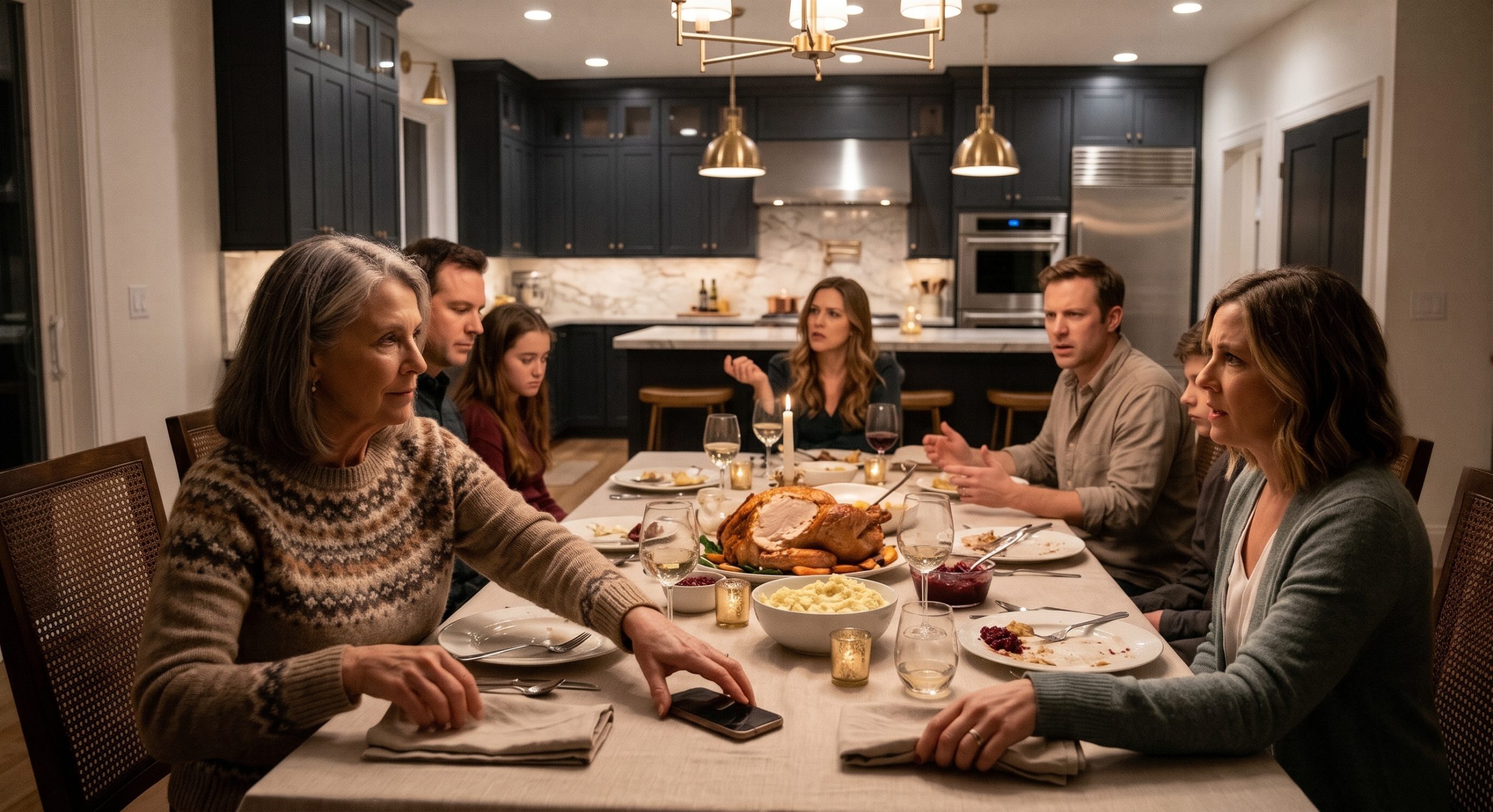
“Do you know how humiliating it was to be told in front of twelve people that I was begging for money?”
She didn’t respond.
“Margaret, I didn’t want to discuss this at Thanksgiving. I tried to speak privately. I tried messages. I tried waiting. Nothing worked.”
“You could have been more understanding.”
“I was understanding for eight months.”
“We have expenses!”
“So do I.”
“Your house is paid off!”
I closed my eyes.
There it was again.
The assumption that because Tom and I had worked hard, saved carefully, and paid off our mortgage, my money belonged to everybody who needed it.
“Margaret,” I said slowly, “my house is paid off because your father and I worked for forty years. It is not an invitation for you to spend my retirement.”
She became quiet.
Then her voice changed.
“You’re really going to do this?”
“I’m going to ask you to honor what we agreed.”
“Fine.”
She hung up.
I stared at the phone.
I had expected anger.
I had expected tears.
But I had not expected the strange emptiness that followed.
I went downstairs, heated some soup, and ate alone.
It was the first evening in a long time that I didn’t check whether one of my children needed anything.
And it was also the first evening in a long time that I slept peacefully.
Three days later, David came to my house.
He arrived around six in the evening, wearing his work jacket and carrying a paper bag from a bakery.
I opened the door.
“Hello, David.”
“Hey, Mom.”
He held up the bag.
“I brought those cinnamon rolls you like.”
I stepped aside.
“Thank you.”
He walked into the kitchen and placed the bag on the counter.
For a moment, he looked almost like the little boy who used to come home from school and place his backpack beside the refrigerator.
Then he saw the blue folder.
His expression changed.
“So it’s true.”
“What is?”
“You’re going after everybody for money.”
I pulled out a chair.
“Sit down.”
He remained standing.
“Mom, I know I owe you money. But I never thought you’d turn this into some kind of legal situation.”
“I haven’t sued anyone, David.”
“Yet.”
I looked at him.
“Do you remember when I gave you $8,500 for your car?”
“Yes.”
“Do you remember promising to repay it?”
He rubbed the back of his neck.
“Yeah.”
“How much have you repaid?”
He looked toward the window.
“I’ve had a lot going on.”
“I know.”
“My rent went up. Work has been difficult. Then the transmission went.”
“I understand that life is expensive.”
“Then why are you making this so difficult?”
I folded my hands.
“Because I am sixty-eight years old, David. I am retired. I have a furnace that needs replacing, a house that needs maintenance, and savings that are supposed to support me for the rest of my life.”
He looked at me.
For the first time, I saw something other than irritation in his expression.
Concern, perhaps.
But it disappeared quickly.
“You’re not broke, Mom.”
“No. But I am not an endless source of money.”
He sat down.
Then he leaned forward.
“Can I ask you something?”
“Of course.”
“Did you tell Sarah about the credit-card charges?”
“She received her own statement.”
“She’s saying you included things she never bought.”
“Then she can identify the transactions she disputes.”
David looked uncomfortable.
“Mom, I think you should be careful. Margaret is really upset. She says she’s thinking about cutting back on visits.”
I looked at him.
“Is that what she told you?”
“Yeah.”
I nodded slowly.
“Well, I hope she changes her mind. I love seeing the children.”
“Then maybe you should apologize.”
I stared at him.
“For asking about money I lent her?”
“For embarrassing her.”
I looked down at my hands.
Then I raised my eyes.
“David, when did you become more concerned about your sister’s embarrassment than your mother’s financial security?”
He opened his mouth.
Nothing came out.
I continued.
“I am not asking you to choose sides. I am asking you to understand that I am a person, not just your mother. I have bills. I have worries. I have a future to protect.”
He looked at the floor.
For several seconds, neither of us spoke.
Then he stood.
“I don’t think we’re going to agree.”
“Maybe not today.”
He picked up his jacket.
At the doorway, he stopped.
“Are you still coming to the kids’ Christmas concert?”
My heart softened.
“Of course I am.”
“Good.”
He hesitated.
Then he walked out.
I watched his car disappear down the street.
I wanted to call him back.
I wanted to tell him that I was sorry for making things difficult.
But I didn’t.
Because I was beginning to understand something important.
An apology should not be the price of being allowed to protect yourself.
The following Saturday, something unexpected happened.
Sarah called.
She was crying.
“Mom?”
“What’s wrong?”
“I need to ask you something.”
“All right.”
“Did you really remove my card?”
“Yes.”
“All of them?”
“Yes.”
She sniffed.
“Well, I tried to buy groceries this morning, and my other card was declined too.”
I frowned.
“What do you mean?”
“I mean the account I use for my monthly expenses.”
I sat down.
“Sarah, I don’t have access to your personal bank account.”
“I know, but…”
She stopped.
“What happened?”
She took a breath.
Then she said something that made my stomach tighten.
“Mom, I think there’s a bigger problem.”
“What kind of problem?”
“I checked my credit report.”
I waited.
“And there are accounts I don’t recognize.”
I gripped the phone.
“What accounts?”
“Two credit cards. One opened last year and another about six months ago.”
My heart began beating faster.
“Are they connected to me?”
“I don’t know.”
“Sarah, what do you mean you don’t know?”
She started crying again.
“I thought they were just cards for the family. Margaret said everything was being handled.”
I stood up.
“Margaret said what?”
There was a long silence.
Then Sarah whispered:
“Mom, I think Margaret has been using more than just your credit card.”
I felt the room grow cold.
“Sarah, I need you to explain exactly what you’re talking about.”
She took a shaky breath.
“Can I come over?”
“Yes.”
“Today?”
“Yes. Come whenever you can.”
She hung up.
I remained standing in the kitchen, staring at the phone.
For months, I had believed the problem was simple.
My daughter had borrowed money, failed to repay it, and become angry when I asked about it.
But now Sarah was telling me there might be something else.
Something that involved credit accounts.
Something that Margaret had supposedly been handling.
I looked toward the blue folder on the table.
Then I heard a car pull into the driveway.
I expected Sarah.
Instead, I saw Margaret’s SUV.
She got out, slammed the door, and walked toward my front entrance.
She was carrying a thick envelope.
When I opened the door, she pushed past me without waiting for an invitation.
“Mom, we need to settle this before Sarah says something she doesn’t understand.”
I stared at her.
“What did you do, Margaret?”
Her eyes widened.
Then she looked toward the blue folder on the kitchen table.
For the first time since Thanksgiving, my daughter looked genuinely frightened.
“Please,” she whispered. “You have to listen to me before you call anyone.”
I slowly closed the front door.
“Then I suggest you start telling me the truth.”
Margaret placed the envelope on my kitchen table.
And when she opened it, I saw a document with my name printed across the top.
It was a loan application.
But I had never applied for that loan.
And beneath my name was a signature that looked almost exactly like mine.
Almost.
I stared at the signature on the loan application, and for several seconds, I couldn’t breathe.
It looked like mine.
The same capital E. The same long curve beneath the W. Even the little mark I always made at the end of my last name.
But I had never signed that document.
I slowly lifted my eyes toward my daughter.
“Margaret, what is this?”
She pulled out a chair and sat down.
“Mom, please don’t overreact.”
I almost laughed.
Don’t overreact?
There was a loan application bearing my name, a signature I hadn’t written, and my daughter was asking me not to overreact.
“Where did you get this?”
“From the bank.”
“Which bank?”
She hesitated.
“First National.”
I looked at the document again.
It listed a personal loan of $32,000.
The application showed my name, my address, my date of birth, and several other personal details.
At the bottom was a signature authorizing the lender to review my credit history.
I turned the page.
There was another document.
And another.
“How many accounts are there, Margaret?”
She pressed her lips together.
“I don’t know.”
“Don’t tell me you don’t know.”
“Mom, I was going to fix it.”
“Fix what?”
She looked down.
Then she whispered something that made my stomach turn.
“The loan was supposed to help us get through the renovation.”
I sat down opposite her.
“Why is my name on it?”
She began twisting her wedding ring.
“Because your credit was better.”
I stared at her.
“What?”
“Mark and I had some financial difficulties. The contractor needed the money, and the bank wouldn’t approve us for enough. I thought we could use your information temporarily.”
“Use my information?”
She nodded.
“Just until we got everything sorted out.”
I felt my hands becoming cold.
“Did you tell the bank I had agreed to borrow $32,000?”
She didn’t answer.
“Margaret, look at me.”
Her eyes filled with tears.
“Yes.”
The word was barely audible.
I stood up and walked toward the window.
For a moment, I couldn’t recognize the woman sitting at my kitchen table.
This was the same little girl I had once carried through a hospital corridor when she had a fever.
The same daughter whose school lunches I had packed for twelve years.
The same woman I had helped with $15,000 because she said she needed her mother’s help.
And now she was sitting in my house explaining why she had used my identity to obtain a loan.
“Did you sign my name?”
She began crying.
“I was going to tell you.”
“Did you sign my name?”
“Yes.”
I closed my eyes.
The room became painfully quiet.
Then I asked the question I was afraid to ask.
“Did Mark know?”
She wiped her cheeks.
“He knew about the loan.”
“Did he know you used my signature?”
She looked away.
“I don’t know what he knew.”
I turned around.
“That isn’t an answer.”
“He knew we were using your information.”
I slowly returned to my chair.
“How much money?”
She hesitated.
“Thirty-two thousand.”
“And the other accounts Sarah mentioned?”
Margaret looked confused.
“What accounts?”
“Sarah found two credit cards she doesn’t recognize.”
