PART 5
Marcus eventually admitted to forging documents and making unauthorized transfers.
The court ordered him to return the assets that had been improperly transferred where recovery was possible.
He also faced criminal consequences for the fraudulent activities.
I won’t pretend I enjoyed watching it happen.
He was still my brother.
We had once shared a bedroom.
We had played football in the backyard.
We had built terrible treehouses and argued over video games.
There were memories I couldn’t erase.
But memories didn’t make his actions acceptable.
My mother eventually sold the family home.
The house where I had grown up.
The house where I had once stood holding an engagement ring while my mother told me Sarah was never meant for me.
She moved into a smaller apartment near my aunt.
I didn’t stop her.
I didn’t celebrate her losing the house.
I simply refused to rescue her financially.
For years, she had taught Marcus that someone else would always clean up his mess.
I wasn’t going to continue that tradition.
As for Sarah, her divorce was finalized.
She and Oliver moved into a modest home closer to her workplace.
She found a job managing operations for a regional business.
She also began rebuilding her life.
One afternoon, I received a letter from her.
It wasn’t long.
She thanked me for not humiliating her at the reunion.
She apologized again for believing Marcus.
And she told me that Oliver had started asking about the man with the shiny car.
At the end, she wrote:
I hope you find someone who never makes you question whether you’re worthy of being loved.
I folded the letter and placed it inside my desk.
I wished her well.
That was enough.
Then something unexpected happened.
Marcus’s attorney contacted mine.
Marcus wanted to send me a personal apology.
I initially refused.
But after thinking about my father’s letter, I agreed to receive it.
A week later, an envelope arrived.
Inside was a single handwritten page.
Thomas,
I know you probably hate me.
I don’t expect forgiveness.
I spent most of my life believing that if you succeeded, it meant I had failed. I watched Dad praise you, and instead of becoming a better person, I became obsessed with taking things away from you.
I told myself you had everything.
I never considered that you were working for it.
I destroyed your relationship with Sarah because I wanted something you had. I destroyed your career opportunity because I couldn’t stand the idea of you moving forward while I remained behind.
I have no excuse.
I am sorry.
Marcus.
I read it twice.
Then I placed it inside a drawer.
I didn’t call him.
I didn’t write back.
An apology was a beginning, not a magical eraser.
If Marcus wanted to become a better person, he could do that without expecting me to stand beside him.
One year after the reunion, Apex Systems opened a new research and development center.
We had grown to more than 1,200 employees.
Our software was being used by major logistics companies across the country.
We had also started a foundation supporting young people from disadvantaged backgrounds who wanted to study engineering, computer science, and business.
I named it the Richard Bennett Future Foundation.
My father’s name.
His belief in building something meaningful.
The first scholarship program supported twenty students.
I personally attended the opening ceremony.
Standing on the stage, looking at those young faces, I remembered the boy I had been.
The boy who built robots in his bedroom.
The boy who won scholarships and received little more than a nod from his mother.
The boy who thought losing everything meant his life was over.
I wished I could go back and tell him something.
That being rejected by the wrong people didn’t mean he was unworthy.
That sometimes walking away was the beginning of finding yourself.
After the ceremony, a young student approached me.
He was seventeen and carried a small notebook.
“Mr. Bennett?”
“Yes?”
“I read your interview in the business magazine. You started your company after losing your job, right?”
I smiled.
“That’s part of the story.”
He looked nervous.
“I’m working on a robotics project. My family thinks it’s a waste of time. They say I should choose something more practical.”
I looked at the notebook in his hands.
“What do you think?”
He shrugged.
“I think it could work.”
“Then keep working on it.”
He smiled.
“But what if I fail?”
I placed a hand on his shoulder.
“Then you’ll learn something that you couldn’t have learned by quitting.”
He nodded.
Before he walked away, I gave him my business card.
“Send me your project when you’re ready. Our engineering team has a mentorship program.”
His eyes widened.
“Really?”
“Really.”
He thanked me and ran back toward his friends.
I watched him disappear into the crowd.
And I realized something.
My father had been right.
I didn’t need to spend my life proving I was better than Marcus.
I could use what I had built to help someone else become better than their circumstances.
That evening, I drove home in my Aston Martin.
The custom obsidian paint reflected the city lights.
For years, I had thought the car would be the perfect symbol of my success.
But now I understood that it was just a machine.
A beautiful one.
An expensive one.
But still just a machine.
The real achievement was the life I had built around it.
I pulled into my driveway.
My phone rang.
It was an unfamiliar number.
I answered.
“Hello?”
A small voice came through.
“Mr. Thomas?”
I recognized it.
“Oliver?”
“Hi!”
I smiled.
“Hey, buddy. How are you?”
“Good! Mom said I could call you.”
I glanced at the clock.
“Is everything okay?”
“Yes. I just wanted to ask if you could come to my school science fair next month.”
I laughed softly.
“Your science fair?”
“I made a robot. It can move things.”
“That sounds impressive.”
“It doesn’t work all the time.”
“Neither do some very expensive machines.”
Oliver laughed.
Then he became quiet.
“Mom said you’re busy.”
I leaned back in my seat.
“I’ll see what I can do.”
“Okay. Bye!”
“Bye, Oliver.”
The call ended.
I sat in the driveway for a moment.
Then I looked at the family photograph on the dashboard.
It was a picture of my father and me when I was about ten.
We were standing beside a little wooden boat he had helped me build.
He was smiling.
I was holding a screwdriver.
I had kept that photograph through eight years of sleeping in motels, building a company, and becoming someone my family never expected me to become.
And now, for the first time, I felt completely at peace.
Three years after that first reunion, my mother sent another invitation.
This time, it was for a small family gathering at my aunt’s house.
There was no mention of Marcus.
No emotional speech.
No dramatic promises.
Just a simple message.
Thomas, if you would like to come, we would be happy to see you.
I stared at it for a while.
Then I replied.
I’ll come.
When I arrived, my mother was standing on the porch.
She looked older.
Her hair had turned almost completely gray.
She approached me slowly.
“Hello, Thomas.”
“Hello, Mom.”
For a moment, we simply looked at each other.
Then she said something I never expected.
“I don’t know whether you will ever forgive me.”
I didn’t answer immediately.
She continued.
“I spent years telling myself I was protecting Marcus. I thought he needed me more. I thought you were strong enough to manage on your own.”
She looked down.
“I confused your silence with not needing anyone.”
I swallowed.
“Mom, I needed you too.”
Her eyes filled.
“I know.”
“No, I don’t think you understood that.”
She nodded.
“You’re right.”
She didn’t make excuses.
She didn’t mention money.
She didn’t ask me to help Marcus.
She simply stood there and accepted what I said.
Then she asked quietly.
“Can I hug you?”
I hesitated.
Not because I hated her.
But because I wasn’t sure what I was ready to give.
Finally, I stepped forward.
We hugged.
It wasn’t the embrace of a perfect mother and son.
It was awkward.
It was brief.
It carried years of disappointment.
But it was honest.
And for that day, it was enough.
Inside, I saw Sarah and Oliver.
Sarah smiled.
“Thomas.”
“Sarah.”
Oliver ran toward me.
“You came!”
I laughed.
“Of course I came. I promised to see your science project.”
He proudly pulled me toward the dining room.
On the table was a small robot made from plastic wheels, wires, and a collection of colorful components.
It wasn’t particularly sophisticated.
One wheel was slightly crooked.
A wire hung loose near the battery.
But when Oliver pressed a button, the little machine moved across the table and pushed a wooden block into a cardboard box.
He jumped excitedly.
“It worked!”
I clapped.
“That is excellent engineering.”
Sarah laughed.
“He’s been working on it for weeks.”
Oliver looked at me.
“Can I make a bigger one?”
I crouched beside him.
“You can make anything you are willing to work for.”
He smiled.
And as I watched him explain every little detail of his creation, I remembered my own childhood.
I remembered the robotics project Marcus had destroyed.
I remembered how my mother had told me I should have put it somewhere safer.
For a moment, the memory hurt.
Then it passed.
Because the little boy standing in front of me deserved something better.
He deserved adults who encouraged him.
Adults who listened.
Adults who didn’t turn love into a competition.
I looked at Sarah.
“Does he want to learn programming?”
Her smile widened.
“Every day.”
I handed her a business card.
“Tell him to apply for our summer engineering program when he’s old enough.
We’ll make sure he gets a fair opportunity.”
Sarah’s eyes filled.
“Thank you.”
I nodded.
“Don’t thank me. He built the robot.”
Oliver grinned.
“I’m going to make a robot that drives a real car!”
I laughed.
“Then I might have to hire you someday.”
Everyone laughed.
Even my mother.
For the first time in many years, the family gathering didn’t feel like a competition.
There was no golden child.
No shadow.
No performance.
Just people trying, imperfectly, to move forward.
Marcus wasn’t there.
He was living separately and continuing to deal with the consequences of his actions. We had not rebuilt our relationship, and I wasn’t going to pretend that everything was suddenly fixed.
Maybe one day we would speak again.
Maybe we wouldn’t.
I had finally learned that forgiveness did not require giving someone another opportunity to hurt me.
And family did not automatically mean access to my life.
That evening, I drove home alone.
The city lights stretched across the windshield.
My phone rested beside me.
There were messages from employees, business partners, and friends.
There was also a photograph Sarah had sent.
It showed Oliver standing beside his little robot.
The caption read:
He says thank you for believing in his project.
I smiled.
Then I pulled into my driveway.
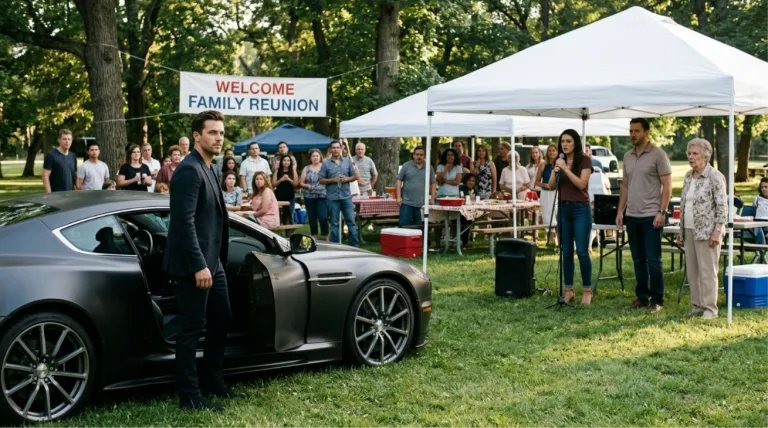
The same Aston Martin that had caused everyone to stop talking at the reunion sat quietly beneath the garage lights.
I remembered the day I drove into Centennial County Park.
I remembered my mother’s frozen expression.
Marcus’s fear.
Sarah’s shaking hands.
The documents.
The accusations.
The truth.
For a long time, I had believed that the greatest moment of my life would be the day my family finally discovered what I had become.
I thought I wanted them to see the expensive car, the company, the success, and the money.
I thought I wanted them to regret treating me like I was nothing.
But standing in my garage, I realized something.
The greatest moment wasn’t when Marcus saw my car.
It wasn’t when my mother discovered my company.
It wasn’t when the entire family learned that I had become wealthy.
It was the morning I woke up in my own home, made coffee, and realized I no longer cared what any of them thought about me.
I had built a life that didn’t depend on their approval.
I had learned to love without begging.
To help without being used.
To forgive without forgetting.
And to walk away without feeling guilty.
I took my father’s letter from the drawer in my office.
I had framed one sentence from it.
Build a life so full that you no longer need an apology.
I looked at those words for a long time.
Then I turned off the office light.
Eight years earlier, I had left home with a broken heart, a duffel bag, and $800.
My family thought I had disappeared because I was ashamed.
They were wrong.
I disappeared because I needed to find out who I was without them.
And I did.
I wasn’t the unsuccessful younger brother.
I wasn’t the man who had been betrayed.
I wasn’t the person my mother had described.
I was Thomas Bennett.
A man who had lost almost everything and still found a reason to build something meaningful.
And that was worth more than any inheritance, any company, or any custom-built car.
Because the greatest revenge isn’t making the people who hurt you watch you succeed.
It’s reaching a point where their opinion no longer matters.
And for the first time in eight years, I was finally home.


One Comment on “PART 5 – My Brother Stole My Fiancée With Fake Evidence, My Mother Took His Side, and I Disappeared for 8 Years—Then I Returned in a $250K Aston Martin”