PART 3
“She called me back. She put a warm tray in front of me, with mashed potatoes, chicken, green beans, and a dinner roll. Then she leaned over and whispered, ‘Daniel, sweetheart, I made too much again. If you don’t help me eat this, I’m going to have to throw it away.’”A few people in the hallway laughed softly through their tears.
Daniel shook his head.“She said that every time. Every single time I was hungry.”
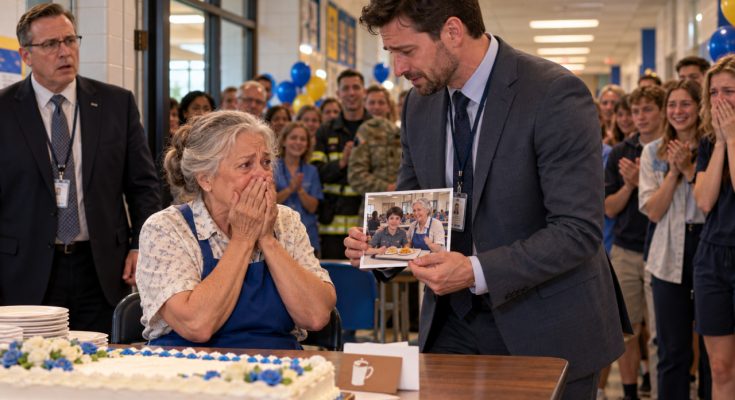
He reached into his jacket and pulled out a small, faded photograph.
“I kept this for thirty years.”
He turned toward Dr. Whitfield.
“And today, I heard that you gave her a ten-dollar gift card after forty-two years of service.”
The principal’s face tightened.
“Mr. Brooks, I appreciate the sentiment, but this is an internal school event. We have procedures for retirement celebrations, and—”
“I’m not finished, sir.”
Daniel’s voice wasn’t loud, but it stopped the principal in his tracks.
“Last year, our hospital hired twenty-three nurses, seven technicians, and four administrative employees who graduated from this school. I know their stories because many of them told me the same thing.”
He turned toward the hallway.
“Would you please come forward?”
A woman in blue hospital scrubs stepped out of the crowd.
Then another.
Then a man with a neatly pressed uniform.
One by one, they moved into the break room.
A nurse named Angela spoke first.
“My mother was in prison when I was thirteen. I lived with my grandmother, who was sick and couldn’t always get out of bed. Miss Bernie used to save me a container of soup to take home. She told everyone it was leftover food, but I knew she was making extra.”
Another woman stepped forward, holding the hand of a little boy.
“I was in foster care. I changed homes three times in one school year. I never knew where I’d be sleeping next month, but I knew that every day at noon, somebody would look me in the eye and ask how I was doing.”
She looked at Mom.
“You remembered my birthday when my own family forgot it.”
Mom began crying.
Not the quiet tears she had wiped away when the principal handed her that envelope.
These were different.
These were the tears of someone who had spent forty-two years giving pieces of herself away and had never expected anyone to notice.
“She told me to use the money to take my mother out to dinner instead.”
Another man spoke from behind him.
“She helped me study for my GED after I dropped out. She wasn’t even supposed to be tutoring anybody. She just stayed late in the cafeteria with me because she said smart people sometimes need a second chance.”
A woman holding a baby wiped her cheeks.
“She taught me how to make the chicken soup she used to serve us. When my daughter was born prematurely, I sat beside her hospital bed and fed her that soup every day because it reminded me that somebody had once taken care of me.”
The stories kept coming.
A man who owned a construction company remembered Miss Bernie buying him winter gloves when he showed up at school with his fingers turning blue.
A woman who now ran a successful accounting firm remembered being the only student who couldn’t afford the class trip. Miss Bernie had quietly handed her an envelope with the money and told her it came from a school fundraiser.
Years later, she discovered that there had never been a fundraiser.
A retired police officer said Miss Bernie had helped him apply for a scholarship after his father died.
A mother explained that Miss Bernie had noticed her son coming to school with bruises and had quietly alerted the counselor, helping the family find support before things got worse.
A teacher admitted that Miss Bernie had once paid for groceries for a student whose family had lost their home in a fire.
And then a man wearing an Army uniform stepped forward.
He stood straight, his hands clasped behind his back.
“My name is Sergeant Michael Hayes. I graduated in 2003.”
He looked at Mom with the kind of respect usually reserved for someone who had saved a life.
“When my brother died, I stopped eating. I stopped talking to people. I started skipping class because I couldn’t stand hearing everyone complain about problems that seemed so small compared to mine.”
His jaw tightened.
“Miss Bernie never forced me to talk. She just put a plate in front of me and sat nearby. Sometimes she didn’t say anything for twenty minutes. She just made sure I ate.”
He took a breath.
“The last thing she told me before I enlisted was, ‘Michael, you don’t have to be strong every minute of every day. Just don’t give up on yourself.’”
He looked down briefly.
“I carried those words overseas. There were nights when I thought I couldn’t take another step. I remembered them.”
Then he faced Mom again.
“I’m here today because I wanted you to know that the kindness you gave a grieving boy followed him all the way around the world.”
By then, the teachers in the break room had stopped pretending not to cry.
Even the ones who had only known Mom for a few years stood quietly, realizing how much of her life they had never truly understood.
Dr. Whitfield shifted uncomfortably near the doorway.
“Look,” he said, forcing a smile, “this is clearly a wonderful tribute. And nobody is questioning Miss Bernice’s kindness. But we have to consider the practical realities of running a school. Budgets, staffing, efficiency—”
A voice from the back interrupted him.
“Then let’s talk about the budget.”
The crowd parted.
An older man in a dark navy suit walked forward, carrying a leather folder.
I recognized him immediately.
Thomas Caldwell.
He was the president of the local community bank, a former student at the high school, and one of the most successful businessmen in our town.
He had graduated in 1989.
He stopped beside Daniel and opened his folder.
“I’ve been listening to these stories for the past three months,” he said. “Because I started asking questions about Miss Bernie after I heard the school was replacing the kitchen with vending machines.”
Dr. Whitfield straightened his jacket.
“Mr. Caldwell, with respect, the cafeteria contract was approved through the appropriate administrative channels.”
“I’m sure it was,” Caldwell replied. “But I don’t think anyone considered what the school would be losing.”
He turned toward Mom.
“Miss Bernie, do you remember a boy who used to sit alone at the table near the windows? The one who always brought a stack of library books to lunch?”
Mom wiped her cheeks.
“Thomas?”
He smiled.
“You remembered.”
“Of course I remembered you, sweetheart.”
Thomas looked down at his folder.
“My father lost his business when I was fourteen. We went from living in a big house to sharing a two-bedroom rental with my aunt. I was angry at everybody. I nearly quit school.”
He paused.
“One afternoon, I told Miss Bernie I wasn’t coming back after Christmas. She asked me why. I told her school wasn’t going to change anything for a kid like me.”
He looked up.
“She handed me an apple and said, ‘Thomas, you don’t get to decide how your whole life ends just because you’re having a difficult chapter.’”
He laughed softly.
“I thought she was just a cafeteria worker giving me life advice.”
Then his expression grew serious.
“Thirty-seven years later, I own a bank. I’ve helped hundreds of families buy homes, start businesses, and recover from financial disasters. I employ people who once believed their lives were over.”
He closed the folder.
“And I have spent the last three months speaking with former students, local business owners, and community organizations. We have a proposal.”
Dr. Whitfield frowned.
“What kind of proposal?”
Thomas turned toward the crowd.
“Raise your hands if Miss Bernie ever helped you with a meal, a school expense, a personal crisis, or something you were too embarrassed to ask anyone else for.”
Nearly every hand in the hallway went up.
Hundreds of hands.
Some belonged to people in expensive suits. Others belonged to workers with rough hands and worn shoes. Some belonged to parents holding small children.
They had become doctors, teachers, electricians, nurses, soldiers, mechanics, business owners, and parents.
But for a moment, they were all teenagers again.
Teenagers who had once stood in a lunch line, hoping nobody would notice they had nothing to pay with.
Thomas looked back at the principal.
“We’re establishing the Miss Bernie Student Meal and Opportunity Fund. It will cover emergency meals, school supplies, transportation assistance, and other basic needs for students who are struggling financially.”
