PART 5
A ninth-grade boy whose father had lost his job received meal assistance without being singled out in front of his classmates.
A young girl who needed transportation to school was given a bus pass.
Another student received supplies for a technical program she had been afraid to apply for because her family couldn’t afford the equipment.
And the organizers kept one rule that Mom insisted upon.
No child would have to stand in a special line to receive help.
Every student deserved to eat without being embarrassed.
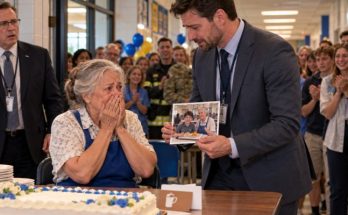
At the ceremony, Thomas announced that donations had reached $425,000, including the initial commitments and additional contributions from former students and local businesses.
She looked uncomfortable with all the attention.
Then Daniel took the microphone.
“Before we celebrate the money raised, I want everyone to understand something. Money can buy food. It can buy books. It can open doors. But Miss Bernie taught us something money alone cannot teach.”
He looked toward her.
“She taught us that the person standing in front of us is never just a problem to solve or a number in a budget. That person has a story. And sometimes, the smallest act of kindness becomes the reason they keep going.”
He paused.
“I became a surgeon because people gave me opportunities. But I survived the years before those opportunities because one woman made sure I didn’t go hungry.”
He turned toward the audience.
“If you remember nothing else today, remember this: we may never know what someone is fighting when they walk into a room. But we can decide whether they leave feeling smaller or feeling seen.”
The entire gym rose to its feet.
Mom covered her face and cried.
This time, she didn’t try to hide it.
A year later, I drove Mom back to the high school.
She had officially retired, but she visited twice a week as a volunteer adviser to the fund. She met students, reviewed requests for assistance, and worked with the staff to make sure no child slipped through the cracks.
The school had also restored a proper cafeteria meal program instead of replacing the kitchen entirely with vending machines.
When we entered the building, I heard familiar laughter coming from the lunchroom.
Mom stopped.
A young boy was standing near the serving counter, staring at the food.
He looked about fourteen.
His backpack was worn, and his sleeves were too short. He kept glancing toward the other students, then looking down at the tray in his hands.
Mom recognized that look immediately.
She walked over.
“Hello, sweetheart. What’s your name?”
“Ethan,” he murmured.
“Well, Ethan, I’m Bernie. Have you tried the chicken today?”
He smiled a little.
Mom leaned closer.
“And if you like the mashed potatoes, you can have a little extra. The cook made plenty today.”
The boy looked at her carefully.
“Do I have to pay?”
Mom’s face softened.
“No, sweetheart. You just have to eat.”
He stared at her for a moment, as though he wasn’t sure he had heard correctly.
Then he sat down and began eating.
Mom didn’t hover over him. She didn’t ask why he couldn’t pay. She simply sat nearby and talked about the weather, his classes, and whether he played any sports.
After a while, his shoulders relaxed.
When we left the cafeteria, I saw him laughing with another boy at the table.
I looked at Mom.
“You’re still doing it.”
She glanced at me.
“Doing what?”
“Making sure nobody feels alone.”
She smiled.
“Some things are too important to retire from.”
That evening, I asked Mom a question I had carried for years.
“Why didn’t you ever tell me how much money you spent feeding those kids?”
She sat quietly at the kitchen table.
“Because I didn’t want you to think we were struggling more than we were.”
“But you used your own money.”
“Sometimes.”
“How much?”
She shook her head.
“I never kept track.”
I thought about the receipts I had found after Dad passed away. The small purchases. The grocery bills. The occasional notes about buying food for students.
“You must have spent thousands of dollars.”
“Maybe.”
“Mom, why?”
She looked at me as if the answer were obvious.
“Because I knew what it felt like to worry about whether there would be enough food tomorrow.”
I had heard stories about her childhood, but never in much detail.
Her family had struggled when she was young. Her mother sometimes skipped meals so the children could eat. Neighbors helped when they could.
Mom had never forgotten the feeling of being hungry and pretending everything was fine.
“When I started working at that school,” she continued, “I recognized the signs. The children who drank water to make their stomachs feel full. The ones who said they weren’t hungry because they knew they couldn’t pay. The ones who took their time in line because they were hoping somebody might change their mind and let them have something.”
She looked out the window.
“I couldn’t fix every problem they had. But I could make sure they had lunch.”
I reached across the table and took her hand.
“I’m sorry I didn’t understand.”
She squeezed my fingers.
“You were busy building your own life. That’s all right.”
Then she smiled.
“And now you understand.”
I did.
More than I ever had before.
On the second anniversary of her retirement, the school invited Mom to speak to the graduating class.
She stood on the stage in the gymnasium where hundreds of former students had once gathered to honor her.
This time, the audience was filled with teenagers preparing to begin their own lives.
Mom didn’t bring notes.
She didn’t talk about the fund’s success or the money raised. She didn’t mention the principal’s apology or the newspaper articles.
She simply looked out at the students.
“Some of you will become doctors,” she began. “Some of you will become teachers, builders, business owners, artists, parents, or people who are still trying to figure out what you want to do.”
A few students laughed.
“And some of you may have difficult days. You may feel like nobody notices you. You may look around and believe that everybody else has more money, more opportunities, or more reasons to be hopeful than you do.”
She paused.
“If that happens, please remember that your life is not decided by your hardest day.”
The gym grew quiet.
“You don’t have to become rich or famous to matter. You don’t have to wait until you’re successful to be kind. And you don’t have to change the whole world to make a difference in it.”
She looked toward the graduates in the front row.
“Sometimes, making a difference means sharing your lunch. Sometimes, it means helping a classmate with homework. Sometimes, it means sitting beside someone who is having a terrible day and letting them know they don’t have to face it alone.”
Her voice trembled slightly.
“For forty-two years, I served lunch in this school. I thought I was just feeding children.”
She smiled.
“Then one day, hundreds of those children came back and reminded me that we had been taking care of one another all along.”
The audience rose to its feet.
The applause continued long after Mom left the microphone.
As I watched her walk off the stage, I remembered that cheap grocery-store cake, the misspelled blue letters, and the ten-dollar gift card.
I remembered the principal’s words about nobody being irreplaceable.
He had been wrong.
Not because Mom was the only person who could serve lunch.
But because nobody else could have lived her forty-two years exactly as she had.
Nobody else could have remembered those names, noticed those empty trays, or offered those quiet acts of kindness in quite the same way.
Her job could be replaced.
Her impact could not.
And the greatest reward wasn’t the money, the applause, or the plaque bearing her name.
It was the fact that somewhere in that town, a hungry teenager could walk into school tomorrow, sit down with a warm meal, and believe that someone cared whether he was okay.
Mom had spent forty-two years making sure children never had to earn the right to be treated with kindness.
And now, thanks to the people whose lives she had touched, that kindness would continue long after she had hung up her apron.
As for the ten-dollar gift card, Mom eventually used it.
She bought herself a cup of coffee and a blueberry muffin.
Then she took the remaining balance and bought breakfast for a young man standing outside the coffee shop who had been counting coins in his palm.
When I asked her why she had done that, she laughed.
“Well, sweetheart, I had more than enough.”
And that was Miss Bernie.
She had always believed there was enough to share.
Sometimes, all it took was one person willing to prove it.

One Comment on “PART 5 – My Mom Served School Lunches for 42 Years—They Gave Her a $10 Gift Card, Then the Gym Doors Opened”