PART 4
“Our bank will provide the initial funding. Several local businesses have agreed to contribute. Daniel’s hospital will support students interested in healthcare careers. Other alumni have offered scholarships and paid internships.”
He glanced at Mom.
“And we want Miss Bernie to help us build the program, if she’s willing. Not as a cafeteria employee. Not as somebody expected to work for free. We want to offer her a paid community adviser position, with flexible hours, so she can help us make sure no student in this town feels invisible.”
Thomas smiled.
“You don’t have to say anything today. You’ve already said enough with forty-two years of actions.”
For the first time since the principal entered the break room, nobody was looking at Dr. Whitfield.
They were looking at Mom.
And I realized something that made my chest ache.
For forty-two years, she had stood behind a serving counter while thousands of people walked past her.
She had watched them grow up, graduate, leave town, and build lives of their own.
She had never asked what they would become.
She had simply hoped they would be okay.
Now they had come back to tell her.
And the story wasn’t finished yet.
Because Daniel Brooks still had one more thing to say.
He reached into his briefcase and removed a thick envelope.
“Miss Bernie, before we announce anything else, there’s something I think you should see.”
He handed it to her.
Mom opened it with trembling fingers.
Inside was a stack of letters.
Dozens of them.
Some were handwritten on yellowed paper. Others were printed emails. A few had photographs attached.
On the first page, in large letters, someone had written:
“To the woman who made sure we never went hungry.”
Mom began reading.
Then she pressed the letters against her chest and whispered the words that made the entire hallway fall silent.
“Oh, my goodness. You kept them?”
Daniel nodded.
“We all did, Miss Bernie. Every single one of us.”
And as the crowd moved closer, ready to tell her what those letters meant, Dr. Whitfield finally looked down at the ten-dollar gift card still lying on the table.
For the first time that afternoon, he seemed to understand that the smallest gesture in the room wasn’t the one Miss Bernie had given away.
It was the one he had offered her.
Mom opened the first letter with shaking hands.
It was written by a woman named Rebecca, who had graduated in 1998.
“Dear Miss Bernie, you probably don’t remember me. I was the quiet girl who sat alone every day. My mother was sick, and some nights we ate crackers for dinner. You never made me feel ashamed when I couldn’t pay for lunch. You told me that someday, when I was able, I should do the same for someone else. I’m a school counselor now. Every time I help a child who feels forgotten, I think of you.”
And another.
Some letters came from people who had become successful. Others came from people still struggling to make ends meet. One was written in a child’s handwriting, with a drawing of a lunch tray and a crooked red heart.
Every letter carried the same message.
You saw me when nobody else did.
I stood beside my mother, crying harder than I had in years.
For most of my life, I had believed Mom was simply a hardworking cafeteria employee who came home tired, washed her apron, and went back to work the next morning.
I hadn’t understood the size of what she was doing.
She had been feeding children, yes.
But she had also been giving them dignity.
And sometimes, dignity was the only thing they had left.
Then Daniel raised his hand.
“There’s one more announcement.”
The crowd quieted.
“Our hospital foundation has committed $100,000 to the Miss Bernie Student Opportunity Fund. That money will support emergency meals, school supplies, and scholarships for students who need help.”
The hallway erupted in applause.
Thomas Caldwell stepped forward.
“Our bank and several local businesses are contributing another $150,000 over the next three years.”
More applause followed.
A woman from the back called out, “I’ll donate ten thousand!”
Another voice answered, “My company will match that!”
Within minutes, people were offering money, supplies, transportation, and professional services.
But Mom raised her hand.
The crowd gradually became quiet.
She looked at Daniel, then Thomas, then the hundreds of faces filling the hallway.
“Please,” she said softly. “I appreciate all of this more than you know. But I don’t want anybody giving money just because they feel sorry for me.”
Thomas nodded respectfully.
“That’s not why we’re doing it.”
“Then promise me something,” Mom continued. “Promise me the money will go to the children. Not to fancy offices. Not to people sitting around having meetings. Make sure the children get fed.”
Daniel stepped forward.
“I promise.”
“And if a child comes to school hungry, don’t make them prove they’re poor before you give them a meal.”
Several people nodded.
Mom’s voice trembled.
“Sometimes the child who needs help the most is the one who is best at hiding it.”
For several seconds, nobody spoke.
Then Thomas closed his folder.
“That’s exactly why we want you involved.”
Mom looked down at the envelope containing the letters.
“I’ll help,” she said. “But I have one condition.”
“Anything,” Thomas replied.
“Let me meet the children. I don’t want to be somebody whose name is printed on a wall. I want to know whether they have enough to eat.”
Daniel smiled through his tears.
“Then we’ll make sure you do.”
The applause that followed was so loud that teachers in classrooms down the hall opened their doors to see what was happening.
And Dr. Whitfield?
He stood beside the break-room table, silent.
The ten-dollar gift card was still there.
Nobody had touched it.
The next Monday, the story spread across town.
Someone had recorded part of the gathering on a phone. By Sunday evening, the video had been shared thousands of times.
The headline on the local news read:
“After 42 Years Feeding Students, Cafeteria Worker Receives a Standing Ovation From Hundreds of Former Students.”
Reporters called the school. Alumni sent messages. Former students who had moved to other states began contacting the organizers to ask how they could contribute.
But Mom refused to give interviews at first.
“I’m not famous,” she told me. “I just made lunch.”
I smiled.
“Mom, you made a lot more than lunch.”
She shook her head.
“People are hungry in different ways, sweetheart. Some need food. Some need somebody to remember their name. Some need to hear that they still have a future.”
She paused while folding the kitchen towel in her hands.
“I was lucky enough to give them a little of what they needed.”
That was how she saw her entire life.
Not as a sacrifice.
Not as a heroic achievement.
Just as something a person ought to do when another person needs help.
Three weeks later, the school board held an emergency meeting after receiving hundreds of messages from parents and alumni.
The vending-machine contract was reviewed. Several board members admitted that they had focused too heavily on reducing costs without properly considering the effects on students who depended on school meals.
The school announced that it would reconsider its food-service plans and work with the community foundation to protect access to affordable, nutritious meals.
Dr. Whitfield was asked to explain his handling of the retirement celebration and the changes to the cafeteria.
He issued a public apology.
He admitted that his remarks about nobody being irreplaceable had been dismissive and disrespectful.
He also acknowledged that he had underestimated Miss Bernie’s impact on the school community.
Some people wanted him fired immediately.
Others said an apology wasn’t enough.
Mom, however, surprised everyone when a reporter asked whether she thought he should lose his job.
“No,” she answered. “I think he should learn something.”
The reporter blinked.
“After what happened?”
Mom nodded.
“People make mistakes. What matters is whether they become better after they realize they’ve hurt someone.”
She paused.
“But he should also understand that saving money means nothing if the children who need us are the ones who suffer.”
Those words became the most quoted part of her interview.
Not because they were cruel.
Because they were fair.
And because they came from a woman who had every reason to be bitter but had chosen not to be.
Two months later, the school held another ceremony.
This time, it wasn’t in the teachers’ break room.
It was in the gymnasium.
Every seat was filled. Alumni traveled from neighboring states. Parents brought their children. Former teachers returned, including several who had retired years earlier.
At the center of the stage stood a simple wooden plaque.
It read:
THE MISS BERNIE STUDENT CARE FUND
No student should ever have to choose between hunger and dignity.
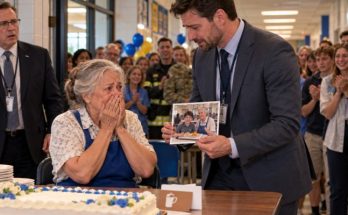
Beneath it was a photograph of Mom standing behind the old cafeteria counter, wearing her familiar white apron.
She had protested when they showed her the plaque.
“You didn’t need to put my picture up there.”
Daniel laughed.
“We know. That’s why we did it.”

One Comment on “PART 4 – My Mom Served School Lunches for 42 Years—They Gave Her a $10 Gift Card, Then the Gym Doors Opened”