She closed her eyes.
I cried when Dr. Ramirez told us.
Grace cried too.
But the doctor reminded us that benign didn’t mean harmless. The mass had caused significant symptoms and required treatment.
We were grateful that Grace had received care before more serious complications developed.
When Daniel learned the results, he sent a message.
“See? I told you it wasn’t cancer. Everyone overreacted.”
I read it twice.
Then I realized that he still didn’t understand.
The issue had never been whether the mass was cancerous.
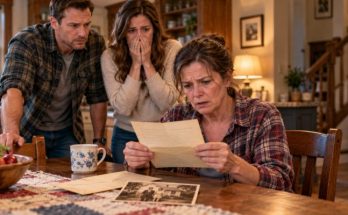
I brought copies of the medical records.
We sat across from each other at the kitchen table.
“Daniel, I need you to understand what happened.”
He sighed.
“Rebecca, I’ve already said I made a mistake.”
“A mistake is forgetting an appointment. You knew doctors recommended more tests, and you told Grace she was pretending.”
His expression tightened.
“I didn’t want her to panic.”
“She was already scared. You made her afraid to ask for help.”
For several moments, neither of us spoke.
Then I told him I needed space to decide what our marriage would look like moving forward.
I wasn’t prepared to continue living in a home where our daughter’s health concerns could be dismissed to avoid inconvenience.
Daniel looked shocked.
“Are you leaving me over one incident?”
I shook my head.
“No. I’m reconsidering our marriage because of the pattern this incident exposed.”
He stared at the table.
I explained that I would be staying with Claire temporarily while Grace recovered. I also planned to seek legal advice about medical decision-making and our parental responsibilities.
For once, Daniel didn’t argue.
The following weeks were difficult.
Grace needed time to heal physically and emotionally. She attended follow-up appointments, rested at home, and gradually returned to school.
I arranged counseling after she admitted that she still felt anxious whenever she experienced even minor discomfort.
She had learned to distrust her own body because someone she loved repeatedly told her that her pain wasn’t real.
Undoing that damage would take time.
Daniel began attending individual counseling after I insisted that apologies alone weren’t enough to rebuild trust.
He also wrote Grace a letter acknowledging that he had dismissed her symptoms and failed to arrange the recommended follow-up care.
I didn’t tell her she had to read it.
That decision belonged to her.
Eventually, she chose to open it.
Afterward, she came into the kitchen carrying the folded pages.
“Mom?”
“Yes, sweetheart?”
“How do you feel about that?”
She thought for a moment.
“I want to believe him. But I’m still mad.”
I put down the dish towel.
“It’s okay to feel both things.”
She looked relieved.
“I don’t have to forgive him right away?”
“No. You can take the time you need.”
She hugged me.
That evening, I realized how much our family had changed.
For years, I had believed that keeping our household together meant avoiding conflict.
Now I understood that a peaceful-looking home wasn’t necessarily a safe or emotionally healthy one.
Sometimes, protecting a child means asking uncomfortable questions, challenging someone you love, and refusing to accept reassuring words without evidence.
Two months after surgery, Grace returned to light physical activity with her doctor’s approval.
She was thrilled when she was finally allowed to attend volleyball practice again, even though she couldn’t participate fully at first.
I watched her from the bleachers.
She laughed with her teammates, tied her hair into a ponytail, and moved around the gym with a confidence I hadn’t seen in months.
After practice, she climbed into my car.
“Mom, can we get ice cream?”
I smiled.
“Absolutely.”
We stopped at a small shop near the school and ordered our favorite flavors.
As we sat outside, Grace suddenly became quiet.
“Can I ask you something?”
“Anything.”
“Why didn’t Dad believe me?”
I looked at her carefully.
I could have made excuses.
I could have told her he was stressed or tired or worried about money.
But she deserved honesty.
“Your dad made a serious mistake. He decided what he wanted to believe instead of listening to what you were telling him.”
Grace stared at her ice cream.
“Was it because I complain too much?”
I reached across the table.
“No, sweetheart. His choices were not your fault.”
She nodded slowly.
Then she asked, “What if something hurts again?”
I smiled gently.
“Then you tell me, and we get the help you need.”
She looked directly into my eyes.
“Even if Dad says it’s nothing?”
“Even then.”
A small smile appeared on her face.
“Okay.”
That single word meant more to me than she could possibly understand.
Our future as a family remains uncertain.
Daniel has begun taking responsibility, but trust doesn’t return simply because someone finally acknowledges what they did wrong.
Grace’s well-being will remain my priority, regardless of what happens to our marriage.
I still remember the moment Dr. Collins turned the monitor toward me and showed me the medical record from five weeks earlier.
I remember the date.
I remember Daniel’s name listed as the accompanying parent.
And I remember looking at my daughter, realizing she had been carrying not only physical pain but also the belief that nobody would take her seriously.
That was the part that hurt most.
Not the hospital bills.
Not the missed appointments.
Not even the fear of surgery.
It was knowing that my fifteen-year-old daughter had learned to hide her suffering because she believed asking for help made her a burden.
Today, Grace is recovering well. Her laughter has returned, and she’s beginning to trust herself again.
Last weekend, I found her sitting at the kitchen table, sketching in her notebook.
She showed me a drawing of a girl standing beneath a storm cloud, holding a bright yellow umbrella.
“What does it mean?” I asked.
Grace smiled.
“It’s about learning that you don’t have to stand in the rain just because somebody says you’re not getting wet.”
I stared at the drawing.
Then I hugged her.
Because in that moment, I understood that my daughter had learned something far more important than either of us expected.
Pain doesn’t become imaginary because someone refuses to believe it. And a child’s suffering doesn’t become less serious because an adult finds it inconvenient.
My husband had known about the recommended follow-up for five weeks.
He had chosen silence.
My daughter had chosen silence because she was afraid of his reaction.
And I had nearly allowed that silence to continue because I wanted to believe everything was fine.
But the day I took Grace to the hospital, that silence finally ended.
The doctor discovered the medical problem. The hidden records revealed the broken trust. And my daughter learned that her voice deserved to be heard.
If there is one promise I will keep for the rest of my life, it is this:
No matter how small her voice becomes, no matter who dismisses her, and no matter how inconvenient the truth may be, I will never again allow my daughter to believe she has to suffer quietly to deserve love.

One Comment on “Final Part-My Husband Said Our 15-Year-Old Daughter Was Faking Her Pain—Then the Doctor Asked How Long He’d Known”