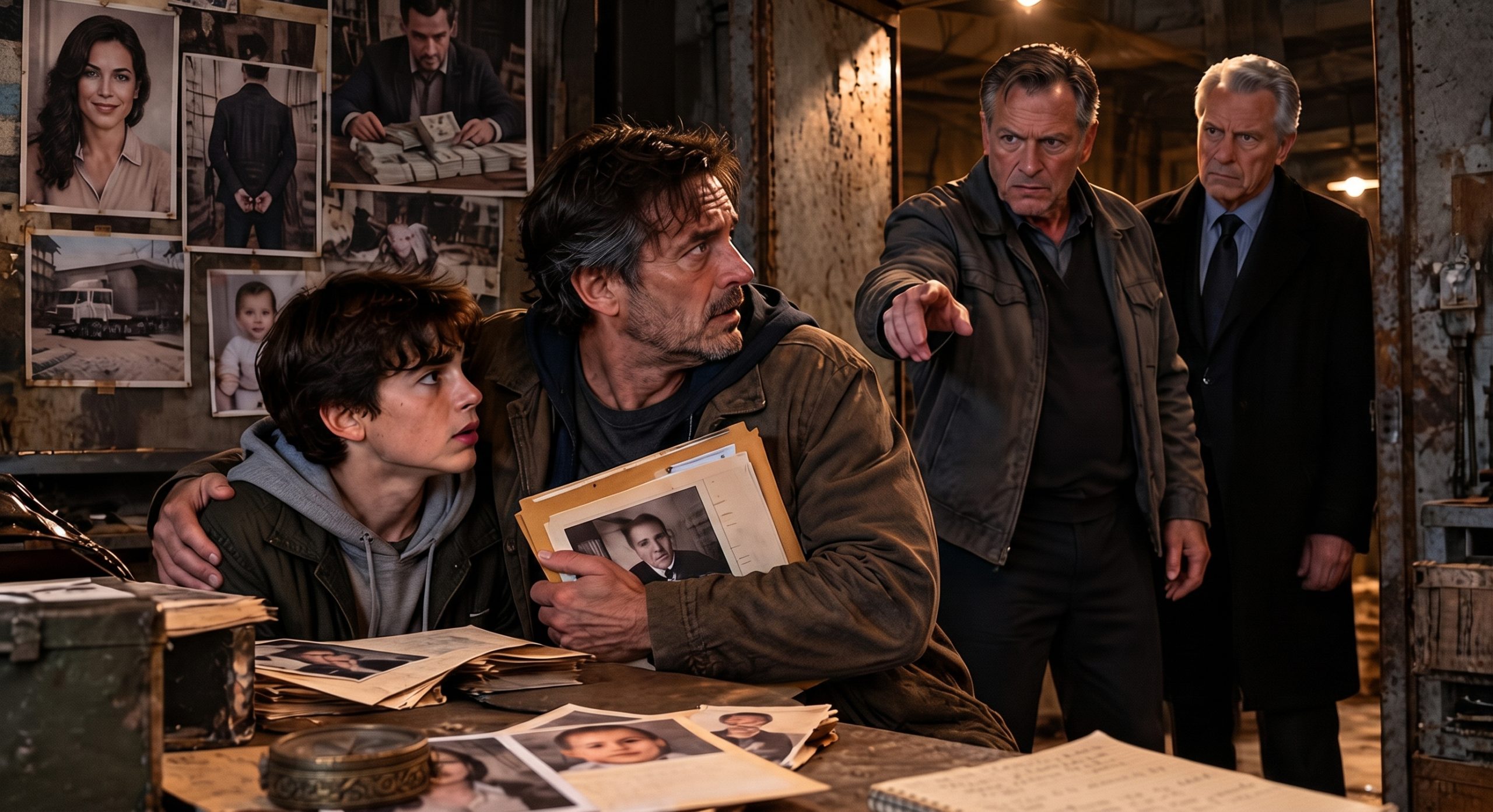
My uncle whispered a name.“Frank Malone.”
My father’s older brother.
My uncle had always told me that Frank moved away years ago after a bitter argument over the family business. My grandmother never spoke about him. Whenever I asked my mother, she changed the subject.
Now I understood why.
Frank looked around the abandoned office and gave a small, humorless smile.
“Raymond,” he said. “You always were a sentimental fool. I told you to burn this place years ago.”
Raymond tightened his grip on the folder.
“You spent eleven years in prison, and you still haven’t learned when to stop talking.”
My father stepped closer.
“Give me the folder, Raymond. This doesn’t concern David.”
My uncle finally turned toward him.
“Doesn’t concern David?” he repeated. “His name is on every page.”
I looked down at the yellow folder in my hands. My fingers were trembling so badly that the papers inside rattled.
“What is going on?” I demanded. “Why is my name on these documents? Why are there pictures of my mother? And why does my birth certificate say David Raymond Barnes?”
Nobody answered.
I looked at my father.
“Dad?”
He wouldn’t meet my eyes.
That frightened me more than anything else.
My father had always been a loud man. He shouted when he was angry, laughed when he was happy, and cursed when things went wrong. Even when he was drunk, he never struggled to find words.
But now he stood silently, staring at the floor.
My uncle took a slow breath.
“David, your mother was born Elizabeth Barnes. Before she married your father, she was the legal owner of this factory, along with the land surrounding it. Your grandfather built the business from nothing. He worked twenty years to turn a small delivery company into a successful transportation operation.”
He pointed toward the old photographs.
“Your grandfather had two children. Your mother and me. When he died, everything was supposed to be divided according to his will. Your mother was supposed to receive the factory, the land, and most of the company shares. I was supposed to manage the business until she was ready.”
I looked at my father.
“But Dad’s name is Malone.”
“Exactly,” Raymond said. “Your father married into our family. At first, he seemed like a decent man. He helped with the business, made promises, and convinced your grandfather that he could be trusted.”
Frank interrupted with a laugh.
“Don’t make yourself sound like a saint, Raymond. You weren’t exactly innocent.”
“No,” Raymond replied quietly. “I made mistakes. But I never murdered anyone, and I never stole from my sister.”
He paused.
“Your father and Frank were behind it.”
My stomach tightened.
I wanted to reject the words. I wanted to tell my uncle that he was lying, that he was angry after spending eleven years behind bars, that he had finally decided to destroy the family that had abandoned him.
But I remembered my father counting coins for drinks while my mother counted coins for bread.
I remembered the bank notices.
I remembered the photographs on the wall.
And I remembered the way my father had looked at the folder.
He already knew.
“Grandfather confronted them,” Raymond continued. “He told them he would report the missing money and transfer control of the business back to your mother. Three days later, he was found dead.”
The factory seemed to tilt beneath my feet.
“What do you mean, dead?”
“He was found at the bottom of the stairs in his house. The police called it an accident. There wasn’t enough evidence to prove otherwise.”
Frank stepped forward.
“Be careful what you accuse people of.”
Raymond didn’t flinch.
“I spent eleven years thinking about that night. I know what I saw.”
“You saw nothing,” Frank snapped.
“I saw you leaving the house through the back entrance. I saw my father lying at the bottom of the stairs. And I saw my brother-in-law washing blood off his hands in the kitchen sink.”
My father suddenly shouted, “That’s enough!”
His voice echoed through the empty factory.
I turned toward him.
“Is it true?”
He looked at me, and for one brief second, I saw something that looked almost like shame.
Then his face hardened.
“Your uncle has spent years filling your head with nonsense.”
“Then explain the photographs!”
“Those photographs prove nothing.”
“Explain my birth certificate!”
My father opened his mouth but said nothing.
Frank moved toward the desk.
“Give us the folder, David. You don’t understand what you’re holding.”
I stepped backward.
“Then explain it to me.”
Frank’s expression changed.
“Your father made mistakes when he was younger. Everyone makes mistakes. But the people who survive are the ones who know when to leave the past alone.”
“Is that a threat?”
“It’s advice.”
Raymond moved in front of me.
“Get away from him.”
Frank looked at my uncle with open disgust.
“You should have stayed in prison.”
“And you should have been there beside me.”
For a moment, I thought Frank was going to strike him.
Instead, he reached into his coat and pulled out a folded document.
“Raymond, you have no idea how much trouble you’ve caused yourself tonight.”
He unfolded the paper and held it toward my father.
My father read it.
The little color remaining in his face vanished.
“What is that?” I asked.
Frank folded the paper again.
“A property notice.”
My uncle stared at him.
“You can’t be serious.”
“Very serious. The factory and the surrounding land are scheduled for transfer. The paperwork has already been prepared. The only remaining obstacle is a claim filed under Elizabeth Barnes’s name.”
My mother.
Frank smiled.
“Tomorrow morning, the claim will be challenged. Your sister won’t have the money to fight us. The house in the Bronx will be gone, and this property will finally belong to the people who know how to use it.”
I felt the yellow folder slip slightly in my hands.
The house.
The house my mother had spent years trying to save.
The house where she had hugged her brother when everyone else had turned away.
The house my father had nearly destroyed through his drinking, his debts, and his anger.
Frank wasn’t just trying to take an abandoned factory.
He was trying to take the last thing my mother had left.
Raymond looked at me.
“David, listen carefully. Whatever happens tonight, don’t let them take that folder.”
Then he turned toward Frank.
“You have one chance to leave.”
Frank laughed.
“You’re going to stop me?”
“No,” Raymond said. “The truth will.”
He reached into his coat and pulled out a small, battered cassette recorder.
My father stared at it as though he had just seen a ghost.
“Where did you get that?” he whispered.
Raymond pressed the play button.
At first, there was only static.
Then came the sound of a door opening, followed by my grandfather’s voice.
“If anything happens to me, Elizabeth must know the truth. The company belongs to her. Raymond has done nothing wrong.”
A second voice answered.
Frank’s voice.
“Then you’ll have to change the papers.”
My grandfather replied, “I will never sign away my daughter’s inheritance.”
There was a loud thud.
A chair scraped across the floor.
Then my father’s voice came through the tiny speaker.
“Frank, what did you do?”
The recording crackled.
And Frank answered with words that made my blood turn cold.
“He fell. Now help me move him before someone comes.”
The tape stopped.
Nobody moved.
I stared at my father.
He was trembling.
Not with anger.
With fear.
“You knew,” I whispered.
He closed his eyes.
Frank lunged toward Raymond, but my uncle was ready. He shoved the recorder into my hands and pushed me toward the doorway.
“Run, David!”
I ran.
I heard a crash behind me, followed by Raymond shouting. I raced through the corridor, clutching the folder and recorder against my chest. My shoes slipped on the damp concrete, but I caught myself and kept going.
I reached the gate and burst onto the sidewalk.
For several seconds, I couldn’t breathe.
Then I heard footsteps behind me.
“David!”
It was my father.
I turned, ready to run again.
But he stopped several feet away, bent over with his hands on his knees.
“Please,” he gasped. “You have to listen to me.”
I stared at him.
“Why should I?”
His eyes filled with tears.
“Because there’s something else you don’t know.”
Before I could answer, a car pulled up beside us.
The driver’s door opened.
My mother stepped out.
She had followed us.
Her face was pale, and she was holding an old photograph in both hands.
When she saw the folder, she began to cry.
“Oh, Raymond,” she whispered. “You finally showed him.”
I looked from my mother to my father.
“What else don’t I know?”
My mother walked toward me and took my hands.
“David, your uncle went to prison to protect someone.”
I felt my heart hammering.
“Who?”
She looked at my father.
Then she looked directly into my eyes.
“You.”
My mother didn’t explain everything in the street.
She simply took my hand, led me to the car, and told my father to get in.
He hesitated.
For the first time in my life, I saw him look at my mother as though she were someone he feared.
“Elizabeth,” he said quietly, “please don’t do this.”
She opened the passenger door.
“You had eleven years to tell the truth. Raymond spent those years in prison because you and your brother made sure nobody would believe him. I won’t let you take another day from my son.”
My father lowered his head and got into the car.
We drove home in silence.
I sat in the back seat with the yellow folder on my lap and the cassette recorder in my pocket. My mother stared through the windshield, gripping the steering wheel so tightly that her knuckles turned white.
When we reached the Bronx, the living room lights were still on.
The television was playing to an empty room.
My mother led us into the kitchen and placed the old photograph on the table.
It showed her standing outside a hospital, holding a newborn baby. Raymond stood beside her, one hand resting gently on her shoulder.
On the back, someone had written a date and a name.
David Raymond Barnes.
I stared at the photograph.
“Why did you let me believe my name was David Malone?”
My mother sat down.
“Because your father insisted. He said it would make things easier for you. He said children shouldn’t have to carry the mistakes of adults.”
She swallowed hard.
“But that wasn’t the real reason. Your father knew that if anyone connected you to Raymond and the Barnes family, they might discover what happened to your grandfather. He wanted you to grow up believing his version of the story.”
I looked toward my father.
He stood near the doorway, silent.
My mother continued.
“Your grandfather died when you were a baby. Before that, he had discovered that Frank and your father were moving company money into private accounts. He intended to expose them. After his death, Raymond found documents proving that the business had been stolen from me.”
“Then why didn’t he go to the police?”
“He did.”
She wiped her eyes.
“But the documents disappeared. Witnesses changed their stories. And then the police found company records showing Raymond had taken money from the warehouse.”
My uncle had told us that he was innocent.
Now I understood what he had meant.
“He was framed,” I whispered.
My mother nodded.
“Raymond discovered the theft and confronted Frank. Your father was there that night. During the struggle, a security guard was injured. Frank arranged things so that the evidence pointed to Raymond. Your uncle refused to accuse your father publicly because he believed doing so would put you and me in danger.”
“But the recording—”
“Your grandfather made several recordings. Raymond kept one. He hoped it would be enough to prove the truth, but the original documents were still missing. Without them, Frank’s lawyers could claim the recording had been edited or taken out of context.”
My father finally spoke.
“Your uncle wasn’t the only person who suffered.”
My mother turned toward him.
“Don’t you dare make yourself the victim.”
He flinched.
She stood.
“You watched your own family destroy my brother. You let me believe that the courts had done their job. You let our son grow up ashamed of a man who sacrificed eleven years of his life to protect us.”
My father rubbed his face.
“I was afraid.”
“Of what?”
He didn’t answer.
“Of losing money?” my mother asked. “Of losing the factory? Of Frank?”
My father sat down heavily.
“All of it.”
For the first time, I felt something other than anger toward him.
I felt pity.
But pity wasn’t forgiveness.
And it certainly wasn’t trust.
My mother opened the yellow folder. Inside were copies of old bank statements, property deeds, company ledgers, and several handwritten letters. Some pages were faded, and others bore signatures that looked suspiciously similar.
At the bottom lay a sealed envelope addressed to Elizabeth Barnes.
My mother stared at it for a long time before opening it.
The letter inside was written by my grandfather.
My dearest Elizabeth,
If you are reading this, then I have failed to protect the family I love. I have reason to believe that Frank and your husband are conspiring to take control of the company. I have transferred copies of the original financial records to a safe place, and Raymond knows where to find them.
Do not trust anyone who tells you that your brother is a thief.
Most importantly, protect David. He is innocent of everything that has happened, and he deserves to grow up knowing the truth.
I love you both.
My mother pressed the letter against her chest.
I had never seen her cry like that before.
Not when the bank threatened our house.
Not when she sold her wedding ring.
Not even when she had to watch her brother leave prison with nothing but a garbage bag.
This was the grief of someone who had spent years wondering whether she had failed the people she loved.
I sat beside her and put my arm around her shoulders.
“Mom, we’re going to fix this.”
She shook her head.
“Your uncle needs help. Frank won’t stop now that he knows the evidence still exists.”
As if summoned by her words, the telephone rang.
My father looked at the screen.
His face drained of color.
“It’s Frank.”
Nobody spoke.
The phone rang again.
My mother reached for it, but my father grabbed her wrist.
“Don’t answer.”
She pulled away.
“Why? What are you afraid he’ll say?”
My father stared at the phone.
Then he whispered, “Because he’ll know we have the tape.”
My mother answered.
“Frank?”
A man’s voice came through the speaker, cold and controlled.
“Elizabeth. I assume Raymond has made his little confession.”
She said nothing.
“You should understand something. Whatever happened twenty years ago, the courts have already decided. Raymond is a convicted felon. His word means nothing.”
My mother glanced at the folder.
“Then why are you so worried about what he has to say?”
Silence.
Then Frank laughed softly.
“Because I would hate to see David dragged into a scandal that could ruin his future.”
My hand tightened around the edge of the table.
My mother replied, “Leave my son alone.”
“Then give me the documents. All of them. Tomorrow morning, a representative will visit your house. If I receive everything, I may be willing to let you keep the property you still have.”
My mother looked at the overdue mortgage notices scattered across the table.
“You mean our house?”
“I mean the house you can no longer afford.”
The line went dead.
My mother lowered the phone.
My father buried his face in his hands.
And I realized that our family’s real battle had only just begun.
Because Frank wasn’t trying to hide the past anymore.
He was trying to control the future.
And he was willing to destroy us all to do it.
PART 4
At 6:15 the next morning, someone knocked on our front door.
My mother hadn’t slept. Neither had I.
My father sat at the kitchen table, staring at the old cassette recorder as if it were a loaded gun.
When the knocking came again, he jumped.
“I’ll get it,” I said.
My mother caught my arm.
“David, be careful.”
I opened the door to find a woman in a navy suit holding a leather briefcase. Behind her stood two men carrying folders.
“I’m here on behalf of Malone Transport Holdings,” she announced. “We need to discuss the pending transfer of the property associated with the Barnes estate.”
I nearly laughed.
The Barnes estate.
For years, we had lived in poverty while Frank Malone treated my mother’s inheritance as his personal fortune.
Now he was sending lawyers to our door to take what remained.
“My mother isn’t signing anything,” I said.
The woman gave me a practiced smile.
“Perhaps you should let your parents handle this.”
“My mother will handle it. And she’ll do it after she speaks to her own lawyer.”
Her smile faded slightly.
I closed the door.
My father stared at me.
“You shouldn’t have done that.”
I turned toward him.
“Then you should have taught me to be afraid of the right people.”
He looked away.
For the first time, I wasn’t interested in protecting his feelings.
I went upstairs, retrieved the yellow folder, and returned to the kitchen.
“Where is Uncle Raymond?”
My mother had already picked up the telephone.
“I’m calling the hospital.”
My stomach dropped.
“What happened?”
“He was hurt last night. I don’t know how badly.”
She had received a call from an unfamiliar number just before dawn. A passerby had found Raymond near the factory and called for an ambulance. He was conscious when the paramedics arrived, but he had suffered a serious injury to his head.
My mother had been too frightened to tell me until now.
I grabbed my jacket.
“I’m going to see him.”
“I’m coming with you,” she said.
My father stood.
“So am I.”
We both looked at him.
For once, he didn’t argue.
At the hospital, we found Raymond in a small room with a bandage around his head and bruises across his face.
His eyes opened when he heard us enter.
“Look at that,” he murmured. “The whole family finally showed up.”
My mother rushed to his bedside and hugged him carefully.
“I’m sorry.”
He gave her a tired smile.
“You’ve said that enough for one lifetime, Lizzie.”
“I should have fought harder.”
“You did what you could.”
“No,” she whispered. “I believed you, but I let everyone else silence me. I let David grow up believing the same lies.”
Raymond looked at me.
“Did you listen to the tape?”
“Yes.”
“And?”
I pulled a chair beside his bed.
“I believe you.”
For a long moment, my uncle said nothing.
Then he turned his face toward the window.
His shoulders began to shake.
He tried to hide it, but I saw the tears slipping down his cheeks.
