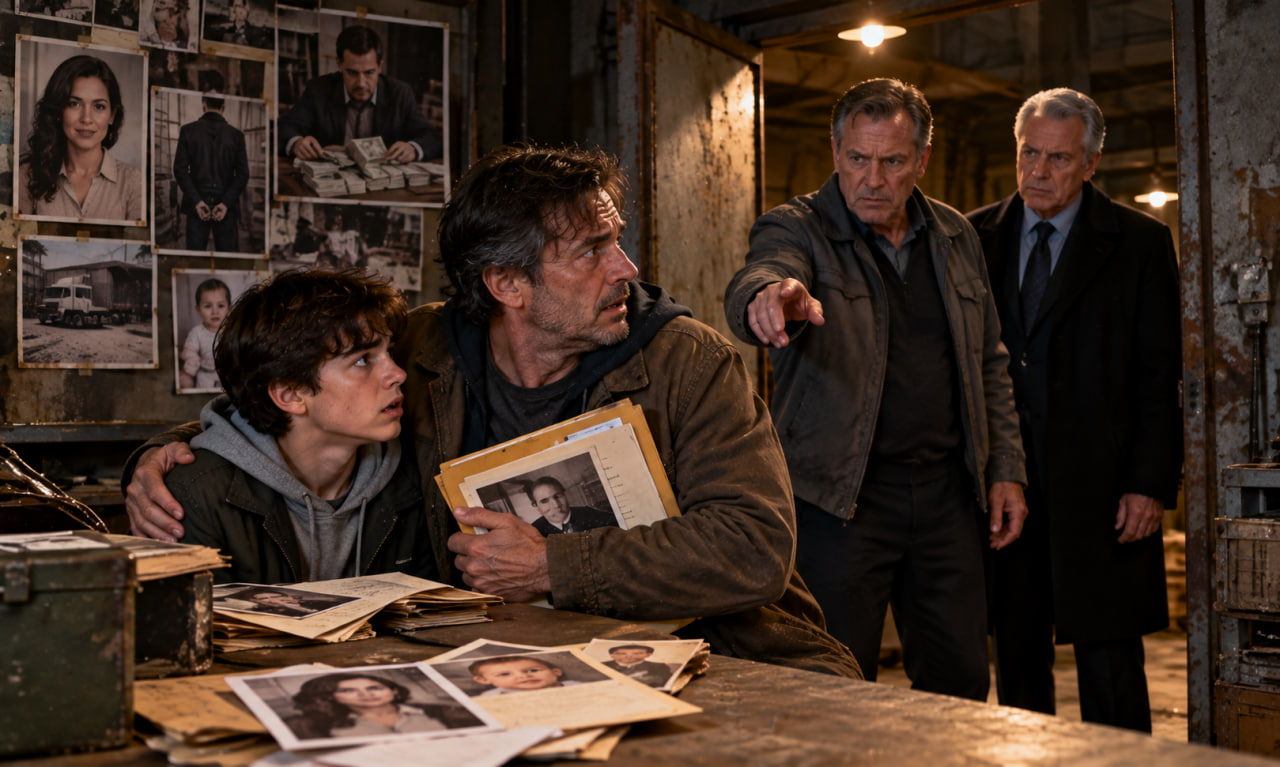
Eleven years of waking up knowing that the people who had destroyed his life were still walking free.
And the first time someone told him they believed him, he cried like a man who had been waiting his entire life to hear those words.
I took his hand.
“You’re not alone anymore.”
He squeezed my fingers.
“Then we need to move quickly.”
He told us that the original company ledgers were hidden inside a safety deposit box at a bank in Manhattan. The box had been opened in my grandfather’s name and placed under Raymond’s control before his death.
If Frank learned where the records were, he could try to obtain a court order to block their release.
“Do you remember the key I used at the factory?” Raymond asked me.
I nodded.
“The one tied with the red thread?”
“There’s a number stamped on it. That’s the number of the deposit box.”
My mother looked astonished.
“You kept it all these years?”
“I kept everything that might one day clear my name.”
He turned to my father.
“And now we need you to tell the truth.”
My father stood beside the window, his hands buried in his pockets.
“I don’t know if I can.”
Raymond’s expression hardened.
“Then you can spend the rest of your life knowing that your son had to save the family you nearly destroyed.”
My father closed his eyes.
“I know what I did.”
“Do you?” Raymond asked. “Because knowing you’ve done something wrong isn’t the same as being willing to face the consequences.”
My father looked at me.
For the first time, I saw him without the authority of a father, without the protection of a husband, without the anger that had made everyone around him afraid.
I saw a frightened man who had spent years running from the truth.
“David,” he whispered, “I was there the night your grandfather died.”
My mother went completely still.
I felt my chest tighten.
“Tell us everything,” I said.
He pulled a chair forward and sat down.
“Frank had been taking money from the company for months. Your grandfather discovered the transfers and threatened to report us. I knew what Frank was doing, and I helped him hide the money. I told myself we would repay it before anyone noticed.”
He looked at Raymond.
“But your grandfather wouldn’t listen. He said he was going to the police that morning.”
My father rubbed his hands together.
“Frank and I went to the house that night to convince him to change his mind. We argued. Your grandfather told Frank that he was finished. He said he would rather lose everything than allow us to steal from Elizabeth.”
My mother covered her mouth.
“He fell down the stairs,” my father continued. “I remember the sound. I remember Frank standing there, staring at him. For a few seconds, neither of us moved.”
He swallowed.
“Then Frank told me to help him. We moved things around and made it look like an accident. I was terrified. I thought if I told the truth, I’d lose everything.”
I stared at him.
“So you let Uncle Raymond go to prison?”
My father began to cry.
“Frank arranged the evidence. He made it look as if Raymond had stolen the money and attacked the guard during the warehouse robbery. I knew the truth, but I said nothing.”
“Why?” I shouted. “Why would you let him lose eleven years of his life?”
“Because I was a coward!”
The words rang through the room.
My father bowed his head.
“And because I thought Frank would protect me. But he never intended to protect anyone. He used me, and I was too afraid to admit it.”
My mother stepped away from him.
“You watched your brother-in-law go to prison. You watched me struggle. You watched your own son grow up believing that a good man was a criminal.”
“I know.”
“No,” she said, her voice trembling. “You know now because you have nowhere left to hide.”
She turned toward the door.
“I need some air.”
I followed her into the hallway.
She stopped beside a window and stared out at the city.
“Do you hate him?” she asked quietly.
I thought about the years of shouting, the unpaid bills, the nights my mother cried while my father drank himself into a stupor.
“I don’t know.”
She nodded.
“That’s honest.”
“Do you hate him?”
She looked at me.
“I loved him. I still remember the man I married. But love doesn’t erase what someone has done.”
She wiped her cheeks.
“Whatever happens next, David, you must understand something. You can forgive someone without allowing them to hurt you again.”
I didn’t fully understand then.
But I would.
That afternoon, Raymond was discharged with instructions to rest and return for follow-up care. We took him to our house, where my mother made him soup and prepared the small bedroom she had kept for him in the backyard shed.
He refused to sleep there.
“Not anymore,” she told him. “You’re staying inside.”
He smiled.
“Your husband won’t like that.”
“My husband has had enough opportunities to decide what he likes.”
For the first time in years, Raymond laughed.
It was a small laugh, rough and unfamiliar, but it filled our kitchen with something we hadn’t felt in a long time.
Hope.
The next morning, we went to Manhattan.
My mother brought her identification and the old estate documents. Raymond carried the key tied to the red thread. I carried the cassette recorder.
My father came with us.
Nobody asked him to.
At the bank, a manager led us into a private office. After checking the documents and confirming Raymond’s identity, she brought out a small metal box.
When she opened it, we found several bundles of papers wrapped in brown cloth.
There were original financial ledgers, property deeds, bank statements, copies of company correspondence, and a sealed envelope bearing my grandfather’s signature.
Raymond opened the envelope with shaking hands.
Inside was a notarized declaration identifying my mother as the rightful owner of the factory and its associated land. There were also records documenting the company’s missing funds and correspondence showing that Frank had attempted to transfer ownership without her consent.
Most importantly, the papers included a signed statement from my grandfather describing his suspicions about Frank and my father.
My mother read the declaration twice.
Then she sat down and began to cry.
“This is real,” she whispered.
Raymond nodded.
“Your father made sure it would survive, even if he didn’t.”
The bank manager advised us to take the records directly to a lawyer experienced in estate disputes and criminal matters. We did exactly that.
The lawyer’s name was Helen Carter.
She listened to our story without interrupting, examined every document, and played the cassette recording twice.
When it ended, she leaned back in her chair.
“This is significant evidence,” she said. “But we need to be careful. The recording must be authenticated, and the documents must be examined. We cannot assume that every issue will be resolved immediately.”
“How long will it take?” my mother asked.
“I can’t promise a specific timeline. But we have enough to challenge the property transfer, request an emergency court order, and ask the appropriate authorities to investigate the original case.”
Raymond leaned forward.
“What about clearing my name?”
Helen met his eyes.
“That will require a separate legal process. But these records could give us a foundation that didn’t exist before.”
For the first time, Raymond allowed himself to believe that justice might be possible.
Helen worked quickly.
Within days, she filed a request to prevent the disputed factory and land from being transferred while the ownership claim was reviewed. She also contacted the appropriate authorities about the newly discovered evidence relating to the warehouse robbery and my grandfather’s death.
Frank responded exactly as Raymond had predicted.
He denied everything.
His lawyers claimed the documents were unreliable, the recording was incomplete, and Raymond was a convicted criminal seeking revenge.
But this time, Raymond wasn’t standing alone.
My mother provided sworn statements about the original ownership arrangements. The bank records established a trail of suspicious transactions. An independent document examiner began comparing the signatures and records.
Then Helen discovered something even more important.
The security guard who had been injured during the warehouse robbery was still alive.
His name was Thomas Greene.
For years, everyone had assumed he had disappeared after the case. In reality, he had moved out of state and rebuilt his life away from the Malone family.
Helen located him and arranged an interview.
When Thomas heard Raymond’s name, he fell silent.
Then he said something that changed everything.
“Raymond didn’t attack me.”
According to Thomas, he had arrived at the warehouse that night after receiving a report of suspicious activity. He found several men moving cash into an unmarked vehicle. Before he could call for help, one of them struck him from behind.
He never saw Raymond attack him.
He had identified Raymond during the investigation only after being shown a photograph by an investigator who repeatedly insisted that Raymond was the suspect.
Thomas admitted that he had been uncertain from the beginning.
“I was recovering from a head injury,” he explained. “I told them I couldn’t be certain. But they kept asking the same questions until I started doubting my own memory.”
His testimony didn’t automatically prove every detail of Raymond’s innocence, but it seriously undermined the evidence that had helped send him to prison.
Helen arranged for Thomas to give a formal statement.
The investigation expanded.
And Frank began to panic.
One evening, my father received a call from his brother. I was in the kitchen when he answered.
“Fix this,” Frank demanded through the speaker. “Tell them Raymond made the whole thing up. Say the recording is fake.”
My father stared at the telephone.
“No.”
There was a pause.
“What did you say?”
“I said no.”
Frank’s voice became vicious.
“You owe me everything you have.”
“No,” my father replied. “I owe you my silence. And I’m done paying.”
Frank threatened him.
He threatened our house, our finances, and my father’s future.
Then he hung up.
My father sat in the kitchen for a long time afterward.
Finally, he looked at me.
“I know this doesn’t fix anything.”
“No,” I said. “It doesn’t.”
“I know you may never forgive me.”
I said nothing.
“But I’m going to tell them what happened. All of it.”
For the first time, his words sounded like a decision rather than an excuse.
Two days later, my father met with investigators and gave a detailed statement about the events surrounding my grandfather’s death, the missing company funds, and Raymond’s prosecution.
He handed over financial records he had kept hidden for years.
His statement did not guarantee him immunity or a particular outcome. He was told that his own conduct would be investigated and that he would have to face the consequences of his actions.
He agreed.
When he returned home, my mother was waiting in the kitchen.
“Did you tell them everything?” she asked.
“Yes.”
“Even the things that make you look guilty?”
He nodded.
“Especially those things.”
My mother studied him for a long moment.
“I don’t know what will happen to us,” she said.
“Neither do I.”
“And I don’t know whether I can ever trust you again.”
He lowered his head.
“I understand.”
She looked at him with exhausted sadness.
“Then, for once in your life, don’t ask me to make you feel better about what you’ve done.”
He didn’t.
And that was the first honest conversation they had shared in years.
The Day Frank Malone Lost Everything
Three weeks later, we received notice that the court had granted temporary protection against the disputed property transfer.
The factory could not be sold or transferred while the legal challenge proceeded.
Our house was a separate matter. The mortgage company still had a claim against it, and the order did not erase our debts. But it prevented Frank from using the disputed property arrangements to strengthen his position against my mother.
For the first time in months, we had a chance to fight.
My mother found part-time work at a neighborhood bakery. I returned to school through an alternative program that allowed me to work during the day and attend classes in the evening.
Raymond helped me study whenever I came home.
He wasn’t a teacher, but he was patient.
Sometimes, while I struggled through mathematics, he would tell me stories about my grandfather.
“He never cared how much money a person had,” Raymond told me one night. “He cared whether they kept their word.”
“Then why did he trust Dad and Frank?”
Raymond considered the question.
“Because trusting people is not the same as knowing everything about them. Your grandfather believed in giving people opportunities. They took advantage of that belief.”
He tapped my textbook.
“Don’t let what they did turn you into someone who trusts nobody. Learn to recognize the difference between kindness and weakness.”
I remembered those words.
They would stay with me long after the case ended.
The investigation continued for months.
Experts authenticated portions of the financial records. Investigators compared the documents with existing bank records. Thomas Greene’s statement raised serious questions about the original identification. My father’s testimony supplied information that had not been available during Raymond’s trial.
Frank’s lawyers fought every development.
But his carefully constructed story began to collapse.
Several former employees came forward with information about suspicious financial transactions. One had kept copies of invoices showing that payments had been diverted into companies connected to Frank.
Another remembered being instructed to alter warehouse records shortly before the robbery.
The evidence did not emerge all at once, and not every allegation could be established immediately. But together, the records created a picture far different from the one that had been presented at Raymond’s trial.
Then came the hearing.
My mother, Raymond, my father, and I sat in the courtroom while the lawyers argued over the evidence.
Frank sat at the opposite table in an expensive suit, surrounded by attorneys.
He looked confident.
He had spent years believing that money could silence everyone.
When Raymond entered the courtroom, Frank smirked.
“You should have stayed away,” he muttered as Raymond passed.
Raymond stopped.
For eleven years, that man’s voice had haunted his memories.
Now he looked directly at him.
“I spent eleven years away,” Raymond replied. “I won’t spend another minute hiding from you.”
Then he continued to his seat.
During the hearing, the judge reviewed the new evidence and the requests concerning the original conviction. The court did not decide every issue that day, but it allowed the challenge to proceed and ordered further examination of material that had not been properly considered in the original case.
Frank’s expression changed.
For the first time, he appeared uncertain.
Outside the courtroom, reporters asked questions. My mother refused to speak to them.
Raymond did not look at the cameras.
He looked at me.
“Whatever happens,” he said, “remember that clearing my name isn’t about making Frank suffer. It’s about making sure the truth is finally heard.”
I nodded.
But the truth still had one more obstacle.
My father.
His statement had helped the investigation, but he had participated in concealing evidence and had benefited from the stolen money. He was not going to walk away without consequences.
A few weeks later, he was formally questioned about his role in the financial scheme and the events following my grandfather’s death.
He cooperated with investigators, surrendered the remaining records he had concealed, and accepted that he would have to answer for his actions.
Our family could not bargain away his responsibility.
And none of us tried.
My mother began making plans for a life independent of him. She consulted Helen about the house, the debts, and her rights as a spouse. She told my father that she needed space and that any future between them would depend on more than apologies.
He moved into a small rented room.
For the first time in my life, our house became quiet.
There were no drunken arguments.
No shouting from the living room.
No threats about Raymond.
At first, the silence felt strange.
Then it began to feel peaceful.
The Truth About My Name
Six months after that first night at the factory, Helen called us into her office.
She had news.
The review of Raymond’s case had uncovered serious problems with the original investigation. The prosecution’s case had relied on disputed identification evidence, financial records that had not been properly examined, and information that now appeared inconsistent with the newly discovered documents.
The authorities had agreed to pursue the appropriate legal steps to challenge the conviction.
Raymond sat beside my mother, holding her hand.
“What happens now?” he asked.
Helen smiled gently.
“We keep going. But this is the strongest position you’ve been in since your arrest.”
A few months later, the court granted relief in Raymond’s case after reviewing the new evidence and the problems with his original conviction.
His conviction was vacated, and he was no longer legally regarded as the man who had committed the warehouse robbery.
The decision did not give him back the eleven years he had lost.
It could not erase the humiliation, the loneliness, or the years when his own family had refused to open their doors.
But it gave him something he had nearly stopped believing he would ever receive.
His name.
The morning the decision became official, my mother invited everyone to the house.
She prepared a large meal, though she kept wiping her eyes while she cooked.
Raymond arrived wearing a clean shirt and the same old shoes he had worn when he left prison.
I hugged him at the door.
“Uncle Raymond,” I said, “you don’t have to hide anymore.”
He smiled.
“No, David. Neither do you.”
We ate together at the kitchen table.
My mother raised her glass of water.
“To my brother,” she said. “The man who lost eleven years because he refused to let a lie become the truth.”
Raymond shook his head.
“To the people who finally listened.”
Then he looked at me.
“And to David, who asked the questions nobody else wanted to ask.”
I smiled, but something had been troubling me for months.
“Uncle Raymond, can I ask you something?”
“Anything.”
“Why did you let everyone believe you were guilty for so long? Why didn’t you tell me everything when I was younger?”
He leaned back in his chair.
“Because I was afraid, David. Not of prison. Not of Frank. I was afraid that if I spoke without proof, your father would make sure you and your mother paid for it.”
He paused.
“And because I made a promise to your mother.”
My mother looked at him.
“Raymond…”
He continued.
“Your mother wanted you to have a childhood. She didn’t want you growing up in the middle of a war between adults. We thought we could protect you by keeping you away from the truth.”
He looked down at his hands.
“We were wrong about one thing. Silence doesn’t always protect people. Sometimes it gives the wrong people more time to hurt them.”
I thought about the years I had spent believing my uncle was a criminal.
I thought about the way I had watched my mother hug him while my father called him a thief.

One Comment on “My Uncle Spent 11 Years in Prison for Theft—Then He Took Me to an Abandoned Factory and Opened a Locked Door”