PART 3
Then the commander of the local naval installation.
Within seconds, the entire ballroom was rising.
Nearly four hundred people.
Four hundred chairs scraping against the floor.
Four hundred people turning toward me.
And nearly all of them were standing at attention.
I didn’t move.
I didn’t return the salute immediately.
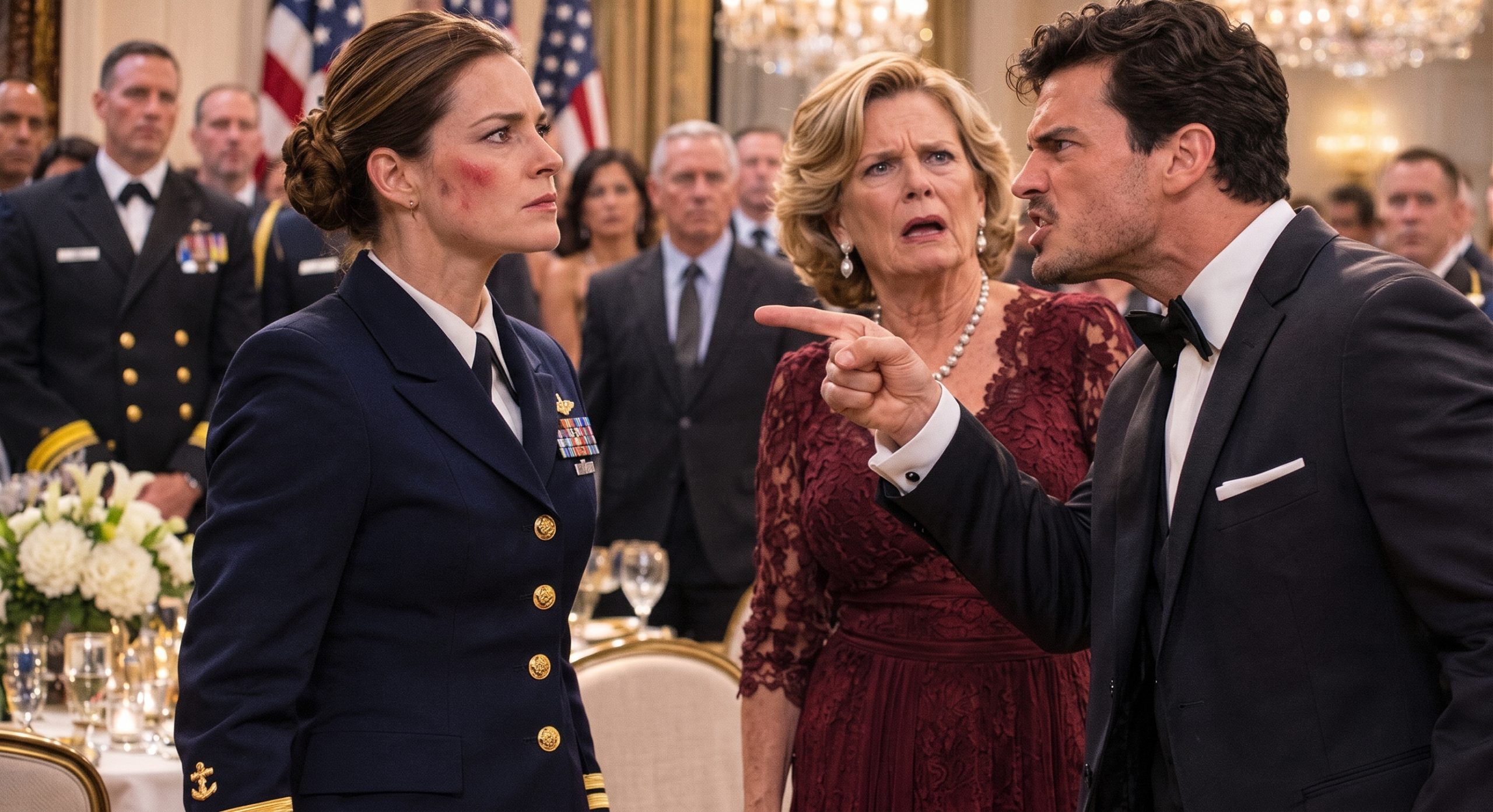
I simply stood there, my left cheek burning, my eyes fixed on the brother who had just struck me.
Derek’s face had lost its color.
“Wait,” he whispered.
My mother grabbed his sleeve.
“What is happening?”
Nobody answered her.
Master Chief Keating stepped forward.
He was seventy-one years old, with silver hair, broad shoulders, and the kind of presence that made younger officers instinctively straighten their posture.
He looked at Derek.
Then he looked at me.
“Admiral Claire Carter,” he said, his voice carrying across the ballroom. “It is an honor to stand in your presence.”
I finally returned the salute.
“Thank you, Master Chief.”
The room remained silent.
Derek swallowed.
“Admiral?”
He said the word as though he had never heard it before.
I turned toward him.
“Yes, Derek.”
My mother shook her head.
“No. That’s impossible.”
I didn’t argue.
I didn’t need to.
The insignia on my shoulders had been there all evening. The uniform she had mocked was the same uniform in which I had spent twenty-five years serving my country.
And the title she had never bothered to learn was one that every senior officer in that room understood.
I was Rear Admiral Claire Carter.
For twenty-five years, I had served in the United States Navy.
I had commanded sailors, led operational teams, managed complex missions, and carried responsibilities that sometimes kept me awake long after everyone else had gone home.
I had received commendations I rarely discussed.
I had stood beside families who had lost loved ones.
I had made decisions that affected hundreds of people.
And I had never once needed my mother to be proud of me.
At least, that was what I had told myself.
Because the truth was more complicated.
A small part of me had spent twenty-five years hoping that one day she would look at me and see something other than the daughter she had thrown away.
That night, she finally looked.
But not with love.
With fear.
“Claire,” she whispered, forcing a smile. “Why didn’t you tell us?”
I looked at her.
“I did.”
“No, you never told us you were… this.”
“This what?”
She glanced at my shoulders.
“An admiral.”
I almost laughed.
“Mother, I sent you the announcement when I was promoted.”
Her mouth opened.
I continued.
“I sent you the invitation to my promotion ceremony. I sent you photographs. I even called you personally.”
Derek looked at her.
Patricia’s expression tightened.
“You know how busy we are,” she said.
I nodded slowly.
“Yes. I remember.”
Then I turned toward Master Chief Keating.
“Would you please have everyone return to their seats?”
He hesitated.
His eyes moved toward my cheek.
“Ma’am, are you all right?”
“I’m fine.”
“Respectfully, Admiral, you are bleeding.”
I touched my lower lip.
There was a small amount of blood on my fingertip.
“It’s nothing serious.”
Thomas looked as though he wanted to say something else, but he stepped back.
The officers slowly returned to their seats.
However, nobody was watching the stage anymore.
Everyone was watching my family.
And Derek, for the first time in his life, seemed unable to find a clever thing to say.
My mother recovered first.
She always did.
Patricia Carter had spent decades turning uncomfortable situations into opportunities to rewrite the truth.
She straightened her dress, lifted her chin, and gave the room a practiced smile.
“Well,” she announced, “this is certainly a surprise. Claire has always been a private person.”
I looked at her.
Private.
That was an interesting word for a woman who had spent twenty-five years telling relatives that I had abandoned my family because I was too selfish to maintain relationships.
She continued.
“We are incredibly proud of both our children. Derek has always been a natural leader, and Claire has found her own path.”
Derek nodded quickly.
“Yes. Exactly.”
I watched him.
He was already trying to recover.
My mother took another step toward me.
“Come here, sweetheart.”
I didn’t move.
She lowered her voice.
“Let’s not make this embarrassing.”
I stared at her.
“You should have thought about that before.”
Her smile disappeared.
“Claire, please. We’re family.”
The words almost made me smile.
Family.
Twenty-five years earlier, I had stood outside her house holding a black trash bag.
It contained two pairs of jeans, three shirts, a pair of sneakers, my father’s old wristwatch, and a photograph of the two of us standing beside a lake.
I had been nineteen.
I had just told my parents that I intended to join the Navy.
My father had been too sick to argue.
My mother had been furious.
She said I was throwing away my future.
She said the Navy was for people who had no ambition.
Derek had been standing behind her, laughing.
“You’ll be back in a month,” he had said.
I never came back.
But my father found me three days later.
He drove nearly two hours in an old sedan, despite his failing health, just to sit with me in a diner and make sure I had eaten.
He slipped an envelope across the table.
Inside was $2,000.
His savings.
“Your mother doesn’t understand,” he had whispered. “But I do.”
I remembered that moment every time I felt alone.
And I remembered the letter he sent me six months before he died.
The letter that changed everything.
I looked at Patricia.
“You don’t get to call me sweetheart just because the room has witnesses.”
Her face hardened.
Derek stepped between us.
“Okay, enough. You’re making a scene.”
I turned toward him.
“You slapped me.”
He shrugged.
“You were disrespecting Mom.”
A few people nearby shifted in their seats.
Master Chief Keating stepped forward again.
“Sir, I would strongly advise you to stop speaking.”
Derek laughed nervously.
“Who are you to tell me what to do?”
Thomas didn’t raise his voice.
“Someone who understands respect.”
Derek looked at me.
“Are you going to let your people threaten me?”
“My people?”
I glanced around the ballroom.
“These men and women are not here to protect my ego, Derek. They’re here because they served alongside people who understand what responsibility means.”
I paused.
“And unlike you, they don’t need to pretend.”
His jaw tightened.
Then he said something that made the room go cold.
“You think you’re better than us because you got some fancy rank?”
“No.”
I looked him directly in the eyes.
“I think you’re responsible for what you did tonight.”
A few minutes later, the event’s security director approached us.
He was a retired Navy commander who had volunteered to coordinate security for the gala.
“Admiral Carter, would you like us to contact local law enforcement?”
My mother immediately shook her head.
“No! Absolutely not. This is a family disagreement.”
I looked at her.
“A family disagreement?”
She nodded quickly.
“Brothers and sisters fight. Things happen.”
“Derek is my brother.”
“Yes.”
“And you watched him strike me.”
Her eyes narrowed.
“You provoked him.”
There it was.
Twenty-five years, and not a single thing had changed.
I could have been nineteen or forty-four.
I could have been wearing civilian clothes or a Navy uniform.
I could have been standing in a grocery store or beneath a chandelier surrounded by senior officers.
Somehow, Patricia would always find a way to make me responsible for the actions of the people who hurt me.
I turned toward the security director.
“Please preserve the ballroom security footage. I would also like the incident documented.”
He nodded.
“Understood, Admiral.”
Derek’s expression changed.
“Wait. You’re actually reporting this?”
I looked at him.
“You struck me in a public venue. What did you expect?”
He glanced toward the surrounding tables.
“You’re going to ruin my life over one slap?”
“No, Derek. Your choices are yours.”
My mother stepped forward.
“Claire, listen to me. Your father would never have wanted this.”
I went completely still.
Then I reached inside the small pocket of my uniform jacket and touched the folded photograph I carried with me.
A photograph of my father.
The one thing I had never been able to throw away.
“Don’t tell me what Dad wanted,” I said.
Patricia’s eyes narrowed.
“What does that mean?”
“It means you should stop using his name.”
For the first time that evening, she looked genuinely frightened.
The gala coordinator approached the stage.
“Admiral Carter, we’re ready whenever you are.”
I nodded.
I had almost forgotten that I was scheduled to deliver the evening’s keynote remarks.
Almost.
I walked toward the stage.
The room parted naturally.
Master Chief Keating followed several steps behind, while the officers and veterans watched me make my way to the podium.
I adjusted the microphone.
For a moment, I looked out at the audience.
Then I began.
“Ladies and gentlemen, thank you for being here tonight.”
My voice was steady.
“I had prepared a speech about service, sacrifice, and the responsibilities we carry when others place their trust in us.”
I paused.
“But something happened this evening that reminded me why those words matter.”
The ballroom became silent.
“People often misunderstand military service. They see the uniforms, the ceremonies, the medals, and the titles. They imagine that leadership is about authority.”
I looked toward Derek.
“It isn’t.”
I continued.
“Leadership is about what you do when nobody is watching. It’s about how you treat people who cannot give you anything in return. It’s about accepting responsibility when you make a mistake instead of blaming someone else.”
My eyes briefly moved toward my mother.
“And perhaps most importantly, service teaches us that respect is not something we demand because of our position. It is something we demonstrate through our actions.”
I let those words settle.
“I didn’t join the Navy because I wanted to impress my family. I joined because I believed my life could mean something beyond the expectations other people had placed on me.”
My throat tightened.
“I was nineteen when I left home. I had very little money, almost no support, and a family that believed I would fail.”
Several veterans nodded.
“But I had one person who believed in me.”
My voice softened.
“My father.”
I looked down briefly.
“He was not there when I received my first promotion. He was not there when I took my first command. He was not there when I became an admiral.”
I took a breath.
“But I have carried his words with me through every assignment.”
I looked at the audience.
“He once told me, ‘Claire, never measure your worth by the people who refuse to recognize it.’”
The room was completely still.
“And tonight, I want every young sailor, every veteran, and every person who has ever been made to feel small by someone who should have loved them to remember something.”
I placed both hands on the podium.
“You do not need permission to become the person you were meant to be.”
The applause began slowly.
Then it grew.
Within seconds, nearly four hundred people were standing again.
This time, I didn’t feel humiliated.
I felt something I hadn’t felt in years.
Peace.
But as the applause continued, I noticed something unusual.
My mother was no longer looking at me.
She was staring at the photograph I had placed beside the podium.
My father’s photograph.
And her face had turned completely white.
After the speech, Master Chief Keating approached me.
“Admiral, may I speak with you privately?”
“Of course.”
He glanced toward the far side of the ballroom.
“There’s something you need to know about your father.”
My heart tightened.
“What about him?”
Thomas lowered his voice.
“I knew your father, ma’am. Not as well as you did, but enough to remember what happened twenty-five years ago.”
I stared at him.
“What do you mean?”
He hesitated.
“Your father contacted someone in the Navy after you left home. He asked that your enlistment paperwork be handled carefully and that certain personal documents be protected.”
I felt my stomach drop.
“What documents?”
Thomas looked toward Patricia.
“I don’t know everything. But I remember hearing that he had been trying to protect you from a financial situation involving your family.”
For a moment, I couldn’t speak.
My father had written to me about family matters.
But he had never explained everything.
He had only said that there were things I would understand when I was older.
Thomas continued.
“There’s another reason I wanted to speak with you.”
He reached into the inside pocket of his jacket and removed a small envelope.
It was yellowed with age.
The edges were worn.
My name was written across the front.
Claire.
I recognized the handwriting immediately.
My father’s.
My hands began to shake.
“Where did you get this?”
“Your father gave it to me shortly before he died. He asked me to hold onto it in case you ever came back into contact with your family.”
I stared at the envelope.
“Why didn’t you give it to me earlier?”
Thomas looked genuinely uncomfortable.
“Because he made me promise not to deliver it unless I believed the time was right.”
I slowly turned it over.
There was a sentence written on the back.
One sentence.
And the moment I read it, the entire ballroom seemed to disappear.
Claire, if your mother ever tells you that the family has nothing left, remember that she is not the person who owns what I left behind.
I looked up.
Thomas was watching me carefully.
“What did he leave behind?” I whispered.
Before he could answer, someone grabbed my arm.
It was my mother.
Her fingers were trembling.
“Give me that envelope.”
I pulled my arm away.
“No.”
“Claire, you don’t understand.”
“Then explain it.”
Her eyes filled with tears, but I had seen those tears before.
I knew how quickly they could disappear when she no longer needed them.
“Your father was sick,” she whispered. “He wasn’t thinking clearly.”
I looked at the handwriting again.
“He wrote this before he died.”
“He was confused!”
“Then why are you afraid of it?”
She opened her mouth.
Nothing came out.
Derek suddenly appeared beside her.
“What is this?”
My mother looked at him.
“Derek, we need to leave.”
He frowned.
“Why?”
She grabbed his arm.
“Now.”
But Derek didn’t move.
He was staring at the envelope.
“Is that Dad’s handwriting?”
I nodded.
He looked at our mother.
“What did Dad leave?”
Patricia’s face tightened.
“Nothing that concerns you.”
Derek laughed.
“Excuse me?”
For the first time that night, the two of them seemed to be turning against each other.
I carefully opened the envelope.
Inside was a folded letter, several photocopied legal documents, and a small handwritten note.
The letter began:
My dearest Claire,
If you are reading this, then I am no longer there to explain what happened. I have waited too long to tell you the truth, and I am sorry for that.
My eyes blurred.
I continued reading.
Your mother has spent years telling people that I made certain financial decisions for the family. That is not entirely true.
There is a property, an account, and a legal arrangement that I established before my illness became serious.
Your name is on every document.
I stopped.
A property?
An account?
A legal arrangement?
I looked at the photocopies.
The first page appeared to be a property transfer document.
The second was a bank-related legal statement.